Double Transformation in Mechanical and Plant Engineering |
Digitalization and sustainability for one-of-a-kind and small-batch manufacturers

| Journal | Industry 4.0 Science |
| Issue | Volume 40, 2024, Edition 5, Pages 10-17 |
| Open Access | https://doi.org/10.30844/I4SE.24.5.10 |
| Bibliography | Share | Cite | Download |
Abstract
Keywords
Article
One-of-a-kind and small-batch manufacturers in mechanical and plant engineering play a key role in the industry because, in contrast to mass production, they offer customized solutions, such as special machines, for individual requirements. By combining know-how and state-of-the-art manufacturing technologies, they deliver high-value products with high precision and quality, while their business model is strongly project-based [1]. On-time completion, delivery, and commissioning on the customer’s premises are decisive competitive factors for these mostly medium-sized companies [2].
In addition to the design of production-related processes, such as manufacturing and assembly, the precise planning and implementation of all logistics processes surrounding a customer-specific project also play a decisive role in reliable planning and meeting deadlines. However, these processes are subject to uncertainties [3], for example due to local boundary conditions at the customer’s site, the division of labor with suppliers, service providers, and subcontractors, or the lack of real-time status reports for commissioning on the construction site [4]. Due to the unique nature of the projects and their specific framework conditions, experience and data from past projects cannot be used 1:1 for planning new projects.
In order to increase efficiency and productivity, digital technologies, methods, and tools are increasingly being adopted as part of digital transformation to enable end-to-end digital project planning and management [5]. As the digital transformation progresses, project knowledge can be made available and evaluated for subsequent projects on a long-term basis. At the same time, environmental compatibility, social responsibility, and long-term profitability must be aligned with the growing emphasis of sustainability in this industry in recent years [6].
This trend is reflected in an increased commitment to the development of sustainable products and technologies, including energy-efficient machines, CO2-reduced systems, innovative recycling and waste recovery solutions, and the introduction of resource-efficient production processes. Due to political developments, customers are increasingly demanding sustainability aspects and the associated reporting [7].
In their role as suppliers, one-of-a-kind and small-batch manufacturers in mechanical and plant engineering, in particular, face specific challenges when it comes to determining the PCF (see [8]) of their customer-specific products. This includes the selection of a suitable reporting standard to determine the carbon footprint (see e.g. [9]), the collection of all relevant information and data, their correct calculation and accounting as well as the adaptation of the determined key figures for customer-oriented reporting and the provision of the carbon footprint as a value-added service in order to generate economic added value in a global competitive environment.
Specific challenges and initial solutions
The project-based nature of one-of-a-kind and small-batch production makes it difficult to apply digital methods and tools in the planning and realizing new products, as the necessary information and data are generally not available in the required quality and quantity. Although project plans can be validated using simulations, the duration of the processes to be performed remains highly uncertain [10]. Project management can only rely on empirical knowledge and derive assumptions for new projects based on past experiences. However, valid forecast of the exact process duration is not feasible due to the lack of sufficient historical data from completed projects [11].
Learning from historical data and interventioning early when anomalies arise in the project process – based on actual status data – cannot be fully utilized in one-of-a-kind and small-batch production because digital technologies for the (partially) automated identification, recording, and transmission of data, e.g. on the near-real-time status of commissioning at the customer’s premises, are not available [12]. The lack of transparency in project execution complicates resources allocation (especially personnel) and, due to the manual processes, leads to significant effort in documenting working hours and categorizing them into specific activities (e.g., electrical or mechanical commissioning at the customer’s site).
In addition, the information technology available on construction sites does not support the determination of the PCF because neither the data required for CO2 balancing of a special machine nor the technologies for data collection are known. Consequently, due to the unique nature of each project, external service provider must be involved to calculate the greenhouse gas emissions generated.
Over the last few years, several solutions have been developed to support SMEs in their digital transformation and to address the specific challenges of one-of-a-kind and small-batch production. Digital technologies for (partially) automated data collection can record specific process statuses (in real time) and thus provide a solid basis for tailored applications.
However, selecting the right technology remains a challenge for many SMEs because, on the one hand, they do not have the expertise required for the wide range of available options and, on the other hand, their financial resources are limited. An initial approach overcoming these hurdles is to prepare SME-friendly technology profiles and a user-friendly selection interface based on a completed requirement profile (cf. [13]).
Targeted data collection must be aligned with the intended purpose and specified in advance. To ensure sustainable data usage, semantic models (= information models) can be used to describe a digital shadow, representing all relevant processes and information within a project (cf. [14])
According to [15], a digital shadow is a sufficiently accurate representation of processes to enable real-time evaluation of all relevant data. A generally applicable and extensible semantic model of a digital shadow for logistics processes in mechanical and plant engineering, which can be used to realize a (partially) automated data collection, was developed in [12] (see also [16]).
When planning a new customer-specific system with a distinct project character, the database compiled of completed projects in the digital shadow still does not allow a 1:1 transfer to new projects, but new processes can be planned much more accurately taking comparative data into account. By using a methodology for reliable forecasting of logistics data based on explicit empirical knowledge and historical data, planning uncertainties can be reduced by 10 % [11]. Project management also benefits from the digital shadow during project execution. Whereas previously around 30 % of the time on a construction site was spent searching [17], the location of materials and resources is now known with tracking and tracing systems.
In principle, after the initial implementing of a digital shadow, sustainability questions can be addressed in the next step. However, the tools currently available on the market for calculate the Carbon Footprint of products (see e.g. [18]), which are already tailored to the needs of SMEs (see e.g. [19]) in addition to their use in large corporations, still do not offer a solution for unique products.
The individual processes do not yet allow any recognizable transfer to the standardized recording of a PCF. However, a digital shadow can serve as a basis for calculating the PCF, provided that the necessary data have been identified and recorded (for technology selection, see [13]), and can initiate an individual calculation of greenhouse gas emissions for a unique product.
The resulting double transformation provides the mechanical and plant engineering industry with a solid foundation to meet future competitive requirements.
Research approach to double transformation
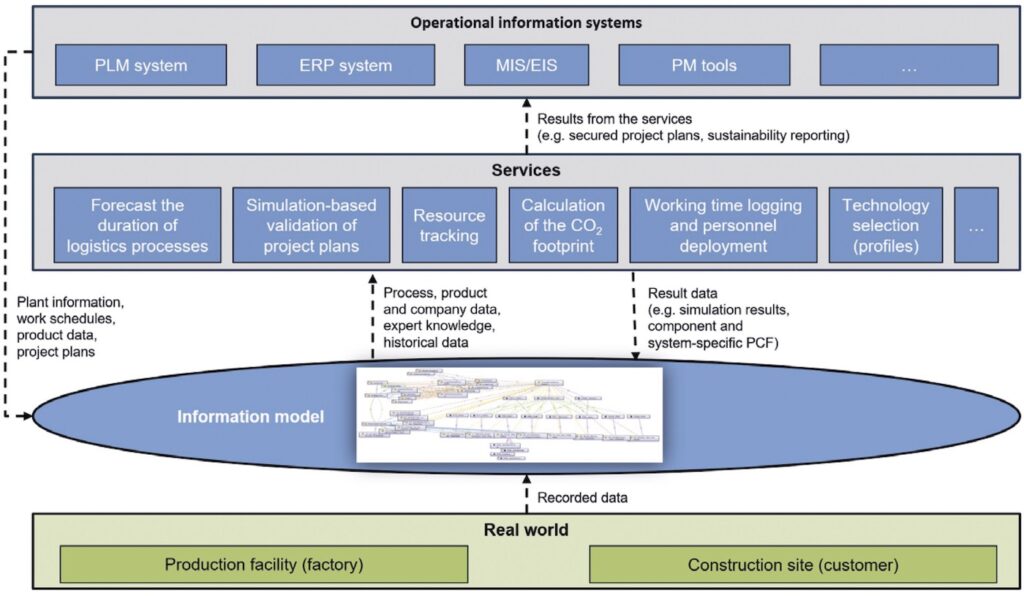
To address the challenges of practical application, the following research approach aims to support the double transformation in mechanical and plant engineering through services and a semantic information model (Fig. 1). Partial aspects of this holistic approach have already been researched in [10-12].
Integration into the real world and the company’s IT landscape
In mechanical and plant engineering, the production of one-of-a-kinds or small-batches usually occurs within the company’s own production facility, with commissioning carried out at the customer’s construction site. By using technologies for manual and/or (partially) automated data collection and data transfer, data from the real world is determined and supplemented with additional information, such as plant information, work schedules, product data, or project plans from operational information systems, such as Product Lifecycle Management (PLM) systems, Enterprise Resource Planning (ERP) systems, Management Information Systems (MIS), Executive Information Systems (EIS) or Project Management (PM) tools.
Services
Services that retrieve and use process, product, and company data, along with expert knowledge or historical data, depending on their purpose, must be provided to fulfill specific information requests, particularly from project management. These services include, for example, forecast of logistics process duration (cf. [11]), simulation-based validation of project plans (cf. [10]), resource tracking (cf. [12]), calculation of the CO2 footprint, recording working hours and planning personnel deployment as well as selecting suitable technologies for data collection and transfer using profiles (cf. [13]).
The list of services can be extended as needed. The data generated by these services are fed back into the information model to enrich the operational knowledge base. The results from the services are then further processed within the operational information systems for day-to-day business activities.
Information model to describe a digital shadow
The central element of the overall concept is an information model that describes a digital shadow; this can be implemented for example, using an ontology, which organizes domain-specific terminologies and their semantic relationships [20]. The ontology accounts for all relevant information, links and relates them to each other. In principle, an ontology is generally valid at the beginning and only undergoes a company-specific adaptation during the operational integration, as each company and its products, and customer projects have unique characteristics.
A procedure model outlined in [12] describes the necessary activities for this adaptation process across the five phases company analysis, knowledge and data management, implementation, instantiation, and application testing. The ontology ensures uniform and consistent representation of data from different sources and systems, regardless of their origin or structure. It is flexible and extensible to accommodate new requirements or changes within the domain.
However, transforming an ontology into a digital shadow is a complex process that requires deep domain knowledge, skilled personnel and adequate resources. Determining a sufficient level of detail for the application, integrating necessary data sources, ensuring regular updates and monitoring, presenting results and enabling user interaction must be specified and tailored to company’s needs during development and maintenance of a digital shadow.
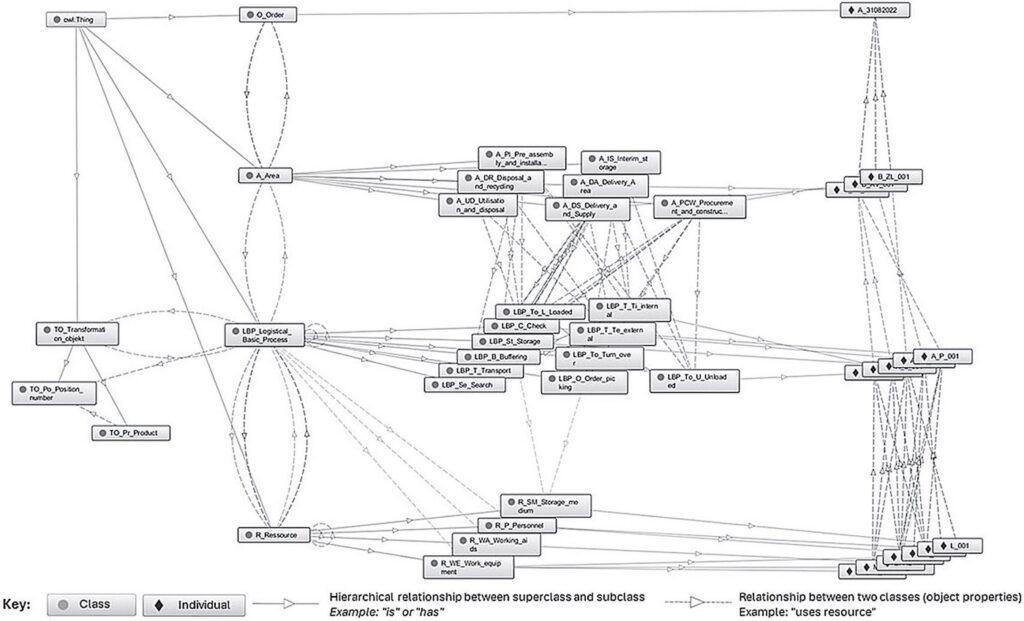
In [12], an ontology for describing logistics processes in mechanical and plant engineering was developed and evaluated with the tool Protégé, which represents the central connection point between the PM tools and the data recorded on the construction site. Due to the project-based nature of the business, all data must be assigned to a specific order (class “O_Order”) (Fig. 2). The master data of a product is stored, taking into account the specific item numbers (class “TO_Transformation object”).
On the construction site (class A_Area), specific logistics processes (class “LBP_Logistical_Basic_Process”) take place using specific resources (class “R_Resource”). Internal and project-specific individuals are stored in the classes and uniquely described by data properties.
This ontology is used, for example, to create a comprehensive image of the logistics processes on the construction site. SPARQL queries can be used to retrieve the necessary data to execute a service, while real-time data or result data is persistently stored in the ontology via SPARQL updates. A cloud-based solution is ideal for company use, for example, to protect internal company data from unauthorized access while making it accessible to multiple users.
If a digital shadow is integrated with operations, the various services mentioned above can be set up, such as forecasting the duration of logistics processes or validating project plans using simulation. Additional, a digital shadow can be used to calculate the PCF through another service if the necessary data is continuously recorded in the digital shadow over the entire lifecycle of a product, from the extraction of raw materials, the manufacture of the one-of-a-kind or small-batch, external transportation all the way to the use, and disposal of the product. Furthermore, potential areas along the entire supply chain where improvements to the PCF can be made by reducing environmental impacts can be identified.
Digital shadow makes project knowledge available
The benefits of digital transformation have been extensively discussed in the literature, but for one-of-a-kind and small-batch manufacturers in mechanical and plant engineering the digital transformation still poses significant challenges due to the project-based nature of their business, which differs to series production. Implementing solutions to provide information models as digital shadows allows more project knowledge to be available for future projects.
The practicability of this solution approach has already been confirmed in various research projects (cf. e.g. [11; 12]). Extending this approach through service-oriented IT structures creates the prerequisites for the upcoming sustainable transformation processes, for example by determining the information and data required for calculating the carbon footprint and offering corresponding PCF services.
However, further research is still necessary to determine what information and data are available, how to ensure to collect them in the right quality and quantity, and how to store them in an information model. Another particular challenge is the selection of an appropriate accounting method and the integration of logistics data, which accounts for a significant proportion of Scope 3 emissions [9].
Bibliography
[1] Heidmann, R.: Windenergie und Logistik. Losgröße 1: Logistikmanagement im Maschinen- und Anlagenbau mit geringen Losgrößen. Berlin 2015.[2] Schuh, G.; Hering, N.; Brunner, A.: Einführung in das Logistikmanagement. In: Schuh, G.; Stich, V.: Logistikmanagement. Handbuch Produktion und Management 6. 2. Edition. Berlin 2013.
[3] Wenzel, S.; Stolipin, J.; Weber, J.; König, M.: Digitale Planung der Baustellenlogistik im Großanlagenbau. Ontologie zur Nutzung digitaler Modelle für die Logistikplanung auf der Baustelle. In: Industrie 4.0 Management 3 (2019) 6, pp. 55-59.
[4] Burghardt, M.: Einführung in Projektmanagement. Definition, Planung, Kontrolle, Abschluss, 6. revised Edition. Erlangen 2013.
[5] Blome, W.: Der digitale Zwilling und die Automatisierungstechnik. In: Der Maschinenbau. URL: https://der-maschinenbau.de/allgemein/der-digitale-zwilling-und-die-automatisierungstechnik/, accessed 11.06.2024.
[6] Altmeppen, K.-D.; Zschaler, F.; Zademach, H.-M.; Böttigheimer, C.; Müller, M.; Nachhaltigkeit in Umwelt, Wirtschaft und Gesellschaft. Interdisziplinäre Perspektiven. 2017.
[7] IW Consult GmbH: CO2-Fußabdruck in Lieferketten – Studie für den Verein ECLASS. URL: https://www.iwconsult.de/fileadmin/user_upload/projekte/2023/eclass_co2/ Bericht_CO2_Fussabdruck_in_Lieferketten_Rev.pdf, accessed 11.06.2024.
[8] ISO 14067: Treibhausgase – Carbon Footprint von Produkten – Anforderungen an und Leitlinien für Quantifizierung. Berlin 2019.
[9] GHGprotocol: Webseite der Organisation. URL: https://ghgprotocol.org/, accessed 11.06.2024.
[10] Gutfeld, T.; Jessen, U.; Wenzel, S.; Akbulut, A.; Laroque, C.; Weber, J.: Schlussbericht zum Projekt simject – Simulationsgestütztes logistikintegriertes Projektmanagement im Anlagenbau. URL: https://kobra.uni-kassel.de/handle/123456789/2015102249152, accessed 11.06.2024.
[11] Gliem, D.; Jessen, U.; Stolipin, J.; Wenzel, S.; Kusturica, W.; Laroque, C.: Schlussbericht zum Projekt SimCast – Simulationsgestützte Prognose der Dauer von Logistikprozessen. URL: https://kobra.uni-kassel.de/handle/123456789/11210, accessed 11.06.2024.
[12] Gliem, D.; Vössing, D.; Wenzel, D.; Kusturica, W.; Laroque, C.: Schlussbericht zum Projekt dataject.log – Entwicklung eines semantischen Modells zur Beschreibung eines Digitalen Schattens der Logistikprozesse im Maschinen- und Anlagenbau zur Verwendung im Projektmanagement. URL: https://kobra.uni-kassel.de/handle/123456789/15333, accessed 11.06.2024.
[13] Gliem, D.; Wenzel, S.; Kusturica, W.; Laroque, C.: Methodik zur Auswahl von Datenerfassungstechnologien. Digitalisierung der Baustellenlogistik. In: PROJEKTMANAGEMENT AKTUELL 34 (2023) 4, pp. 49-53.
[14] Gliem, D.; Jessen, U.; Wenzel, S.; Kusturica, W.; Laroque, C.: Ontology-based Forecast of the Duration of Logistics Processes in One-of-a-Kind Production in SME. In: Logistics Research 15 (2022) 5, pp. 1-29.
[15] Bauernhansl, T.; Krüger, J.; Reinhart, G.; Schuh, G.: WGP-Standpunkt Industrie 4.0. Darmstadt 2016.
[16] Wenzel, S.; Vössing, D.; Gliem, D.; Laroque, C.; Kusturica, W.: Digitalization of Logistical Processes on Construction Sites – Concept for the Creation and Use of a Digital Shadow for Construction Site Logistics in Mechanical and Plant Engineering. In: Industry 4.0 Science (2023) 1, pp. 54-58.
[17] Boenert, L.; Blömecke, M.: Kostensenkung durch zentrales Logistikmanagement. In: Clausen, U. (ed): Baulogistik – Konzepte für eine bessere Ver- und Entsorgung im Bauwesen, Dortmund 2006, pp. 29-41.
[18] Carbon Trust: Webseite der Carbon Trust mit CO2-Berechnungssoftware. URL: https://www.carbontrust.com/de, accessed 11.06.2024.
[19] Hottenroth, H.; Joa, B.; Schmidt, M.: Carbon Footprints für Produkte. Handbuch für die betriebliche Praxis kleiner und mittlerer Unternehmen. URL: https://businesspf.hs-pforzheim.de/fileadmin/user_upload/uploads_redakteur/Forschung/INEC/Dokumente/Hottenroth_et_al_Carbon_Footprints_fuer_Produkte_web.pdf, accessed 11.06.2024.
[20] Busse, J.; Humm, B.; Lubbert, C.; Moelter, F.; Reibold, A.; Rewald, M.; Schlüter, V.; Seiler, B.; Tegtmeier, E.; Zeh, T.: Was bedeutet eigentlich Ontologie? In: Informatik-Spektrum 37 (2014), pp. 286-297.
Your downloads
Potentials: Energy Efficiency Resource Efficiency
Solutions: Production Control
You might also be interested in