Training

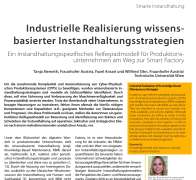
Industrial Realization of Knowledge-Based Maintenance Strategies

Industrial Realization of Knowledge-Based Maintenance Strategies

Ein instandhaltungsspezifisches Reifegradmodell für Produktionsunternehmen am Weg zur Smart Factory
Tanja Nemeth, Fazel Ansari, Wilfried Sihn
In order to cope with the complexity and automation of cyberphysical production systems (CPPS), knowledge-based maintenance (KBM) strategies and models have been identified as a key factor. They are intended to secure and improve machine availability and process stability. Although many companies are willing to invest in these innovations, they lack the certainty of having the necessary competence and capacity. In order to overcome this problem, the authors present a holistic process model for the evaluation and identification of strengths and weaknesses on an operational, tactical and strategic level by applying a multidimensional analytical approach.
Industrie 4.0 Management | Volume 35 | 2019 | Edition 5 | Pages 17-20
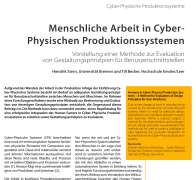
Humans in Cyber-Physical Production Systems

Humans in Cyber-Physical Production Systems

A Method for Evaluation of Design Principles for User Interfaces
Hendrik Stern ORCID Icon, Till Becker
Due to the change of work in manufacturing caused by the introduction of Cyber-Physical systems, there is a need for adequate design principles for user interfaces between humans and machines. Within a research project, a method for the determination and evaluation of such design principles was developed. The method can be used to create a catalogue of rules regarding the successful integration of human factors into Cyber-Physical production systems.
Industrie 4.0 Management | Volume 35 | 2019 | Edition 4 | Pages 51-54
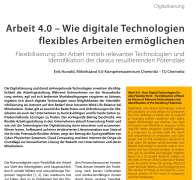
Work 4.0—How Digital Technologies Enable Flexible Work

Work 4.0—How Digital Technologies Enable Flexible Work

Flexibilization of work through relevant technologies and their resulting potentials
Erik Hunold
Digitization and related technologies extend the possibility of work design. As companies face the challenge of being able to respond to changing market conditions with agility, digital technologies are creating new ways to increase work flexibility in response to the need for better employee work-life balance. It is important to consider both the needs and requirements of employees and companies and to find satisfactory solutions for both sides. The present article describes how flexible work design is currently used in companies and how the technologies of digitization can be classified and brought together. Based on a structured literature analysis on the state of the art of the potential of flexible work, the article shows the synergy effects of cyber-physical systems, cloud computing and the Internet of Things as the basis for a consensual solution of the needs of companies and their employees.
Industrie 4.0 Management | Volume 35 | 2019 | Edition 3 | Pages 11-14
Continuing Vocational Training 4.0

Continuing Vocational Training 4.0

Gamification in E-Learning in Combination with Individual Game Applications for the Employee-Oriented Further Training of the Future
Thies Beinke, Michael Freitag ORCID Icon, Annabell Schamann, Klaas Feldmann
The digitalisation of the working world leads to the need and at the same time to the possibility of qualifying employees in a context-oriented, individual and process-oriented way. The challenge in this context is the target-oriented and coordinated use of different learning forms and systems. The present contribution provides an approach for combining content-related and structural gamification in e-learning and the increase of motivation for e-learning as well as knowledge consolidation through mobile learning by means of a game application tailored to the sector of application. To this end, the need to adapt education to digital change is described at the beginning, the pillars of the envisaged concept (gamification, e-learning and mobile learning) are classified, an implementation of the application case of the maintenance of wind turbines is delivered and, finally, the results of the evaluation as well as the added value of this contribution are discussed.
Industrie 4.0 Management | Volume 35 | 2019 | Edition 2 | Pages 13-17
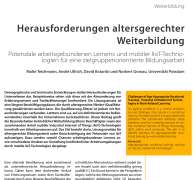
Challenges of Age-Appropriate Vocational Training

Challenges of Age-Appropriate Vocational Training

Potential of Mobile IIoT Techno-logies in Work-Related Learning
Malte Teichmann, André Ullrich ORCID Icon, David Kotarski, Norbert Gronau ORCID Icon
An ageing workforce is a central entrepreneurial challenge. One solution is vocational training. For older workers it is associated with problems. The contribution addresses these problems and the increasing amount of mobile industrial Internet of Things Technology (IIoT) within work processes. The aim is to identify solutions for age-appropriate vocational training by work-related learning.
Industrie 4.0 Management | Volume 35 | 2019 | Edition 2 | Pages 23-26
Learning by Playing in Virtual Reality

Learning by Playing in Virtual Reality

Weiterbildung durch Gamification
Steve Killian, Nicola Nendel, Tobias Markert, Ralph Riedel ORCID Icon
Many companies face the challenge of training their employees to handle increasingly complex products and to execute complex processes. In the course of globalization, this is no longer just classically interdisciplinary, but also multicultural and multilingual. In addition, the same level of knowledge often needs to be built up and maintained at production sites around the world. In this context, the question arises if traditional training in the form of external human-to-human training will meet the requirements of today’s qualification or whether digitization itself offers opportunities to make training more effective and efficient. An innovative approach, which is presented in the article and is currently being developed by DECURA Consulting GmbH is the combination of virtual reality (VR) and photogrammetry in combination with gamification elements.
Industrie 4.0 Management | Volume 35 | 2019 | Edition 2 | Pages 53-56
Knowledge Management for Industry 4.0

Knowledge Management for Industry 4.0

Herausforderungen und Lösungsansätze
Klaus North, Ronald Maier
The digital interactions along the value chain pose new challenges for managing information and knowledge. The objectives of this article are to describe the changes in knowledge-based value creation induced by digitalisation and to derive fields of action for knowledge management for Industry 4.0. The “knowledge ladder 4.0” shows how digital technologies can transform strategic and operative knowledge management. Subsequently, we offer a framework for the knowledge-oriented design of dynamic digital organisations that consists of three layers of activities for the operation, reflection and design of knowledge management illustrated with leading questions and case examples in order to promote the productive, responsible and sustainable usage of digital technologies.
Industrie 4.0 Management | Volume 35 | 2019 | Edition 2 | Pages 7-12
Systematic Goal Definition in Digital Change

Systematic Goal Definition in Digital Change

Development of a Checklist to Support Digital Change Processes
Lisa Mlekus, Günter W. Maier
Companies are increasingly acquiring new technologies that enable higher quality and efficiency. Every technology adoption is also a change process which affects the employees and their work and thus needs to be managed in an optimal way. This article is focused on the importance of goal definition during a change process. To facilitate this process, a checklist with 81 goals is presented. The checklist was developed based on scientific literature and practice-oriented tools and can be used by project teams to focus their activities on a holistic change process and track the goal progress.
Industrie 4.0 Management | Volume 34 | 2018 | Edition 6 | Pages 60-65
Bionic Inspired Structures Based on Smart Materials

Bionic Inspired Structures Based on Smart Materials

Creating systems with low complexity but high functionality
Welf-Guntram Drossel, Holger Kunze, Martin Ettrichrätz
Functional materials, so called smart materials, have the ability to adapt to external environmental conditions i.e. they are able to change their properties through external physical stimuli so that, they are optimally adapted to their surroundings. These processes are accompanied by energy conversion processes. These properties predestine smart materials to act as sensors and actuators. They enable high functionality in simplified structures, already on the material level. Therewith, a new and better quality can be achieved in product design.
Industrie 4.0 Management | Volume 34 | 2018 | Edition 4 | Pages 15-18 | DOI 10.30844/I40M_18-4_15-18
Internet of Things Calls for a New Way of Working

Internet of Things Calls for a New Way of Working

Ways to Digitally Transform Qualification, Organization, and Leadership
Birgit von See, Wolfgang Kersten ORCID Icon
When aiming for an Industry 4.0 vision, companies are well-advised to not only focus on technology and data. With any digital transformation, the careful consideration of all elements of the company’s “socio-technical triangle” (man, technology, and organization) is a central success factor. Based on a qualitative survey, we identified qualification, organization, and leadership as central dimensions of the work system. Integrative measures include identification of competence requirements, training in data-thinking as well as agile working methods and structures. Finally, leadership plays a central role in orchestrating the digital transformation.
Industrie 4.0 Management | Volume 34 | 2018 | Edition 3 | Pages 8-12 | DOI 10.30844/I40M_18-3_S8-12
1 7 8 9 20