Training

Modeling the Usage of Knowledge for Industry 4.0

Modeling the Usage of Knowledge for Industry 4.0

Norbert Gronau ORCID Icon
This paper describes an analysis and design method for knowledge management integrating man and machine in the age of the 4th Industrial revolution (Industry 4.0). Digitized work p rocesses require employees in an Industry 4.0 environment to have the competence to adequately deal with fluid situations on the basis of their own knowledge and the ability to place this knowledge in situation-specific contexts. To this end, the development of a comprehensive understanding of processes is elementary.
Industrie 4.0 Management | Volume 37 | 2021 | Edition 3 | Pages 6-10 | DOI 10.30844/I40M_21-3_S6-10
Industry 4.0 to Compensate the Shortage of Skilled Workers

Industry 4.0 to Compensate the Shortage of Skilled Workers

Eine Betrachtung für den deutschen Mittelstand
Günther Schuh ORCID Icon, Patrick Scholz, Thomas Scheuer, Tim Latz
German industrial companies are suffering from an increasing shortage of skilled workers. In order to secure Germany’s existing competitive advantages, suitable solutions have to be carried out to counter this shortage. Technologies in the context of “Industry 4.0” offer promising solutions. Using this technologies, significant productivity improvements as well as higher resource utilization rates can be achieved. However, the main challenge is to identify the right technical solutions for the specific business challenges. In the following, a systematic approach is presented to face these challenges.
Industrie 4.0 Management | Volume 37 | 2021 | Edition 1 | Pages 12-16
Learning and Competence Development in AI-based Adaptive Systems

Learning and Competence Development in AI-based Adaptive Systems

Uta Wilkens ORCID Icon, Dominik Lins, Christopher Prinz ORCID Icon, Bernd Kuhlenkötter ORCID Icon
The paper reflects the potential and remaining shortcomings of AI-based work systems for exploiting and enhancing individual and organizational learning processes. It especially refers to the use adaptive systems in production and gives examples of good practice for the design of AI-based work systems which promote the interplay between individual and artificial intelligence. The conceptual framework refers to different methods in machine learning which are complemented by insights from individual and organizational learning theory.
Industrie 4.0 Management | Volume 36 | 2020 | Edition 6 | Pages 30-34
Digitally Processable Competency Descriptions

Digitally Processable Competency Descriptions

A linked data-approach for a generic competency model
Jan Wunderlich, Meike Tilebein ORCID Icon
Due to increasingly specialised, diverse and also new competencies and competency profiles it becomes progressively more difficult to interpret educational achievements and to match requirement profiles with the competencies of individual persons or groups. The computational support with regards to keeping the information up to date, communication, search and analysis is limited if the competencies are described in natural language only. Thus, it seems advantageous to model competencies in a formal and machine-readable specification language. The following article suggests the notion of a generic formal syntax for learning outcomes. We outline how this would allow expressing intricate learning outcomes in a machine-readable ontology and their further processing with the Linked Data- and Semantic Web-approaches.
Industrie 4.0 Management | Volume 36 | 2020 | Edition 3 | Pages 37-40
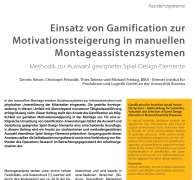
Gamification for Incentive-based Assembly Systems

Gamification for Incentive-based Assembly Systems

Methodology for Suitability, Valuation and Selection of Game Design Elements in Manual Assembly Processes
Dennis Keiser, Christoph Petzoldt, Thies Beinke, Michael Freitag ORCID Icon
In manual assembly, assistance systems are applied for the informational and physical support of employees. So far, assistance mainly focuses on some process-related aspects of assembly processes, while system acceptance, motivational perspectives are not considered. This article presents the gamification approach as a possibility to support the motivation of the workers. To facilitate a successful implementation of gamification, this paper presents a structured and method-based selection approach for game design elements.
Industrie 4.0 Management | Volume 36 | 2020 | Edition 3 | Pages 59-52
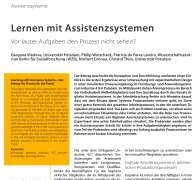
Learning with Assistance Systems

Learning with Assistance Systems

Not Seeing the Process for the Tasks?
Gergana Vladova, Philip Wotschack, Patricia de Paiva Lareiro, Norbert Gronau ORCID Icon, Christof Thim
The paper describes the conception and implementation as well as offers an insight into the first results of a study with experimental design in a simulated process environment at the Research and Application Center Industry 4.0 in Potsdam. The focus is on learning processes in the field of simple work and their organization through the use of digital assistance systems. In labour research, there are indications that process knowledge is lost with the use of these systems, in the sense of a good knowledge of the entire work process in which the individual activities are embedded. To investigate the role of process knowledge in the use of digital assistance systems, a real factory situation is simulated in the experiment.
Industrie 4.0 Management | Volume 36 | 2020 | Edition 3 | Pages 16-20 | DOI 10.30844/I40M_20-3_S16-20
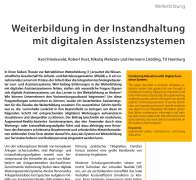
Continuing Education with Digital Assistance Systems

Continuing Education with Digital Assistance Systems

Axel Friedewald, Robert Rost, Nikolaj Meluzov, Hermann Lödding ORCID Icon
The paper describes a modular, AR-based assistance system that guides the user through a maintenance task by displaying components and meta-information step by step. By supplementing a learning success control, the system can also be used for continuing education of service technicians and operating personnel. Special emphasis was placed on an integrated information system that allows maintenance information and training tasks to be created with little effort and at the same learning and work tasks to be teached on the systems used in practice.
Industrie 4.0 Management | Volume 36 | 2020 | Edition 3 | Pages 7-10
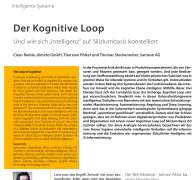
The Loop of Cognition

The Loop of Cognition

How “intelligence” is constellated on a silicon basis
Claus Riehle, Thorsten Pötter, Thomas Steckenreiter
In process engineering, one thinks of production operations that are controlled or regulated by sensors and actuators. And any realization of matter transformation is based on a physical substratum, which holds equally for living systems and their behaviour. The article distinguishes between three system levels: the functional level, the interface to the environment and the cognitive level of. Using these three levels, the learning cycle or the previous Cognitive Loop can be very well illustrated. If one compares with this way of distinction the Bio-Informatization of human intelligence with the technical development stages of mechanization, automation, regulation and deep learning, then the cybernetic-sociological term “operational closure” becomes understandable. It becomes obvious that in the context of a digitized culture of production and organization, we should be prepared for a new kind of cognitive loop based on silicon (SI), an intelligent system behavior via ...
Industrie 4.0 Management | Volume 36 | 2020 | Edition 2 | Pages 52-56 | DOI 10.30844/I40M_20-2_S52-56
Digitalization: The Labour Market Changes

Digitalization: The Labour Market Changes

Enzo Weber
Public discussions on the future of labour in the era of digitalization are dominated by notions of self-driving cars, factories without workers or fully automatic logistics. This creates fears of mass destruction of jobs and shrinking employment rates in the future. At the same time, it has led to intense debates on an unconditional basic income: While productivity would rise, a substantial drop in the number of jobs would question the income distribution mechanism our working societies are currently built on. This article argues that while replacement of existing jobs - or at least tasks - by technology will happen and has always happened, this is only one side of the coin. The future of labour markets will be more complex. This is discussed in a macroeconomic, firm and international dimension.
Industrie 4.0 Management | Volume 35 | 2019 | Edition 6 | Pages 62-66 | DOI 10.30844/I40M_19-6_62-66
Human Work in Industrie 4.0

Human Work in Industrie 4.0

Actions to prepare enterprises for new requirements
Holger Kohl, Thomas Knothe ORCID Icon, Burkhard Schallock, Julia-Anne Scholz
Trends towards more customized products and shorter product life cycles are creating challenges, which companies are trying to meet with the use of Industrie 4.0 technologies. The digitalization and automation associated with this is causing employees in the manufacturing industry in particular to fear changes in work processes and requirements. This paper proposes four key socio-technical design measures to enable enterprises to cope with the new demands of human work in Industrie 4.0 - and thus to counteract fears. The focus is on increasing entrepreneurial agility and expanding employee skills.
Industrie 4.0 Management | Volume 35 | 2019 | Edition 6 | Pages 37-41
1 6 7 8 20