Bionic Inspired Structures Based on Smart Materials

Creating systems with low complexity but high functionality

JournalIndustrie 4.0 Management
Issue Volume 34, 2018, Edition 4, Pages 15-18
Open Accesshttps://doi.org/10.30844/I40M_18-4_15-18
Bibliography Share Cite Download

Abstract

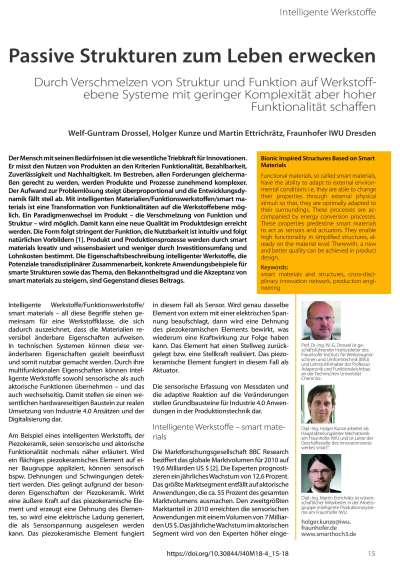
Functional materials, so called smart materials, have the ability to adapt to external environmental conditions i.e. they are able to change their properties through external physical stimuli so that, they are optimally adapted to their surroundings. These processes are accompanied by energy conversion processes. These properties predestine smart materials to act as sensors and actuators. They enable high functionality in simplified structures, already on the material level. Therewith, a new and better quality can be achieved in product design.

Keywords


Bibliography

[1] Neugebauer, R.; Drossel, W.-G.; Ihlenfeldt, S.; Harzbecker, C.: Design method for machine tools with bionic inspired kinematics. In: CIRP Annals 58 (2009) 1, S. 371-374.
[2] BBC Research LLC: Smart Materials: Technologies and Global Markets. 2011.
[3] Wenzel, E.; Dziemba, O.; Langwieser, C.; Pock, B.; Sturm, D.: Die Zukunftsmatrix; Zukunftsletter der ITZ GmbH 2012, S. 138-139.
[4] Bundesministerium für Bildung und Forschung: Ideen. Innovation. Wachstum. Hightech-Strategie 2020 für Deutschland. Bonn 2010
[5] Bundesministerium für Bildung und Forschung: Abschlussbericht des Strategievorhabens „Start Smart“ des Konsortiums smart3. Dresden, 10.05.2016, BMBF-Datenbank.
[6]  Sydow, J.; van Well, B: Wissensintensiv durch Netzwerkorganisation – strukturationstheoretische Analyse eines wissensintensiven Netzwerkes. In: Sydow, S. (Hrsg): Management von Netzwerkorganisationen: Beiträge aus der Managementforschung. Wiesbaden 2006, S. 107-150.
[7]  Funken,C.;Hörlin,S.:Misstrauen als Ressource. In: OrganisationsEntwicklung 31 (2012) 1, S. 41-45.
[8]  Liu, C.; Xu, X.: Cyber-physical Machine Tool – The Era of Machine Tool 4.0. ; Procedia CIRP 63:70-5; 2017
[9]  Liang, Q.; Zhang, D.; Wu, W.; Zou, K.: Methods and Research for Multi-Component Cutting Force Sensing Devices and Approaches in Machining; Sensors (Basel, Switzerland) 16(11; 2016.
[10] Drossel, W.-G.; Gebhardt, S.; Bucht, A.; Kranz, B.; Schneider, J.; Ettrichrätz, M.: Performance of a new piezoceramic thick film sensor for measurement and control of cutting forces during milling; CIRP Annals; 2018.

Your downloads


You might also be interested in
Serious Games as a Training Tool

Serious Games as a Training Tool

Game mechanics design to promote resilience
Annika Lange ORCID Icon, Thomas Knothe ORCID Icon
Unforeseen events are increasingly challenging manufacturing companies. Being resilient during crises is becoming a key competence. Serious games (SG) can help make resilience-building processes more transparent. This article derives specific requirements for SG from different phases of resilience and shows how these can be implemented in game mechanics in order to effectively support the training of resilience.
Industry 4.0 Science | Volume 42 | 2026 | Edition 2 | Pages 98-104
Learning Factories for the Future of Manufacturing in Brazil

Learning Factories for the Future of Manufacturing in Brazil

Advancing manufacturing through technology and skills development
Manufacturing firms in developing countries face challenges in closing productivity gaps while adopting Industry 4.0 technologies. Learning factories are one helpful approach to countering these challenges. One such example is the learning factory Fábrica do Futuroin São Paulo, Brazil, which has engaged students, supported competence development, and collaborated with industry in applied research, functioning as a hub for advanced manufacturing initiatives.
Serious Gaming and the Energy Transition

Serious Gaming and the Energy Transition

Collaborative knowledge generation and interactive understanding of complex interrelationships
Janine Gondolf ORCID Icon, Gert Mehlmann, Jörn Hartung, Bernd Schweinshaut, Anne Bauer
Conveying the complexity and multifaceted nature of the energy transition to a broad audience is a challenge. This article demonstrates how interactive serious games on a multitouch table can help make connections tangible and comprehensible. The games and the table were used in various conversational contexts. These are presented here in three case vignettes based on participant observation of the different applications, as well as situated and shared reflection. The vignettes demonstrate how interaction can trigger epistemic processes, enable shifts in perspective, and foster collective thinking, all of which are necessary for shaping the future of society as a whole.
Industry 4.0 Science | Volume 42 | 2026 | Edition 2 | Pages 62-69
Experiencing Digital Twins in Production and Logistics

Experiencing Digital Twins in Production and Logistics

The fischertechnik® Learning Factory 4.0 as a development platform for possible expansion stages
Deike Gliem ORCID Icon, Sigrid Wenzel ORCID Icon, Jan Schickram, Tareq Albeesh
The fischertechnik® Learning Factory 4.0 has proven to be a suitable experimental environment for testing digital twins. Depending on the targeted maturity stage, the functions of a digital twin range from status monitoring and forecasting to the operational control of production and logistics systems. To systematically classify these functions, this article presents a maturity model that serves as a framework for the development of a digital twin. Building on this, selected use cases are implemented in a test and development environment based on a system architecture with multi-layered logic structure. These initial implementations serve to highlight application purposes, relevant methods, and typical challenges and potentials in the transfer to real factory environments.
Industry 4.0 Science | Volume 42 | Edition 2 | Pages 30-37 | DOI 10.30844/I4SE.26.2.30
From Brownfield to Industry 4.0

From Brownfield to Industry 4.0

Learning factories as training and testing environment for digital transformation
Jakob Weber, Sven Völker ORCID Icon
To succeed in their digital transformation, manufacturing companies need engineers with in-depth knowledge of key technologies and concepts, and a profound understanding of the transition from Industry 3.0 to Industry 4.0. This article describes the concept of a learning factory that is continuously subjected to a digital transformation, thereby creating an environment for the development of transformation competencies. The concept of digital transformation is based on digital worker assistance systems and multi-agent systems for production control. These enable the incremental integration of existing resources into the digitalized factory. The learning factory is not presented to students as a completed solution. Instead, it is continuously developed further as part of student projects. This way, it contributes directly to the qualification of personnel for the implementation of Industry 4.0.
Industry 4.0 Science | Volume 42 | 2026 | Edition 2 | Pages 88-96
Collaborative Robots in Production Environments

Collaborative Robots in Production Environments

Employee qualification and acceptance for human-machine interaction
Tobias Wienzek, Mathias Cuypers ORCID Icon
The introduction of new technologies poses a major challenge, especially for small and medium-sized enterprises (SMEs). At the same time, SMEs must rise to this challenge in order to keep pace technologically and economically. Employee acceptance is an important factor in ensuring that both the introduction and the long-term use of a technology are successful. At the same time, the introduction process also has a central influence on acceptance in the long term. This article uses the implementation of collaborative robotics as an example for examining such an introduction process, identifying the key factors that influence employee acceptance and the important role played by advanced employee training. It serves to highlight how the introduction process and employee training are seamlessly interlinked.
Industry 4.0 Science | Volume 42 | 2026 | Edition 2 | Pages 14-21 | DOI 10.30844/I4SE.26.2.14