Autor: Michael Schenk

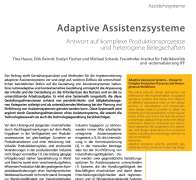
Adaptive Assistance Systems

Adaptive Assistance Systems

Answer to complex production processes and heterogeneous workforces
Tina Haase, Dirk Berndt, Evelyn Fischer, Michael Schenk
The article presents design approaches and methods for the implementation of adaptive assistance systems and shows the influence of different operational roles on the design process. A user-adaptive and context-sensitive design makes it possible to adapt the contents and the presentation to the requirements of the user and to the task. We present a systematic approach that shows the design dimensions based on individual and task-related categories. We supplement this systematic with design dimensions of an assistance system including the technology selection as well as the design.
Industrie 4.0 Management | Volume 36 | 2020 | Edition 3 | Pages 25-28
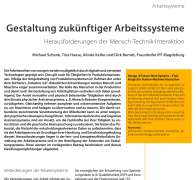
Design of Future Work Systems – Challenges for Human-Machine Interaction

Design of Future Work Systems - Challenges for Human-Machine Interaction

Herausforderungen der Mensch-Technik-Interaktion
Michael Schenk, Tina Haase, Alinde Keller, Dirk Berndt
Assistance technologies are an approach to support skilled workers in their work processes that are currently changing under the influence of the 4th industrial revolution. They aim at reducing physical and psychological stress by processing the big amount of decision-relevant data in a way that it serves workers for their decision-making process. Work places need to be designed in a way that they encourage learning and competence development and that involves future users in this design process.
Industrie 4.0 Management | Volume 33 | 2017 | Edition 3 | Pages 63-67
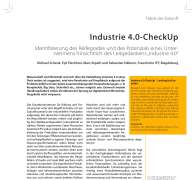
Industry 4.0 CheckUp – Leveling for Evolution

Industry 4.0 CheckUp - Leveling for Evolution

Identifizierung des Reifegrades und des Potenzials eines Unternehmens hinsichtlich des Leitgedankens „Industrie 4.0“
Michael Schenk, Eyk Flechtner, Marc Kujath, Sebastian Häberer
Research and industry have agreed on the aims of Industry 4.0. Contrary to what this suggests, a variety of issues and related challenges, e.g. complexity, big data, security, etc., will not make a revolution at the push of a button easy. Humans in particular will also play a crucial role on the way to adaptive, networked and resource efficient factories and directly influence the factory of the future. The Fraunhofer IFF Magdeburg is therefore pursuing research on collaborative robots that will assist humans.
Industrie Management | Volume 31 | 2015 | Edition 3 | Pages 21-25
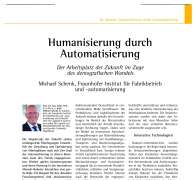
Humanization through Automation

Humanization through Automation

Der Arbeitsplatz der Zukunft im Zuge des demografischen Wandels
Michael Schenk
tensive thought about the organization and optimization of workplaces. The level of automation in these domains provides a response of these trends. Assisting systems and their use in innovative human-robot interaction are playing a major role. Pressure-sensitive sensor systems using so-called tactile sensors like those described in this article are one example of current trends in future research.
Industrie Management | Volume 30 | 2014 | Edition 1 | Pages 31-33
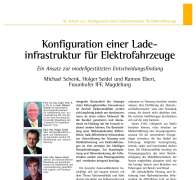
Configuration of  a Charging Infrastructure for Electric Vehicles

Configuration of a Charging Infrastructure for Electric Vehicles

Ein Ansatz zur modellgestützten Entscheidungsfindung
Michael Schenk, Holger Seidel, Ramon Ebert
Drive-train electrification intended to create sustainable mobility by enhancing efficiency and identifying supplements and alternatives to crude oil is integral to many vehicle manufacturers’ strategies. However, innovations in the field of electromobility, i.e. mobility rendered possible by electrically powered vehicles, will only establish themselves when they generate genuine value added for customers and are environmentally compatible. Thus, cost effective configuration of a ubiquitous (public, semi-public) infrastructure that supports the use and market launch of electric vehicles constitutes one of the key challenges and will necessitate support from new planning approaches and models.
Industrie Management | Volume 26 | 2010 | Edition 6 | Pages 53-56
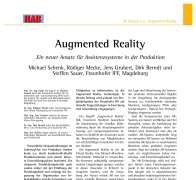
Augmented Reality: A New Approach for Assistance Systems in Manufacturing

Augmented Reality: A New Approach for Assistance Systems in Manufacturing

Ein neuer Ansatz für Assistenzsysteme in der Produktion
Michael Schenk, Rüdiger Mecke, Jens Grubert, Dirk Berndt, Steffen Sauer
Customized product variants and ever shorter development cycles are defining the basic challenges in product life cycles. Moreover, enhanced product quality is connected with increasing product complexity and necessitates adapting workflow organization and integrating IT aids, which are intended to minimize process times, reduce fault potential and render complex work steps manageable. Augmented reality technology helps meeting increased requirements, particularly for manual work. Projects from the Fraunhofer IFF provide a basis to elucidate current issues in research and application.
Industrie Management | Volume 26 | 2010 | Edition 2 | Pages 33-36
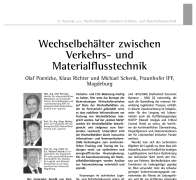
Interchangeable Containers between Transport and Material Handling Systems

Interchangeable Containers between Transport and Material Handling Systems

Olaf Poenicke, Klaus Richter, Michael Schenk
Mounting numbers of end customers and simultaneously declining delivery quantities are making more flexible organization of transport chains essential. Reductions of high-volume commercial transport are being demanded particularly in urban areas to cut traffic and CO2 emissions. This is the starting point for a low-volume commercial transport concept based on interchangeable containers that are combined over long distances to take advantage of established infrastructures in which interchangeable trailers are integrated and then separated in the “last mile” as required for pinpoint delivery to end customers. The interchangeable containers are supported by innovative I&C technologies for continuous cargo tracking and tracing and optimized and energy efficient routing. Automated approaches to consigning interchangeable container cargoes are being designed and tested.
Industrie Management | Volume 25 | 2009 | Edition 5 | Pages 27-30
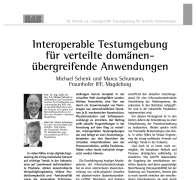
Interoperable Test Environments for Distributed Applications

Interoperable Test Environments for Distributed Applications

Michael Schenk, Marco Schumann
In many cases, digital engineering is the only realistic answer to important trends in industry. This includes increasingly customized products, decentralized value chains, increasing complexity and functionality of products as well as the need to reduce the time to market. Digital Engineering has already resulted in many technology-driven changes of the product development process. Probably the most important change is the ability to execute some of the iteration loops of development and test completely in the virtual environment. Further improvements can only be achieved by simultaneously combining development and simulation tools from many different domains, such as mechanical engineering, physics simulation, and software engineering. This article identifies current research issues in the field of distributed interoperable testing environments. Moreover, two examples of current applications are given to illustrate what functionalities can already be utilized today.
Industrie Management | Volume 25 | 2009 | Edition 2 | Pages 47-50
Virtual Engineering Techniques in Product Development

Virtual Engineering Techniques in Product Development

Michael Schenk, Ulrich Schmucker
The use of virtual engineering techniques in the field of product development requires a continuity of all digital development processes, workflows, tools and data. While this continuity is state-of-the-art on a level of geometric description it is still not achieved on a functional description level of product features. This paper analyses the state of the development and current problems in the process of introduction of virtual engineering in machine and plant engineering enterprises. Furthermore, the authors present their current research works in development of continuous digital process chains for product development.
Industrie Management | Volume 25 | 2009 | Edition 1 | Pages 53-56
Internationalization of Services

Internationalization of Services

An analysis in the form of system bundling
Michael Schenk, Jörg von Garrel
Although German planning service providers have specialized know-how in the field of factory planning, their size and insufficient resources limit their options to provide their services internationally. The formation of networks represents an outstanding opportunity for SME to bundle their competencies to become active in international markets. In order to support this process, this article identifies opportunities for bundling systems from the perspective of providers and describes potential network configurations. In addition, it introduces measures and actions intended to support planning service providers when they implement their services internationally in a network.
Industrie Management | Volume 24 | 2008 | Edition 5 | Pages 65-68
1 2