Industrie 4.0

Additive Manufacturing 4.0 Learning Factory

Additive Manufacturing 4.0 Learning Factory

Digitalization for batch size 1
Fabian Riß, Nicolas Rolinck, Stefan Böhm ORCID Icon, Alessandro Morath
In the course of digitalization, collaboration between humans and machines is inevitable. This should be considered as early as possible in further training. There’s a major obstacle to this in mechanical engineering: the lack of access to the knowledge needed for success. This can have a negative impact on the acceptance of digitalized processes. A teaching and learning platform teaching digitalization on real machines does important work here.
Industry 4.0 Science | Volume 40 | 2024 | Edition 4 | Pages 57-62
The Key to Successful Digitalization

The Key to Successful Digitalization

Development, implementation and benefits of digital twins in Industry 4.0
Andreas Bayha ORCID Icon, Sönke Knoch ORCID Icon, Dirk Schöttke ORCID Icon
The success of technologies depends not only on their innovative strength and acceptance, but also on their management. Decision-makers evaluate factors like technical framework conditions and organizational requirements, with the demand for flexibility adding to the complexity. Industry 4.0 addresses this with networking, transparency and decentralized decisions. Digital twins, which can be implemented with open source software, play a key role.
Industry 4.0 Science | Volume 40 | Edition 4 | Pages 42-49
Learning Factories as Innovative Training Locations for SMEs

Learning Factories as Innovative Training Locations for SMEs

Qualitative analysis of concepts and cooperations
Kathleen Warnhoff ORCID Icon, Simon Dabrowski ORCID Icon, Lea Müller-Greifenberg, Denise Gramß, Monika Stricker
In the context of Industry 4.0, learning factories are important places for company-based learning. Studies show that they have continued to develop since their emergence and are no longer limited to vocational and academic education. This leads to the question of how much the concept of the learning factory represents an innovative approach to further training in small and medium-sized enterprises (SMEs). This article focuses on three selected learning factories relevant to continuing education that were analyzed using qualitative methods with regard to their concepts and cooperation. The findings are embedded in a theoretical framework that links the scientific discussion on learning locations and educational cooperation. The empirical findings from three learning factories illustrate relevant learning locations for continuing education in SMEs.
Industry 4.0 Science | Volume 40 | 2024 | Edition 4 | Pages 32-41
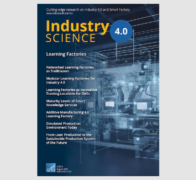
I4S 4/2024: Learning Factories

I4S 4/2024: Learning Factories

Learning locations for SMEs, more resilience through knowledge transfer
The shortage of skilled labor is putting pressure on many manufacturing companies worldwide. While skilled labor is becoming scarcer in traditional industrialized economies, proper training is urgently needed in countries with high unemployment. But how to solve this challenge? Find out what makes learning factories so successful in this issue.
GAIA-X Maturity Model 

GAIA-X Maturity Model 

Assessing the future viability of cross-company 
data exchange
Maximilian Weiden, Jokim Janßen
In order to cope with growing customer requirements and the associated increase in complexity, companies are opening up their value chains, reducing their vertical integration and increasingly entering into collaborations. Cross-company data exchange along the supply chain is thus becoming a key component for competitiveness and the realization of customer-specific solutions. For this reason, the European Union has launched the GAIA-X project, which aims to create the next generation of data infrastructure for Europe and its companies. The GAIA-X maturity model offers an approach for classifying companies into different development stages and provides concrete requirements for further development along a predefined development path towards becoming a fully-fledged participant in the federated GAIA-X data infrastructure.
Industry 4.0 Science | Volume 40 | 2024 | Edition 3 | Pages 14-20
Cost-efficient Digitization of Refrigerating Appliances Recycling

Cost-efficient Digitization of Refrigerating Appliances Recycling

Digital twins and the path to a sustainable future
Christian Thiehoff, Georgii Emelianov ORCID Icon, Jochen Deuse ORCID Icon, Jochen Schiemann, Mikhail Polikarpov ORCID Icon
Correctly recycling obsolete refrigeration devices plays an important role in environmental and climate protection efforts. Recycling plants are subject to regular audits to ensure their compliance with strict environmental regulations. However, the collection of audit-related data is a challenging and time-consuming task, as it is usually done manually and is prone to errors. One solution for more sustainable and efficient monitoring is to automate digital data collection using sensors and artificial intelligence. This enables a direct estimate of the expected level of pollutants. This paves the way for continuous performance monitoring and efficient management of refrigeration appliance recycling plants.
Industry 4.0 Science | Volume 40 | 2024 | Edition 1 | Pages 76-82
Effort and Benefits of IIoT Platforms

Effort and Benefits of IIoT Platforms

A systematic approach to identifying when to implement common use cases in SME
Rainer Eber, Steffen Schwarzer, Yannik Müller, Dennis Kollmann
SME often encounter risks and obstacles when implementing IIoT solutions, but these challenges can be mitigated with the use of an IIoT platform. To select the appropriate platform, a decision- making approach has been developed. By choosing the right use cases, companies can directly benefit from IIoT implementation and gain a competitive edge in the market. Our research indicates that at least three applications have a favorable balance between benefits and effort. Once successfully implemented, these applications can be expanded and scaled as the company becomes more digitally proficient.
Industrie 4.0 Management | Volume 39 | 2023 | Edition 5 | Pages 22-26
Digital Transformation for SMEs

Digital Transformation for SMEs

Developing a roadmap for Industry 4.0 visions in small and medium-sized enterprises
Robin Sutherland ORCID Icon, Nicolas Wittine ORCID Icon, Deike Gliem ORCID Icon, Sigrid Wenzel ORCID Icon
Small and medium-sized enterprises still face the challenge of shaping their digital transformation. Maturity models offer a way to capture the situation within a company and support the formation of an Industry 4.0 vision. This paper presents a methodology that companies can use to develop a roadmap for shaping digital transformation by enabling the transfer of this vision into concrete decision-making steps.
Industrie 4.0 Management | Volume 39 | 2023 | Edition 4 | Pages 59-62 | DOI 10.30844/IM_23-4_59-62
Regulatory Framework for Artificial Intelligence Applications in the Industry 4.0 Context

Regulatory Framework for Artificial Intelligence Applications in the Industry 4.0 Context

Dirk Schmalzried, Marco Hurst, Jonas Zander, Marcel Wentzien
Artificial Intelligence methods can be structured according to different aspects. Applications within Industrie 4.0 can also be classified into levels and process groups using the RAMI framework or the ISA95 standard. However, a taxonomy is lacking that relates the classification of the application areas to the processes improved by machine learning methods while at the same time locating and evaluating them. Such a framework helps to classify new processes and solutions and supports finding suitable machine learning methods for concrete problems in the Industry 4.0 context.
Industrie 4.0 Management | Volume 39 | 2023 | Edition 3 | Pages 28-33 | DOI 10.30844/IM_23-3_28-33
“Data Generated by Cyber-Physical Systems Will Play a Decisive Role”

"Data Generated by Cyber-Physical Systems Will Play a Decisive Role"

Interview with Prof. Bernd Scholz-Reiter, former editor of Industrie 4.0 Management
Bernd Scholz-Reiter ORCID Icon, Bernd Scholz-Reiter ORCID Icon
Professor Bernd Scholz-Reiter studied industrial engineering at the Technical University of Berlin. After several positions in Germany and abroad, he accepted the call to the University of Bremen in 2000, where he initially held the professorship of Planning and Control of Production Systems in the Department of Production Engineering. From 2002 to 2012, he also headed the Bremen Institute for Production and Logistics (BIBA). From 2012 to 2022, Bernd Scholz-Reiter was rector of the University of Bremen.
Industrie 4.0 Management | Volume 38 | Edition 6 | Pages 6-8
1 3 4 5 20