The Key to Successful Digitalization |
Development, implementation and benefits of digital twins in Industry 4.0

| Journal | Industry 4.0 Science |
| Issue | Volume 40, Edition 4, Pages 42-49 |
| Bibliography | Share | Cite | Download |
Abstract
Keywords
Article
Qualification as a success factor: anchoring technical innovations in management
The success of technical innovations and technologies depends not only on the technology itself or its acceptance by users, but also on management support. Decision makers consider several factors in their evaluation, including technological boundary conditions, technological consequences, minimum methodological requirements as well as the organizational prerequisites and their advantages and disadvantages. The framework conditions of the organization must be suitable for the successful implementation and use of technical approaches.
Promoting a holistic understanding in management
A comprehensive understanding in management should not be limited to individual aspects such as costs and should instead adopt a holistic perspective. However, theoretical information often isn’t enough to achieve a deep understanding. The direct experience of a technology in practice is crucial in order to fully comprehend the advantages, disadvantages and the success factors. Therefore, the introduction of a technology or its explanation should not only take place through presentations or reports, but also through technical training measures that explicitly address management.
Customized training measures
These training courses should be designed so that they take into account the technical knowledge and information needs of management, which often differ from those of purely technical users. Entry barriers should be kept as low as possible without resorting to unrepresentative minimum examples. Examples that are related to the day-to-day business of the participants reduce the barriers to understanding the technical background and enable a quick practical insight.
Practical learning through hands-on exercises
Supplementary technical hands-on exercises play a central role here. For example, using well-prepared fill-in-the-blank exercises that only need to be partially completed can keep them practically relevant. Pre-configured training environments and simplified user interfaces make it easier to get started and ensure that the content is relevant to the target group. In addition, support for participants from technical specialists during implementation is essential to answer questions and overcome difficulties.
Combination of theory and practice
The combination of theoretical knowledge and practical exercises promotes a deeper understanding:
- Theoretical Information: A workshop informs management about the basics and advantages of a new technology such as digital twins. Technological framework conditions, minimum methodological requirements, and organizational prerequisites are also discussed.
- Practical exercises: (a) Prepared fill-in-the-blank examples are used to familiarize management with real but simplified production scenarios. (b) Preconfigured training environments allow participants to focus on the learning objectives without having to dive deep into technical details. (c) Simplified user interfaces facilitate operation and shorten the time to full utilization.
- Technical support: Specialist technical staff are on hand to answer questions and provide support in the event of difficulties.
- Feedback and discussion: A discussion round allows participants to share their experiences and ask specific questions about the next steps. The organizational adjustments and technological consequences are discussed again here.
Consideration of extended aspects
In addition to the measures mentioned, the following aspects should also be included:
- Sustainability aspects: How can the new technology contribute to achieving the company’s sustainability goals?
- Employee involvement: Feedback loops can promote the involvement of employees at an early stage and take their feedback into account.
- Long-term training plans: Ongoing training programs anchor knowledge in the company in the long term and keep it up to date.
Implementing digital twins with BaSyx
Digital twins are a digital representation of things in the real world [1]. A thing or object can still be in the creation phase, e.g., when information objects are created for a production object during the engineering, i.e., planning phase. For example, in process planning—which is summarized together in production with work control under the term work preparation [2]—the work steps are planned at the same time as the specific assembly system they’re processed in.
The immaterial objects created during planning, such as processes or services, have a digital twin just like physical objects. The task of the digital twin is to provide relevant information about an object via a standardized interface [1]. Thanks to a process model and a simulation, it provides an image as identical as possible of reality [3].
The information facets provided in the digital twin can, for example, be used to check whether a device has the required properties. On the one hand, this functionality can be used to test and optimize processes and interfaces virtually in advance as part of a simulation [4]. On the other hand, the effort required to integrate new work content and devices into the process is greatly reduced thanks to a standardized description of the interface. The simulation enables errors to be eliminated at an earlier stage. The early definition of a standardized interface facilitates the transition from the planning phase to the operating phase in the production life cycle.
Within the BMBF-funded research project BaSys 4.0 and the follow-up projects BaSys 4.2 and BaSys4Transfer, an Industry 4.0 middleware is being developed. The platform, known as BaSyx [5], is published as an open source reference implementation under the umbrella of the Eclipse Foundation.
Through the participation of 19 partners from industry and research and through 20 accompanying satellite projects, a broad range of expertise has been and will be disseminated beyond the consortium. The software architecture was structured according to the reference architecture model I4.0 (RAMI 4.0) [6]. RAMI 4.0 brings together the most important aspects of Industry 4.0 in the three dimensions of the life cycle of systems and products based on IEC 62890, the IT representation layer and the factory hierarchy in accordance with IEC 62264.
In addition to the provision of an open-source implementation, the aim of the efforts is to implement adaptable production systems, network and integrate existing technologies, and create a digital twin based on the concept of the digital twin. The three central pillars are the concept of the asset administration shell with its sub-models, service-based production, and end-to-end communication:
Asset Administration Shells (AAS) are digital representations of things in production in a standardized, manufacturer-independent manner. AAS consist of sub-models that contain information in defined structures. Thus, an AAS provides the meta-meta model as specified by the Industrial Digital Twin Association [7]. The sub-models, based on this meta-model, define structures for data and services, such as assembly processes, parts lists, device capabilities, and operating data. By implementing the AAS, including sub-models for a specific piece of hardware, a device becomes an Industry 4.0 (I4.0) component. This setup provides a standardized interface to assets and native protocols and enables integration into applications such as data analyses, dashboards, and ERP systems.
Service-based production aims to achieve efficient changeability of production facilities and an efficient I4.0 runtime environment. Objects in production offer services and can be requested by the control process (orchestrator) and can be called up via a control component [8] (service interface). The control component regulates the states and operating modes of devices. This enables a level of abstraction that hides proprietary details from developers (information hiding), allowing them to focus on the implementation of the logic. In addition, components can be run in simulation mode during development, which simplifies software testing in advance and speeds up commissioning.
The final concept is end-to-end communication, which realizes a cross-network and cross-protocol technology independent interface for data transmission.
Use case in the production of thermal switches
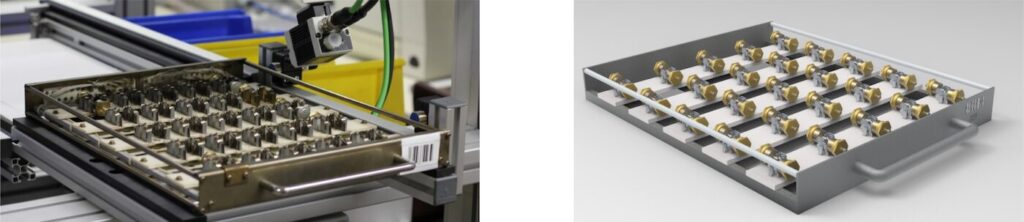
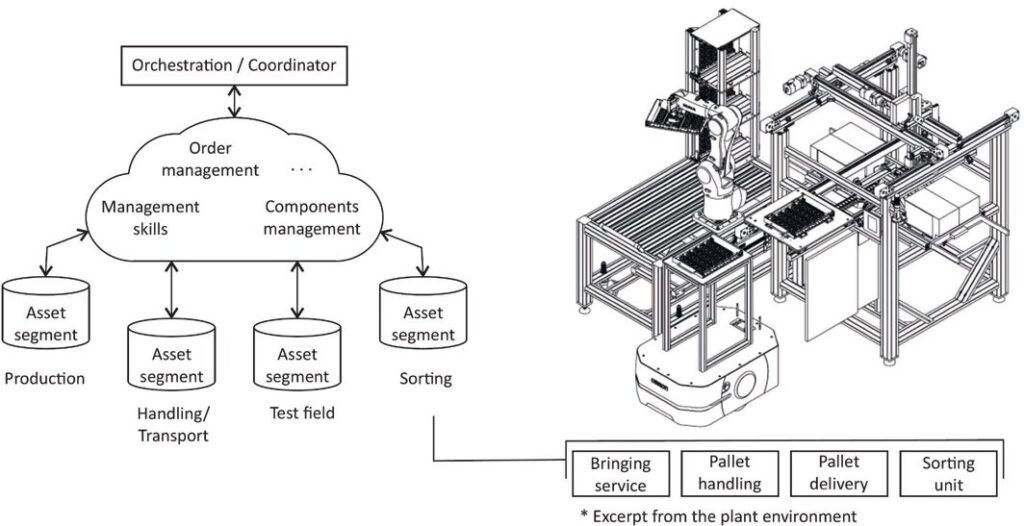
Products, in this case high-quality thermal switches, are tested in an industrial environment during or after the production process. In this environment, each product is subjected to predefined test scenarios. The products are placed on a special carrier (Fig. 1) and made available to the respective processes.
The required test frame, the sequence, and the dwell time of the products on the test stations vary according to the product batch. The technological diagram (extract) of the system environment with its processes is shown as an example in Figure 2.
As part of the preparation of the use case, a possible migration of system components using asset administration shells was discussed. The analysis of the environment of the test station for thermal switches and their components showed that a large number of processes must be included, starting with the preparation of the test specimens, their provision, transfer, and other processes
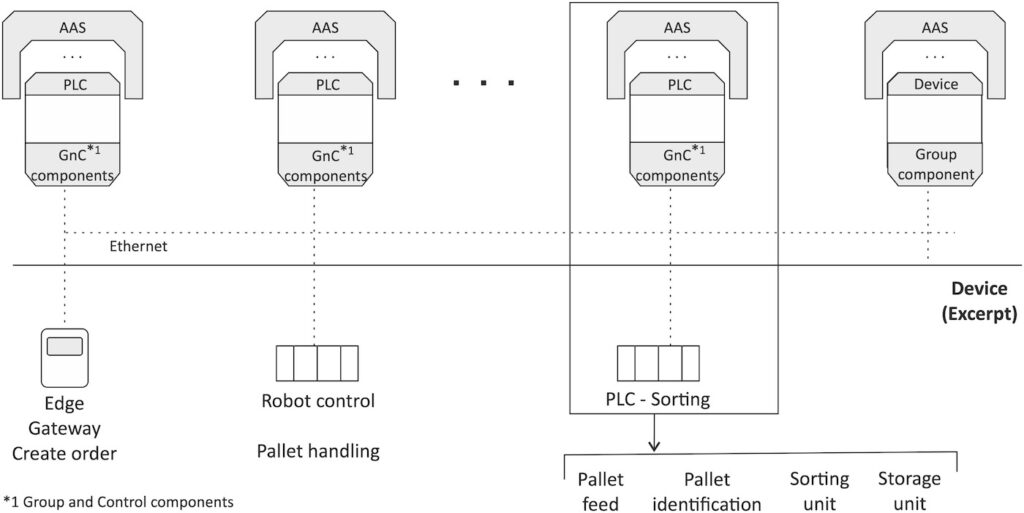
The automation of the inventory was carried out with heterogeneous instrumentation, starting with the use of process control systems (PLCs) from different manufacturers and ending with industrial robots for handling. Comprehensive synchronization and coordination of the processes are needed for this. That can be achieved, for example, by establishing control components at the level of the asset administration shell or by using a PackML state machine implemented at process level and possible extensions.
The question of transferring components to a future I4.0 environment arose as key components of the system in the use case were implemented in an IEC 61131-3-compliant Codesys environment. Among other things, a large number of function libraries and various communication protocols can be used in this environment [9]. However, there are no solutions that allow simple integration into an I4.0 environment and synchronization via AAS.
From the discussion of the use case, it is necessary to both migrate the existing industrial controllers to the future environment and to implement their representation in the form of asset administration shells with minimal effort. With the implementation of the Pack-ML state machine on the controllers and various extensions, which enable a range of functions comparable to the “Control Component”, the step-by-step migration offers a number of advantages. These include, for example, the booking of resources, the synchronization of processes and the possibility of migration’s temporal equalization.
Implementation with Eclipse BaSyx
The Eclipse BaSyx middleware was used to implement the digital twin. It offers the option of implementing asset administration shells in different programming environments. Asset administration shells with SDKs can be configured manually according to the general description of the structure with its submodels. However, this means that IT expertise must be brought in during implementation in the engineering area of the company. This aspect may limit the spread of AAS in the industrial environment and in the company. In many cases, employees with the necessary knowledge are not available in the company.
However, automation engineers are already employed for the existing machinery and equipment, who are responsible for supporting the system, among other things. Their knowledge and skills can be used to design solutions. This also applies to the coordination and synchronization of processes.
The question arises as to how users of industrial control systems can be enabled to use asset administration shells in an industrial environment. One option is the largely generic preparation of AAS without knowledge of the SDK environment using “off-the-shelf” components. The only prerequisites for this should be the description of the asset as AAS type 1 (passive AAS) and the adaptation of the required interfaces in the control software. As the software development process runs through several phases, it makes sense to establish the generation of the AAS online with the control system, as well as offline without the control system, but with a defined data model and communication protocol.
The possibility of a largely generic preparation of asset administration shells was created, for example, with the “off-the-shelf” component OPC2AAS. The generic approach not only simplifies software development, but also reduces the time required and possible malfunctions. With this component, AAS type 2 (reactive AAS) can currently be realized without SDK knowledge. The company’s employees only need to make minor corrections and additions to their process controls and provide the appropriate asset description with the submodels (SM) “Nameplate”, “Identification”, “Technical Data” and the SM “Communication” (option) as asset administration shell type 1.
This mainly concerns knowledge of the data model used and the communication channel, as the AAS generator in the current version accesses defined global variable tables. On request, a type 2 asset administration shell is generated largely automatically, which can be stored in a container once the process is complete.
With the help of this approach, the user can easily design reactive AAS and transfer them to an I4.0-compliant environment.
Integration of technology and training
This article analyzes the role of digital twins in Industry 4.0 and highlights the importance of Eclipse BaSyx. Digital twins are virtual representations of physical assets, processes or systems that are able to integrate and monitor real-time data and optimize production processes. These technologies contribute significantly to increasing operational efficiency and reducing costs, as various studies have shown [10, 11].
However, successful implementation of digital twins requires more than just technological adaptation. Management support and employee training are particularly important in order to promote acceptance and efficiency of the technology. Eclipse BaSyx offers an open source platform that implements digital twins of physical products or systems using asset administration shells and standardized interfaces in accordance with DIN SPEC 91345:2016-04.
An important aspect of training is the provision of practical training and methodical implementation concepts. These concepts are needed to meet the requirements of flexible production environments and overcome challenges. Sound knowledge and methodical training can contribute significantly to the acceptance and efficiency of digital twins [12, 13]. Experience-based learning that applies theoretical knowledge in a real-world context has proven to be particularly effective [14, 15]. In addition, practical application and management support are crucial to accelerate the adoption of digital twins in the industry.
In order to achieve a broad adaptation of these technologies and make the benefits of Industry 4.0 tangible, targeted measures to lower the barriers to entry and practical support from management are required [16]. The article emphasizes the need for a holistic approach that takes both technical and human aspects into account [17]. The focus of training is on equipping employees with the necessary skills and knowledge to exploit the full potential of digital twins and other Industry 4.0 technologies [18].
This article was written as part of the project “BaSys4Transfer: BaSys—Transformation von Unternehmensprozessen, Fertigung und IT-Systeme zur Industrie 4.0, which is funded by the Federal Ministry of Education and Research under the reference 01IS22089C.
Bibliography
[1] Kuhn, T.: Digitaler Zwilling. 2017. URL: gi.de/informatiklexikon/digitaler-zwilling, Accessed 05.06.2024.[2] Lotter, B.: Die Primär-Sekundär-Analyse. In: Lotter, B. ; Wiendahl, H.-P. (Eds.): Montage in der industriellen Produktion: Ein Handbuch für die Praxis. Berlin Heidelberg 2012.
[3] Bauernhansl, T. ; Krüger, J. ; Reinhart, G. ; Schuh, G.: WGP-Standpunkt Industrie 4.0. Wissenschaftliche Gesellschaft für Produktionstechnik WGP e. V. Darmstadt 2016.
[4] Kannwischer, M.: Interaktive Präzisionswerkzeuge für die effizientere Bearbeitung. In: VDMA Themen-Supplement (2015). Die Informationsreihe für technische und innovative Themen.
[5] Eclipse Foundation: Eclipse BaSyx: Industry 4.0 Operating System. 2023. URL: www.eclipse.org/basyx/.
[6] Plattform Industrie 4.0: RAMI4.0 – a reference framework for digitalisation. 2018. URL: www.plattform-i40.de/PI40/Redaktion/EN/Downloads/Publikation/rami40-an-introduction.pdf, Accessed 05.06.2024.
[7] Specification of the Asset Administration Shell Part 1: Metamodel (IDTA Number: 01001-3-0). 2023. URL: industrialdigitaltwin.org/wp-content/uploads/2023/06/IDTA-01001-3-0_SpecificationAssetAdministrationShell_Part1_Metamodel.pdf, Accessed 05.06.2024.
[8] DFKI: A BaSys 4.2 Control Component Implementation. 2024. URL: github.com/BaSys-PC1/control-component, Accessed 05.06.2024.
[9] Rayment, M.: Flexible Motion Control Using IEC 61131-3. In: Mini Symposia UKACC Control (2004), S. 27-36.
[10] Tao, F.; Qi, Q.; Wang, L.; Nee, A. Y. C.:. Digital Twins and Cyber–Physical Systems toward Smart Manufacturing and Industry 4.0: Correlation and Comparison. In: Engineering 8 (2022) 6, S. 738-757.
[11] Fuller, A.; Fan, Z.; Day, C.; Barlow, C.: Digital Twin: Enabling Technologies, Challenges and Open Research. In: IEEE Access 8 (2020), S. 108952-108971.
[12] Müller, H.; Coreynen, W.; Dewulf, W.: The Role of Digital Twins in Knowledge Management: A Systematic Literature Review. In: Journal of Manufacturing Technology Management, 32 (2021) 5, S. 1225-1240.
[13] Jones, D.; Snider, C.; Nassehi, A.; Yon, J.; Hicks, B.: Characterising the Digital Twin: A Systematic Literature Review. In: CIRP Journal of Manufacturing Science and Technology 29 (2020), S. 36-52.
[14] Kolb, D. A.: Experiential Learning: Experience as the Source of Learning and Development. Prentice-Hall 1984.
[15] König, M.: Torp, O.: Experiential Learning and Digital Twins: Enhancing Construction Management Education. Education Sciences, 12 (2022) 7, S. 459.
[16] Wamba, S. F.; Gunasekaran, A.; Bhattacharya, M.; Dubey, R.; Ngai, E. W. T.: Industry 4.0 and the supply chain digitalisation: A review. In: International Journal of Production Research, 59 (2021) 16, S. 4974-4992.
[17] Lasi, H.; Fettke, P.; Kemper, H.-G.; Feld, T.; Hoffmann, M.: Industry 4.0. Business & Information Systems Engineering, 8 (2020) 4, S. 239-242.
[18] Vogel-Heuser, B.; Fay, A.; Tracht, K.: Engineering methods and tools for flexible automation and robotic systems in changing production environments. In: Automation, 69 (2021) 3, S. 70-81.
You might also be interested in