Regulatory Framework for Artificial Intelligence Applications in the Industry 4.0 Context

JournalIndustrie 4.0 Management
Issue Volume 39, 2023, Edition 3, Pages 28-33
Open Accesshttps://doi.org/10.30844/IM_23-3_28-33
Bibliography Share Cite Download

Abstract

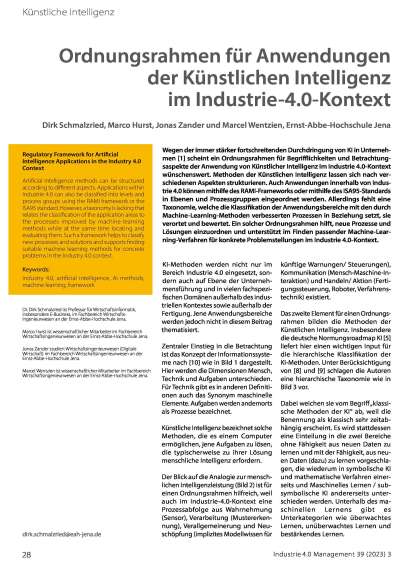
Artificial Intelligence methods can be structured according to different aspects. Applications within Industrie 4.0 can also be classified into levels and process groups using the RAMI framework or the ISA95 standard. However, a taxonomy is lacking that relates the classification of the application areas to the processes improved by machine learning methods while at the same time locating and evaluating them. Such a framework helps to classify new processes and solutions and supports finding suitable machine learning methods for concrete problems in the Industry 4.0 context.

Keywords


Bibliography

[1] Bundesministerium für Wirtschaft und Energie: Kompetenzen und Kooperationen zu Künstlicher Intelligenz. URL: www.de. digital/DIGITAL/Redaktion/DE/ Digitalisierungsindex/ Publikationen/publikation-download-ki-kompetenzen.pdf?__blob=publicationFile&v=1, S.13 ff, Abrufdatum 12.01.2023.
[2] Bundesministerium für Wirtschaft und Energie: Technologieszenario „Künstliche Intelligenz in der Industrie 4.0“. URL: www.plattform-i40.de/IP/ Redaktion/DE/Downloads/ Publikation/KI-industrie-40.pdf?__blob= publicationFile&v=1, S.14 ff, Abrufdatum 12.01.2023.
[3] Bundesministerium für Wirtschaft und Energie: Potenziale der schwachen künstlichen Intelligenz für die betriebliche Ressourceneffizienz. URL: www.ressource-deutschland. de/fileadmin/user_upload/1_ Themen/h_Publikationen/ Studien/VDI-ZRE_Studie_KI-betriebliche-Ressourceneffizienz_ Web_bf.pdf, S.72-73, Abrufdatum 12.01.2023.
[4] Forschungsbeirat der Plattform Industrie 4.0: Künstliche Intelligenz zur Umsetzung von Industrie 4.0 im Mittelstand. URL: www. plattform-i40.de/IP/Redaktion/DE/ Downloads/Publikation/ Expertise-Forschungsbeirat_KI-fuer-Industrie40.pdf?__blob= publicationFile&v=1, S. 19, Abrufdatum 13.01.2023.
[5] DIN e.V., DKE Deutsche Kommission Elektrotechnik Elektronik Informationstechnik in DIN und VDE: Deutsche Normungsroadmap Künstliche Intelligenz, Ausgabe 2. URL: www.din.de/resource/ blob/891106/57b7d46a1d2514 a183a6ad2de89782ab/ deutsche-normungsroadmap-kuenstliche-intelligenz-ausgabe-2–data.pdf, S. 177 ff, Abrufdatum 14.01.2023.
[6] McKinsey Global Institute: Notes from the AI frontier, insights from hundreds of use cases. 2018. URL: www.mckinsey.com/~/media/ mckinsey/featured insights/ artificial intelligence/notes from the ai frontier applications and value of deep learning/notes-from-the-ai-frontier-insights-from-hundreds-of-use-cases-discussion-paper.ashx, S. 9 ff, Abrufdatum 15.02.2023.
[7] Barredo Arrieta, A.; Díaz Rodríguez, N.; Del Ser, J. u. a.: Explainable Artificial Intelligence (XAI): Concepts, taxonomies, opportunities and challenges toward responsible AI. 2020. URL: www.sciencedirect. com/science/article/pii/ S1566253519308103, S. 83, Abrufdatum 15.02.2023.
[8] Adams, S.; Arel, I.; Bach, J. u. a.: Mapping the Landscape of Human-Level Artificial General Intelligence. 2012. URL: ojs.aaai.org/ index.php/aimagazine/article/ view/2322, S. 32, Abrufdatum 16.02.2023.
[9] Mohammadi, M.; Al-Fuqaha, A.; Sorour, S. u. a.: Deep Learning for IoT Big Data and Streaming Analytics: A Survey. 2018. URL: www. arxiv.org/pdf/1712.04301.pdf, S. 7, Abrufdatum 16.02.2023.
[10] Aplar, P.; Alt, R.; Bensberg, F.; Weinmann, P.: Anwendungsorientierte Wirtschaftsinformatik. 9. Auflage. Wiesbaden 2019.
[11] Deutscher Ethikrat: Mensch und Maschine – Herausforderungen durch Künstliche Intelligenz, Stellungnahme. 2023. URL: https:// www.ethikrat.org/fileadmin/ Publikationen/Stellungnahmen/ deutsch/stellungnahme-mensch-und-maschine.pdf, Abrufdatum 24.04.2023.
[12] Petrik, D.; Mormul, M.; Reimann, P.; Gröger, C.: Anforderungen für Zeitreihendatenbanken im industriellen IoT. In: Meinhardt, S.; Wortmann, F. (Hrsg): IoT – Best Practices. Edition HMD. Wiesbaden. 2021. URL: https://doi. org/10.1007/978-3-658-32439-1_19, Abrufdatum 24.04.2023.

Your downloads


You might also be interested in

Generative AI in Organizational Knowledge Management

Generative AI in Organizational Knowledge Management

AI literacy as a prerequisite for augmentation
Uta Wilkens ORCID Icon, Valentin Langholf ORCID Icon, Niklas Obermann ORCID Icon
Generative Artificial Intelligence (GenAI) offers new opportunities for organizational knowledge management, particularly when it comes to learning processes at the interface between explicit, firm-specific, and tacit knowledge. Its use is therefore of particular interest for application areas such as industrial maintenance. Based on a mechanical engineering case study, this article demonstrates that augmenting both processes and employees with GenAI requires AI literacy combined with professional skills.
Industry 4.0 Science | Volume 42 | 2026 | Edition 5 | Pages 118-126 | DOI 10.30844/I4SE.26.5.14
Foundation Models in Industrial Robotics

Foundation Models in Industrial Robotics

Requirements for AI-supported assistance in production and logistics
Bernd Kuhlenkötter ORCID Icon, Daniel Syniawa ORCID Icon
Foundation models are increasingly changing the way robots are used in industry. Instead of writing complex programs line by line, programmers will soon be able to collaborate more closely with AI systems, describe tasks, and review generated solutions. This shifts their role from purely generating code to conceptual, supervisory, and validation activities. This article highlights the new possibilities that large AI models create for robot programming and the changes they entail for work and required skills in industrial practice.
Industry 4.0 Science | Volume 42 | 2026 | Edition 5 | Pages 16-23 | DOI 10.30844/I4SE.26.5.2
AI-Driven Organization as a New Work Paradigm

AI-Driven Organization as a New Work Paradigm

Implications for individual and organizational change
Katharina Hölzle ORCID Icon, Leonie Krauch, Wolfgang Beinhauer ORCID Icon, Carsten Schmidt, Josephine Hofmann ORCID Icon
Is it sufficient to train employees in the use of AI tools, or does the AI organization require an entirely new set of competencies? This paper introduces a digital enablement model comprising three competency dimensions and demonstrates, through an upskilling program implemented at the Fraunhofer Institute for Industrial Engineering IAO, how organizations can sustainably bridge the AI adoption gap.
Industry 4.0 Science | Volume 42 | 2026 | Edition 5 | Pages 94-100 | DOI 10.30844/I4SE.26.5.11
Designing Effective AI Certification

Designing Effective AI Certification

Insights from established certification domains for the standardization of human-centered AI
Katharina Morsch ORCID Icon
Certification for human-centered AI is becoming increasingly important—as a source of competitive differentiation, a response to regulatory expectations, and a mechanism for fostering human-centered work environments. But how can organizations determine whether the underlying requirements are truly embedded in practice? Drawing on expert interviews from established certification domains, this paper shows that the decisive question is answered not during the audit itself, but in the period between audit cycles. Ultimately, it is not the certificate that matters, but the commitment of organizational leadership and the organization as a whole to engage seriously in the certification process and its continuous implementation.
Industry 4.0 Science | Volume 42 | 2026 | Edition 5 | Pages 86-92 | DOI 10.30844/I4SE.26.4.10
Data-Driven Supplier Selection in Industry 4.0

Data-Driven Supplier Selection in Industry 4.0

Towards an industrial platform for selection and configuration
Purushothaman Ganesh ORCID Icon, Baris E. Albayrak ORCID Icon, Jörg Franke ORCID Icon, Till Sindel ORCID Icon, Jens Fürst, Sebastian Lang ORCID Icon
Industrial supply chains must repeatedly reconfigure sourcing strategies in response to disruptions, yet supplier capability information remains heterogeneous and difficult to operationalize. Existing research addresses supplier selection, simulation, and interoperability standards separately, treating discovery, evaluation, and optimization as disconnected steps requiring manual data transformation. This paper presents a framework for a data-driven industrial platform integrating three components: Asset Administration Shell-based supplier profiles structured by an Actor-Service ontology for semantic discovery, automatic discrete-event simulation model generation from layout data for performance evaluation, and KPI-driven configuration using optimization algorithms. The main contributions are an end-to-end interoperable workflow, a two-tier supplier profile concept separating semantic descriptions from simulation parameters, and a standardized KPI interface maintaining consistency ...
Industry 4.0 Science | Volume 42 | 2026 | Edition 4 | Pages 50-61 | DOI 10.30844/I4SE.26.4.6
Open Source as Enabler for Smart Data Ecosystems

Open Source as Enabler for Smart Data Ecosystems

How collaboration shapes sovereignty and interoperability across industrial applications
Anna Maria Schleimer ORCID Icon, Julia Pampus ORCID Icon
From automotive supply chains to smart factories, data ecosystems promise seamless collaboration across company boundaries. But how can industries build the necessary infrastructure without creating new dependencies? This article explores how open-source software can serve as a foundation and impactful tool for sovereign, interoperable technologies and standards. Yet, open-source software is not a silver bullet; rather, it poses challenges for digital sovereignty in burgeoning data ecosystems.
Industry 4.0 Science | Volume 42 | 2026 | Edition 4 | Pages 6-13 | DOI 10.30844/I4SE.26.4.1