Sustainability

Changeability as Enabler for Sustainable Logistics

Changeability as Enabler for Sustainable Logistics

IT-Tool zum Nachhaltigkeitstrendmonitoring und Wandlungsagent
Horst Wildemann
Customers, society and politics challenge companies to ensure the sustainability of their value creation. Many stakeholder groups have an eye on the logistics. These groups constantly raise new requirements and regulations affecting companies’ businesses.  This is the reason why it is not sufficient anymore to react on changing requirements. Companies can gain competitive advantages if they anticipate trends in sustainability and react immediately. In this context, this article presents an approach for trend monitoring and a change agent suppor-ting to react effectively and efficiently on trends in sustainability.
Industrie Management | Volume 29 | 2013 | Edition 5 | Pages 35-38
Innovation Management in Logistics

Innovation Management in Logistics

Analysis and Validation of Innovation Management Methods for Logistic Service Providers
Wolfgang Kersten ORCID Icon, Andrea Victoria Seidel, Nikolaus Wagenstetter
Technological progress, stringent competitive conditions and continually changing customer behaviour force the logistics industry to develop innovative solutions to generate long-term competitive advantage. Compared to the development of physical products, a systematic innovations management has not been established in logistics yet. Grounded in the analysis of interviews with experts from industry, this article puts forward requirements with respect to innovation management implementation and suggests the use of specific methods.
Industrie Management | Volume 28 | 2012 | Edition 6 | Pages 31-34
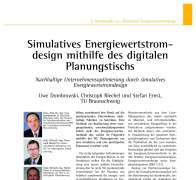
Energy Value Stream Mapping as a Tool of the Digital Factory

Energy Value Stream Mapping as a Tool of the Digital Factory

Sustainable Optimization with Simulative Energy Value Stream Mapping
Uwe Dombrowski, Christoph Riechel, Stefan Ernst
Rising energy costs, the changing political context as well as growing customer requirements are increasing the pressure on manufacturing companies to run sustainable factories. A method to realize an energy efficient factory is the Energy Value Stream Mapping. This paper shows an approach which adds a simulative and participative dimension to the method by using the IFU planning table.
Industrie Management | Volume 28 | 2012 | Edition 6 | Pages 55-58
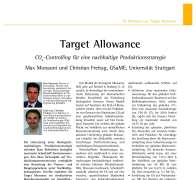
Target Allowance, CO2-Controlling for a Sustainable Production Strategy

Target Allowance, CO2-Controlling for a Sustainable Production Strategy

CO2-Controlling für eine nachhaltige Produktionsstrategie
Max Monauni, Christian Freitag
Heading for an ecological production, precise specifications regarding a maximal amount of harmful substances emitted is needed. By defining a quantifiable goal for carbon dioxide on product component level, a precise evaluation of the current product-portfolio’s sustainability becomes feasible. Therefore incorrect practices on shop floor level can be observed and eliminated by appropriate and cost-efficient concepts. A structured calculation model for quantifying the sustainable carbon dioxide emission over the entire product life cycle is being developed: the Target Allowance. This enables production systems to implement ecological minimum requirements oriented on the absolute, global maximum loading.
Industrie Management | Volume 28 | 2012 | Edition 5 | Pages 41-44
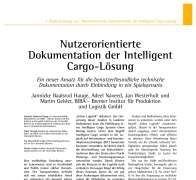
Technical Documentation in a Gaming Environment

Technical Documentation in a Gaming Environment

Using the example of an intelligent cargo solution
Jannicke Baalsrud Hauge, Adeel Naveed, Jan Westerholt, Martin Geisler
A sustainable constitution of our way of living is more and more subject to the discussion in society and politics. The transportation sector, causing a considerable percentage of the worldwide CO2 emissions, resides right in the middle of the debate. As a result companies find themselves in an area of conflict between economical and ecological objectives, which cannot always be reconciled. Approaches to solve this dilemma are discussed under the general term „Green Logistics“. The implementation of an intelligent cargo system can contribute to bring these approaches to practice.
Industrie Management | Volume 28 | 2012 | Edition 4 | Pages 29-32
Approaches to Support Discrete-event Simulation as a Knowledge-intensive Process

Approaches to Support Discrete-event Simulation as a Knowledge-intensive Process

Dennis Abel, Markus Schmitz, Sigrid Wenzel ORCID Icon
Planning, design and continuous improvement of today’s complex corporate structures and technical systems require a sophisticated level of extensive know-ledge of technology, processes and IT. To apply planning and simulation tools effectively and efficiently engineers and plant operators have to rise to the challenge to use their knowledge in a goal-oriented way and to expand it within creative processes. Consequently, knowledge is more than ever a key productivity factor and an important component of corporate capital. Against this background, the article discusses possibilities for systematization and standardization in simulation studies and especially approaches to increase productivity in simulation studies by supplying assistance functions as well as systematic evaluation methodologies.
Industrie Management | Volume 28 | 2012 | Edition 3 | Pages 7-11
Green Supply Chain Evolution – Green Logistics as Business Success Factor

Green Supply Chain Evolution - Green Logistics as Business Success Factor

Grüne Logistik als Erfolgsfaktor für Unternehmen
Matthias Wohlfahrt, Denny Rusche
Global warming is one of the major challenges of the 21th century. The reduction of the greenhouse gases is therefore of special interest. Companies have to face several challenges if they want to measure and reduce greenhouse gases. Two studies have asked the question how companies evaluate the efforts for a green supply chain. These surveys were conducted by the management and technology consultancy BearingPoint. A change in mindset of executives can be revealed by comparing the corresponding results of both studies. This article highlights the position for green logistics of more than 600 companies in the 2010-2011 survey. The results are compared with the former study of 2008. An evolution over the past years becomes visible: from awareness to implementation actions.
Industrie Management | Volume 27 | 2011 | Edition 6 | Pages 43-46
Implementing Greener Logistics

Implementing Greener Logistics

Ökoeffiziente Logistik mittels Target Costing
Wolfgang Kersten ORCID Icon, Sebastian Brockhaus, Sebastian
Following increasing public demand, sustainability is currently on the agenda of every company. In particular for logistics, environmental considerations play an important role today. This manuscript will put forward the concepts of “green” and “greener” logistics and highlight the differences between the two. “Greener logistics” encompasses all approaches dedicated to increasing the resource efficiency of logistics processes. In this article a practical guide to implementing greener logistics will be outlined. In order to ensure customer focus, a target costing approach is suggested. Practical relevance is demonstrated with a case study.
Industrie Management | Volume 27 | 2011 | Edition 6 | Pages 57-60
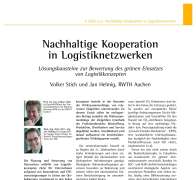
Sustainable Cooperation in Logistics Networks

Sustainable Cooperation in Logistics Networks

Lösungsbausteine zur Bewertung des grünen Einsatzes von Logistikkonzepten
Volker Stich, Jan Helmig
The importance of sustainable planning and managing of networks by logistics concepts is rising. However, estimating these logistics concepts under sustainability aspects is a problem which many logistics managers have to face. The impact of logistics concepts to the target figures in a sustainable performance measurement system highly depends on the correlation between the variables. In this paper the correlation between the target figures within the functional areas of procurement, production, distribution and service are depicted. Based on these findings a cross-functional causal loop diagram is derived.
Industrie Management | Volume 27 | 2011 | Edition 6 | Pages 69-72
Sustainability as a Logistic Challenge: Potentials and Barriers

Sustainability as a Logistic Challenge: Potentials and Barriers

Potenziale und Barrieren
Wolf-Rüdiger Bretzke
The current discussion on sustainability lacks a firm foundation on a clear and unambiguous definition of this pivotal concept. This impedes a concentrated discussion among scientists as well as politicians and managers on a subject-matter concerning the future of mankind. It gives room for hollow commitments of companies claiming publicly to be „green“. The article therefore starts by proposing a clear and unambiguous definition which can fill this gap. Based on this preliminary work the author argues that logistics cannot become sustainable if it remains in a position where it only has to ensure the demands of other departments’ means (especially those of marketing) thus neglecting fundamental interdependencies. Logisticians often claim systems thinking as the dominant perspective of their work. Based on a practical example the author shows that systems thinking can only work as a door opener to sustainability if it is applied to the company as a whole.
Industrie Management | Volume 27 | 2011 | Edition 6 | Pages 65-68
1 12 13 14 18