Sustainability

Ways Out of the Human Resources Dilemma

Ways Out of the Human Resources Dilemma

SMEs Use Sustainable Strategies for Recruiting Highly Talented Employees
Werner Geilenkirchen
Small and medium enterprises (SME) in Germany are in a good mood. More than 90 % of the SMEs are in an appropriate economic situation reports the Bundesverband mittelständische Wirtschaft (BVMW). About 38 % of these companies expect a higher turnover in 2014 [1]. But there is one real problem the companies are faced with: the lack of skilled labour.
Industrie Management | Volume 30 | 2014 | Edition 3 | Pages 35-38
Combination of Production Characteristics Curves and the Process Chain Paradigm

Combination of Production Characteristics Curves and the Process Chain Paradigm

Analysis of Different Perspectives
Holger Beckmann, Frederik Döbbeler, Oliver Künzler, Michael Lücke
Nowadays factories have to withhold an ever rising pressure to succeed. Customer demands become more demanding and goods have to be available within shorter lead times and lower prices. Flexibility, reliability and resilience are key factors for companies. Against this background, there is a need in companies for constant analysis of their business processes. This is an addition to a paper that was published in the last issue of this journal. The first part focused on the general possibility of the two methods “Dortmunder Process Chain Model” and production characteristics curves and how they could be used to analyse factories in different detail levels. In this second part the focus is set more on the perspectives that both models base on. On the one hand there is the order flow perspective of the “Dortmunder Process Chain Model” and on the other hand the resource perspective of the production characteristics curves that have to be aligned.
Industrie Management | Volume 30 | 2014 | Edition 2 | Pages 22-26
On the Way to Industry 4.0

On the Way to Industry 4.0

Christian Gorldt, Alexander Pflaum
The development of information and communication technologies (ICT) is progressing rapidly and is seen in today‘s economic action as a key driver of innovation. Future industrial production is characterized by a high degree of customization of products and a strong production flexibility. The rapid development of the Internet has contributed especially in recent years in the private life of merging the real with the virtual world and will get stronger in the future of industrial sector. This paradigm shift is referred to as Industry 4.0. This paper gives an overview of the Industry 4.0 and represents the potential of the transformation process.
Industrie Management | Volume 30 | 2014 | Edition 1 | Pages 15-18
Automatic Assessment of Physical Workload in Order Picking Systems

Automatic Assessment of Physical Workload in Order Picking Systems

Bewertung der physischen Belastung von Arbeitsplätzen in der Kommissionierung durch das WMS
Myriam Koch, Willibald A. Günthner
In order picking, the workers lift, lower, push and pull variable loads. This manual handling is a common cause of musculoskeletal disorders. In order to assess the risk of musculoskeletal disorders, risk assessments in order picking are nowadays performed manually. This article presents an approach how to integrate two methods of risk assessment in warehouse management systems so the physical workload in order picking systems can be determined automatically.
Industrie Management | Volume 30 | 2014 | Edition 1 | Pages 47-50
The Client’s Role in Promoting Industrial Development

The Client’s Role in Promoting Industrial Development

Fritz Rehsteiner
Unemployment is one of biggest prob-lems menacing the “industrial world”. On the other hand few other things justify human activity more reliably than his working which, at the same time, contri-butes remarkably to his self-esteem as a key source for his happiness. Common alter-natives to work like so called crea-tive activities, charity, but also purely passive pleasures don’t fill the gap in the long run. Also, classical human work is expected to create dangerous results in the material (eco-lo-gical) sense as well as, increa-singly, in the psychological domain. While classical economic wisdom attributes the amount and the quality of work to technical, political, and social efforts the role of the client as an active partner in furthering the importance of work is emphasized.
Industrie Management | Volume 30 | 2014 | Edition 1 | Pages 63-65
Combination of Production Characteristics Curves and the Process Chain Paradigm

Combination of Production Characteristics Curves and the Process Chain Paradigm

Holger Beckmann, Frederik Döbbeler, Oliver Künzler, Michael Lücke
Nowadays factories have to withhold an ever rising pressure to succeed. Customer demands become more demanding and goods have to be available within shorter lead times and lower prices. Flexibility, reliability and resilience are key factors for companies. Against this background, there is a need in companies for constant analysis of their business processes. The process perspective that was established in the industry since the 1980s will be addressed in the following by using the “Dortmunder Process Chain Model”. A permanent preparedness for change relies on being able to report about the plant’s status quo at all times. Therefore valuation methods and key figures are needed that represented by production characteristics curves in this paper. After an introduction to these two topics, the combination of both to one process based valuation method will be outlined. The intended methodology will represent a holistic decision model for plant controlling. This approach is being ...
Industrie Management | Volume 30 | 2014 | Edition 1 | Pages 22-26
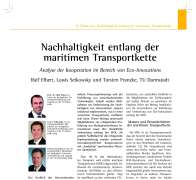
Sustainability Along Maritime Transport Chains

Sustainability Along Maritime Transport Chains

Analysis of Cooperation in Terms of Eco-Innovations
Ralf Elbert, Lowis Seikowsky, Torsten Franzke
The majority of international transport is processed via maritime transport chains, which contribute significantly to global emissions of CO2. As a result, companies attempt to reduce the pollution by optimizing processes and by introducing environmental friendly technologies. However, initiatives are rather pursued on an individual company level than in an inter-actor cooperation. This strategy is ineffective because the key for sustainable operations in a transport chain is the alignment of linking intersections. This paper examines opportunities for the successful implementation of Eco-Innovations along the maritime transport chain as well as its actual adaption. Boundary-spanning cooperation with “landside” actors has been identified as the largest lever for a successful implementation of Eco-Innovations.
Industrie Management | Volume 29 | 2013 | Edition 6 | Pages 53-56
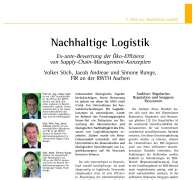
Sustainable Logistics

Sustainable Logistics

Ex-ante evaluation of the eco-efficiency of logistics strategies
Volker Stich, Jacob Andreae, Simone Runge
When selecting logistics strategies for their production networks, companies increasingly need to consider not only economic but as well environmental aspects. Those environmental aspects are, however, not easy to evaluate. This holds especially for SME with their limited resources. To assist companies in selecting a logistics strategy that meets their needs, a KPI framework to evaluate the economic and environmental sustainability of logistics strategies was developed within the Green-Net research project. Using the system dynamics approach, a simulation model was developed, which helps to anticipate and evaluate the impact of a certain logistics strategy on the company’s network.
Industrie Management | Volume 29 | 2013 | Edition 5 | Pages 27-30
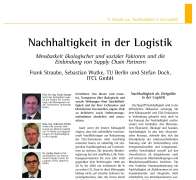
Sustainability in Logistics

Sustainability in Logistics

Measurability of ecological and social criteria and the integration of supply chain partners
Frank Straube, Sebastian Wutke, Stefan Doch
Increasing customer demand and legislative regulations on sustainability lead to growing pressure on companies to provide transparency on the negative social and ecological effects of their business activities and those of their suppliers and service providers. A broad strategic integration of sustainability, incorporating economic, social and ecological aspects, enables companies to gain a competitive advantage. Several standards provide support for the measurement and reporting of ecological and social indicators, though the quantification of social sustainability still remains a challenge. For improving sustainability effectively, the scope of measurement and target setting has to include supply chain partners like suppliers or service providers. Top performing companies include sustainability criteria in their procurement processes for logistics services to reduce their transport-related emissions effectively.
Industrie Management | Volume 29 | 2013 | Edition 5 | Pages 7-10
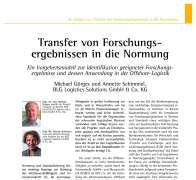
Transfer of Research and Development Results to Standardisation Processes

Transfer of Research and Development Results to Standardisation Processes

A Procedure Model Based Approach and its Application in the Field of Offshore Wind Energy Logistics
Michael Görges, Annette Schimmel
Standardisation of industrial solutions is a crucial factor for the competitiveness of whole industry sectors. Especially young and immature industries, like the offshore wind energy sector, may benefit from standardised processes. Several research and development projects address information flow and the planning in this field. The standardisation of the projects results may improve the performance of the whole supply chain. However, the transfer of research and development results to standardisation processes is a challenging task. Thus, this paper introduces a procedure model for the identification and evaluation of research and development results for standardisation.
Industrie Management | Volume 29 | 2013 | Edition 5 | Pages 11-14
1 11 12 13 18