Logistics

Room for Improvement in Material Supply

Room for Improvement in Material Supply

Design and Optimization of Milkrun Cycles
Eberhard Abele, Felix Brungs
Lean companies naturally use milkruns to improve their internal logistics. Approaches for the design of such milkrun cycles exist, but specific conditions of production are not accounted for. By showing typical development steps of the milkrun design, the correct design-approach for the specific situation becomes clear. Moreover the levers for further optimization and cost reduction are pointed out.
Industrie Management | Volume 25 | 2009 | Edition 5 | Pages 61-64
Logistics Systems Planning

Logistics Systems Planning

Procedure models and formalization of planning knowledge
Tobias Sommer, Dirk Marrenbach ORCID Icon, Karl-Heinz Wehking
Current changes in market situations may compel companies to adapt their products, manufacturing systems, as well as logistics systems. Required planning procedures are characterized by their complexity and their interdisciplinary nature: A system that has to fulfil future requirements is designed using models, methods, and the knowledge of all involved participants. Therefore, this article aims to discuss procedure models applied in different disciplines in order to assess their usability in logistics planning projects. Furthermore, certain aspects of planning procedures are identified that require formalization of applied knowledge. Thus, an approach to apply knowledge formalization is presented.
Industrie Management | Volume 25 | 2009 | Edition 5 | Pages 57-60
Interchangeable Containers between Transport and Material Handling Systems

Interchangeable Containers between Transport and Material Handling Systems

Olaf Poenicke, Klaus Richter, Michael Schenk
Mounting numbers of end customers and simultaneously declining delivery quantities are making more flexible organization of transport chains essential. Reductions of high-volume commercial transport are being demanded particularly in urban areas to cut traffic and CO2 emissions. This is the starting point for a low-volume commercial transport concept based on interchangeable containers that are combined over long distances to take advantage of established infrastructures in which interchangeable trailers are integrated and then separated in the “last mile” as required for pinpoint delivery to end customers. The interchangeable containers are supported by innovative I&C technologies for continuous cargo tracking and tracing and optimized and energy efficient routing. Automated approaches to consigning interchangeable container cargoes are being designed and tested.
Industrie Management | Volume 25 | 2009 | Edition 5 | Pages 27-30
Strategic Power Factors in Buyer Supplier Relationships

Strategic Power Factors in Buyer Supplier Relationships

Josef Oehmen, Paul Schönsleben, Max von Bredow, Philipp Gruber, Gunther Reinhart
The increasing globalization gives western companies great new opportunities. Especially China gained increasing importance as a sourcing market in the last years. Despite these opportunities, a retreat of many companies from China could be witnessed recently. Among other factors, this is due to the fact that western companies cannot exert enough influence on the performance and price of their suppliers. This article presents tools and processes to successfully face this challenge and improve the own position of power as a customer.
Industrie Management | Volume 25 | 2009 | Edition 4 | Pages 29-33
Strategic Management of Swap Bodies in Freight Transportation

Strategic Management of Swap Bodies in Freight Transportation

Christian Gorldt, Marco Lewandowski, Patrick Dittmer, Alexander Podlich
In this paper we show an integrative solution to freight traffic reduction. Beside telematic systems we also regard software for planning and control of swap bodies in the area of courier express and parcel provider. The objective is to design a decision support tool for transport planning to support users to solve their daily problems of tour planning. The software prototype introduced in this contribution was provided in the context of the BMWi promoted project Inwest and will be evaluated in field test in third quarter of 2009.
Industrie Management | Volume 25 | 2009 | Edition 4 | Pages 25-28
Optimized Transport Planning Based on Evolutionary Algorithms

Optimized Transport Planning Based on Evolutionary Algorithms

Thomas Weise, Alexander Podlich, Manfred Menze, Christian Gorldt
In this paper we introduced in transport planning based on evolutionary algorithms. The objective is to design a decision support tool for transport planning manager to support the planning process. An important criterion is to minimize the transportation (km) by using this tool. The prototype introduced in this paper was tested with real business data to check the suitability for transportation planning. Furthermore, different settings for the evolutionary algorithm are experimentally studied their utility is verified with statistical tests.
Industrie Management | Volume 25 | 2009 | Edition 3 | Pages 37-40
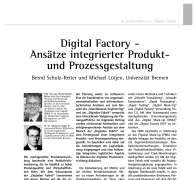
Digital Factory – Approaches for the integrated Product- and Process Design

Digital Factory - Approaches for the integrated Product- and Process Design

Bernd Scholz-Reiter ORCID Icon, Michael Lütjen ORCID Icon
The market-oriented product development describes a focusing of needs, which leads ideally to high product quality and profitability. In the context of “Digital Factory” this paper focuses on the integrated product and process design, which is oriented to the physical part of the product. Due to the high product complexity, shorter product life cycles and increased competition situation is the product development faced with new challenges. Both the speed and the quality of planning should be improved further. Only the combination of organizational approaches and information technologies like for example “Simultaneous Engineering” and the “Digital Factory” promises a sufficient increase of planning efficiency. The following paper deals with existing methodologies and promising approaches in the field of “Digital Factory” against the background of an integrated product and process design. Referring to the requirements of logistics planning, an early integration of ...
Industrie Management | Volume 25 | 2009 | Edition 1 | Pages 19-22
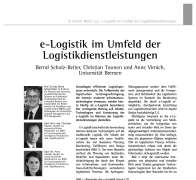
E-Logistics and Services in Logistics

E-Logistics and Services in Logistics

Bernd Scholz-Reiter ORCID Icon, Christian Toonen, Anne Virnich
Modern information technolgies are essential for efficient processes in logistics. Concepts which base intensively on IT have become known as e-logistics. This article discusses the idea of e-logistics and relates it to different concepts within services in logistics. Therefore necessary technologies to realise e-logistics are introduced. As an example the technologies and developments of tracking-and-tracing are detailed.
Industrie Management | Volume 24 | 2008 | Edition 5 | Pages 13-16
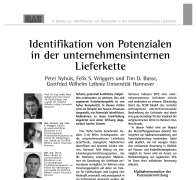
Identification of Potentialities Regarding the Value Chain Showcased for Source

Identification of Potentialities Regarding the Value Chain Showcased for Source

Peter Nyhuis ORCID Icon, Felix S. Wriggers, Tim D. Busse, Gottfried Wilhelm
To excel global players have to satisfy a multitude of requirements nowadays. Contradicting targets have to be resolved by value chain design on a regular basis, taking into consideration the complex setting of necessary decisions. This article explains how to identify and evaluate measures showcasing the source process.
Industrie Management | Volume 24 | 2008 | Edition 2 | Pages 47-49
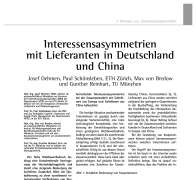
Asymmetry in Interests with Suppliers from Germany and China

Asymmetry in Interests with Suppliers from Germany and China

Josef Oehmen, Paul Schönsleben, Max von Bredow, Gunther Reinhart
The increasing competitive pressure leads to a reduction of the depth of value creation and therefore to a rising importance of suppliers. Additionally, globalization is the cause for a tighter international network in production. Asymmetries in interests can obstruct a cooperation between companies and may endanger the commercial success. The article describes asymmetries in interests in the cooperation with local as well as Chinese suppliers.
Industrie Management | Volume 24 | 2008 | Edition 1 | Pages 31-34
1 13 14 15 19