Hybrid Adaption Planning for Configuration of Network Factories

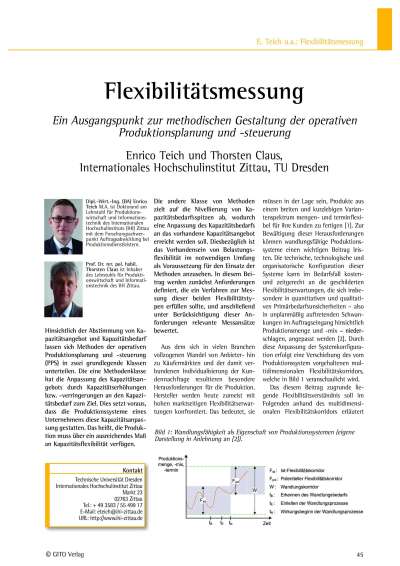
Ein Ausgangspunkt zur methodischen Gestaltung der operativen Produktionsplanung und -steuerung

JournalIndustrie Management
Issue Volume 29, 2013, Edition 4, Pages 45-48
Share Cite Download

Abstract

The increasing turbulence in enterprises environment becomes apparent by rising variant diversity and continuously reducing product life cycles. These results cause immense and not resolvable adaption necessities for producing companies. The approach of network factories combines system immanent and network bounded potentials to increase adaption alternatives, reduce adaption risks, and optimize agility.

Keywords

Access limited

You are currently not logged in / not yet registered.

In order to download the desired file(s), you must be logged in and have an appropriate inclusive subscription. Alternatively, you can also obtain access by paying a one-off fee.

Subscription included Purchase
without 29,00 €
Digital 0,00 €
Expert 0,00 €
Professional 0,00 €

Download for one time 29,00 €

All prices include 7% VAT

After purchasing access rights, you will automatically be redirected back to this page.


Potentials: Profitability

You might also be interested in

Systematically Planning Vertical Factories

Systematically Planning Vertical Factories

Developing factory types as a foundation for intelligent planning support
Nikolaus Kremslehner ORCID Icon, Sebastian Schlund ORCID Icon, Wilfried Sihn
Vertical factories reduce land use and harness the advantages of urban production. However, their multi-story structure significantly increases planning complexity. To counter such effects, this paper presents a typology that combines proven solutions for recurring challenges in the planning and operation of vertical factories. Relevant characteristics were examined using real-world case studies and structured within a morphological framework. This framework was consolidated into factory types that provide guidance for conceptual planning and serve as the foundation for intelligent planning support.
Industry 4.0 Science | Volume 42 | 2026 | Edition 5 | Pages 68-76 | DOI 10.30844/I4SE.26.5.6
AI-Based Building Inspection for Large Structures

AI-Based Building Inspection for Large Structures

A new approach to construction progress monitoring
Jan Sender, Konrad Jagusch, Michael Geist ORCID Icon, David Jericho ORCID Icon, Christian Scharr ORCID Icon
Monitoring construction progress, as required in the one-off production of large structures, is very time- and labor-intensive due to a high level of complexity and individuality. The goal of this article is to develop a sensor-based approach for capturing and evaluating multiple inspection characteristics. The use of machine learning models to detect objects and derive relevant information forms the basis for linking current condition to construction schedule. This enables a significant increase in efficiency during construction progress monitoring and a well-founded assessment of progress.
Industry 4.0 Science | Volume 42 | 2026 | Edition 5 | Pages 78-84 | DOI 10.30844/I4SE.26.5.9
Site Assessment for Flexible Intralogistics in Brownfield Sites

Site Assessment for Flexible Intralogistics in Brownfield Sites

Innovative decision support in practice
Jolanda Schierbaum, Carsten Feldmann, Lars Renhof
Due to its dynamic environment, space planning in intralogistics is not a one-time task but a recurring decision-making process subject to numerous constraints imposed by existing infrastructure. Decisions are often based on incomplete data, resulting in a high risk of poor planning decisions and inefficient use of space. This paper presents a practice-oriented process model for space evaluation in brownfield projects. The proposed approach improves the standardization and consistency of space evaluation and promotes best practices among all stakeholders. By supporting systematic decision-making, the process model contributes to optimized planning and resource allocation, thereby reducing risks and avoiding costly implementation errors.The process model is demonstrated through a case study conducted at a commercial vehicle manufacturer.
Industry 4.0 Science | Volume 42 | 2026 | Edition 3 | Pages 124-133
Conducting Experiments in Hybrid Learning Factories

Conducting Experiments in Hybrid Learning Factories

The example of the InTraLab Potsdam
Industrial production is undergoing rapid transformation through digitalization, automation and cyber-physical systems, creating new competence requirements for employees. Learning factories provide experiential environments for developing these competences. This article presents the Industrial Transformation Lab (InTraLab) as a hybrid learning factory combining physical demonstrators and digital simulations.
Learning Factories for the Future of Manufacturing in Brazil

Learning Factories for the Future of Manufacturing in Brazil

Advancing manufacturing through technology and skills development
Manufacturing firms in developing countries face challenges in closing productivity gaps while adopting Industry 4.0 technologies. Learning factories are one helpful approach to countering these challenges. One such example is the learning factory Fábrica do Futuroin São Paulo, Brazil, which has engaged students, supported competence development, and collaborated with industry in applied research, functioning as a hub for advanced manufacturing initiatives.
AI Implementation in Industrial Quality Control

AI Implementation in Industrial Quality Control

A design science approach bridging technical and human factors
Jens Pöppelbuß ORCID Icon, Kathrin Nauth ORCID Icon
Artificial intelligence (AI) offers significant potential to enhance industrial quality control, yet successful implementation requires careful consideration of ethical and human factors. This article examines how automated surface inspection systems can be deployed to augment human capabilities while ensuring ethical integration into workflows. Through design science research, twelve stakeholders from six organizations across three continents are interviewed and twelve sociotechnical design requirements are derived. These are organized into pre-implementation and implementation/operation phases, addressing human agency, employee participation, and responsible knowledge management. Key findings include the critical importance of meaningful employee participation during pre-implementation, and maintaining human agency through experiential learning, building on existing expertise. This research contributes to ethical AI workplace implementation by providing guidelines that preserve human ...
Industry 4.0 Science | Volume 42 | 2026 | Edition 1 | Pages 120-127 | DOI 10.30844/I4SE.26.1.112
This entry was posted in Uncategorized and tagged .