Fabrikplanung

Digital Factory in Engineering Education

Digital Factory in Engineering Education

A teaching concept from a university of applied sciences
Sven Völker ORCID Icon
The volatility of economic conditions and rapid technological progress require production sites to be constantly adapted and improved. This needs highly qualified factory planners who can use digital planning tools efficiently. The best qualifications emerge from closely interlinking the teaching of planning methods and the application of these methods in a planning project according to the principle of “learning by doing”.
Industry 4.0 Science | Volume 40 | Edition 4 | Pages 8-15
Qualitative Cause-Effect Relationships

Qualitative Cause-Effect Relationships

Planning and implementation of relocation projects in the reorganization of factories
Andreas Nitsche, Malte Stonis ORCID Icon, Peter Nyhuis ORCID Icon
The realization of reorganization projects represents a complex and independent planning task within the framework of factory layout planning. Only little methodical knowledge exists, which considers the temporal, spatial and organizational restrictions in the creation of a schedule. This paper aims to present the interdependencies in the planning and execution of realization projects and thus to provide a basis for discussion for further investigations in the field of scheduling factory relocations for the reorganization of factory objects.
Industrie 4.0 Management | Volume 39 | 2023 | Edition 1 | Pages 53-57
Planning Assistance in Production and Logistics

Planning Assistance in Production and Logistics

A concept for AI-based planning support within a digital platform
Marius Veigt, Lennart Steinbacher, Michael Freitag ORCID Icon
Intense global competition, shorter product life cycles and an increasing number of variants require flexible and adaptable, but at the same time economical production and logistics systems. This requires constant replanning of factories and logistics systems. Value-adding processes are being outsourced to contract logistics providers. Contract logistics planners must respond to tenders as quickly as possible and develop a proposal with an initial planning concept and a cost estimation. Despite standardization efforts in planning, the knowledge is often only implicit at the planners. This article describes the need for support by an AI-based assistance system during the planning process and how a digital platform for such an assistance system should look like.
Industrie 4.0 Management | Volume 37 | 2021 | Edition 5 | Pages 11-15
Flexible Reference Model for Planning and Optimization

Flexible Reference Model for Planning and Optimization

Generierung digitaler Fabrikmodelle mit dem digitalen Zwilling
Michael Schlecht, Jürgen Köbler, Roland de Guio
The digital twin has moved into the focus of manufacturing companies and has been identified by Gartner as a key technology [1]. In the automotive industry, VW uses the digital twin in the cloud to plan, control and optimize production at all 122 locations in the future [2]. The digital twin is also the basis and an integral part of new, digital business models and the digitization of production companies. This article gives an overview of the current state of the art and describes a flexible reference model for planning and optimizing production systems based on the digital twin. The focus is on the one hand on the optimization of static layouts and material flows and on the other hand on the optimization of dynamic material flows and the temporal organization of processes.
Industrie 4.0 Management | Volume 37 | 2021 | Edition 5 | Pages 53-56 | DOI 10.30844/I40M_21-5_S53-56
Discrete-Event Simulation in Industry 4.0

Discrete-Event Simulation in Industry 4.0

Fields of Action for the Industrial Digital Transformation
Sigrid Wenzel ORCID Icon, Jana Stolipin, Ulrich Jessen
Discrete-event simulation of logistics and production systems plays an important role in the context of digital transformation. Its integration into modern planning and control processes is urgently required in order to realize Industry 4.0 concepts. In addition, simulation models will be an important part of the so-called digital twin in the planning and operation. However, the requirements for simulation models and tools are not yet comprehensively defined, and technical solutions have not been adequately implemented. This article presents the fields of action for the implementation.
Industrie 4.0 Management | Volume 34 | 2018 | Edition 3 | Pages 29-32
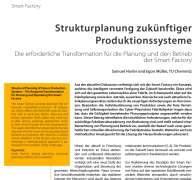
Structural Planning of Future Production Systems

Structural Planning of Future Production Systems

The Required Transformation for Planning and Operating the Smart Factory
Samuel Horler, Egon Müller
The Smart Factory concept describes the extensively networked production of industry 4.0, which affects the entire life cycle of a factory and, in particular, factory planning and factory operation. Both classic and more up-to-date factory planning approaches come to their limits through the new requirements. This paper identifies the requirements that are important for the future structural planning of factories and presents the need for a holistic virtual validation of the factory structure. Furthermore, a methodological approach is addressed for the solution of the challenges.
Industrie 4.0 Management | Volume 33 | 2017 | Edition 3 | Pages 54-58
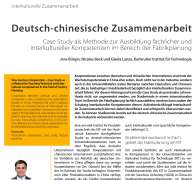
Sino-German Cooperation

Sino-German Cooperation

Teaching technical and intercultural competences in the field of factory planning
Jens Bürgin, Nicolas Beck, Gisela Lanza ORCID Icon
Cooperation between German and Chinese companies is rare considering the potential for growth in China. However, not only in industry but also at university barriers of intercultural cooperation occur between Germans and Chinese. Against this background, case studies can be applied in teaching not only technical knowledge, but also intercultural competences. In this context, deficiencies in intercultural cooperation can be identified and successfully overcome.
Industrie 4.0 Management | Volume 32 | 2016 | Edition 3 | Pages 74-77
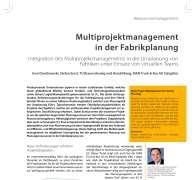
Multi-Project Management for Factory Planning

Multi-Project Management for Factory Planning

Integration des Multiprojektmanagements in die Umplanung von Fabriken unter Einsatz von virtuellen Teams
Uwe Dombrowski, Stefan Ernst, Harald Boog
Manufacturing companies are operating in a turbulent environment, which leads to a higher need for factory replanning. Typically, factory planning activities are carried out as projects. All projects are competing for limited resources. An appropriate coordination between the individual projects and coordination with the daily business increases efficiency and effectiveness. This paper presents multi-project management as a possible approach to the sharing of resources in factory planning.
Industrie Management | Volume 31 | 2015 | Edition 4 | Pages 43-47
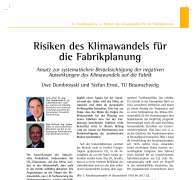
Risks of Climate Change for Factory Planning

Risks of Climate Change for Factory Planning

Ansatz zur systematischen Berücksichtigung der negativen Auswirkungen des Klimawandels auf die Fabrik
Uwe Dombrowski, Stefan Ernst
The impact of industrial production on the climate is discussed in science, but also in politics. Adaptation to the impacts of climate change, such as better flood protection, is also examined. The aspects of manufacturing companies have been considered inadequately. Classical approaches of factory planning take climatic conditions only for location finding into account. Here the climate is considered to be static, when dynamic influence quantity. This has the consequence that the risk of climate change impacts in the planning of factories is not considered. In this paper, an approach to identify and highlight the growing risks is described.
Industrie Management | Volume 30 | 2014 | Edition 5 | Pages 23-26
Urban Factory – Potentials of a New Factory Typology

Urban Factory - Potentials of a New Factory Typology

Uwe Dombrowski, Christoph Riechel
To remain competitive in a globalized market, enterprises must consider sustainably aspects. The classic aims of quality, costs and time are extended by aspects of the ecological, economic and social quality. The challenge to cope with these new dimensions aiming at long term success is raised by the turbulent influences in a global market with varying demands. A new factory typology, the so called urban factory, pursues the aim to exhaust the potentials of an interlinking of factory and town efficiently. The aim of this topology is to improve the competitive situation of enterprises. In this case the synergetic use of material and energy sources is in focus.
Industrie Management | Volume 30 | 2014 | Edition 4 | Pages 11-15
1 2 4