
Corporate Purpose as Guideline for the UN Sustainable Development Goals |
Aligning business strategy with the UN Sustainable Development Goals

| Journal | Industry 4.0 Science |
| Issue | Volume 40, 2024, Edition 1, Pages 37-43 |
| Bibliography | Share | Cite | Download |
Abstract
Keywords
Article
The topic of sustainability has finally arrived on the agenda of corporate strategists. Economic developments in recent years have been characterized by increasing uncertainty and intense competition. Cost-cutting measures and reductions in product quality were the result of increasing price pressure. The continued pressure on decision-makers to succeed led to over-engineering and resulted in short-term decision-making horizons. In addition, event-induced discontinuities such as financial crises, environmental disasters, short-term changes in legislation or geopolitical events such as social unrest or wars also had to be dealt with [1]. One concept that provides a stable and long-term business approach to dealing with these shocks is Corporate Purpose.
Corporate purpose describes an organization’s raison d’être by formulating a goal that goes beyond pure, short-term profit maximization to create value and contribute to the well-being of society and the planet [2]. Purpose is therefore the statement of a company’s moral response given its broad responsibility and not just an amoral plan to exploit commercial opportunities [3]. The aspect of sustainability is a key parameter here.
The purpose concept has developed over time and in three stages: Starting from an initial general reason for an organization’s existence, moving to a raison d’être that goes beyond short-term profit maximization, and culminating in the creation of prosocial value in the corporate environment [2]. The term has its origins in practice, as established decision-making processes and thought patterns are increasingly proving to be no longer fit for purpose as a result of changing environmental conditions.
The economic approach of profit maximization is coming under increasing criticism, as it conflicts with sustainability goals in many areas. As an imperfect solution, companies are making a compromise and pursuing a dual purpose that follows two different logics – one financial and one social. The simultaneous pursuit of both logics leads to complexity in the alignment and management of companies and employees. The resulting conflict between financial and social goals varies depending on the specificity of the social and financial goals, the long-term nature of the target horizon, the social outlook of the managers, the focus of the supervisory board on social and financial goals and the – moderately strong at best – incentives for organizational members [4].
Consequently, managers are looking for new concepts that support them in reconciling traditional corporate goals with sustainability and socially oriented requirements. Formulating a corporate purpose and reflecting on one’s own contribution to the common good provide orientation in resolving the conflict. In addition, a corporate purpose and the resulting sense of meaning it provides can unleash new potential in the areas of employee motivation [5], strength of innovation [6] and reputation management [7]. This lends meaning to both sustainability efforts [8] and work in general [9].
The context of corporate purpose
Although the concept and function of corporate purpose is related to established strategic concepts, it differs significantly from them. In contrast to the shareholder value principle, which aims to maximize shareholder returns and thus short-term profit, the purpose approach pursues the goal of achieving a long-term and sustainable increase in corporate value by creating value within and outside the organization.
The mission and vision statements introduced by a large number of companies at the end of the 19th and beginning of the 20th century can be distinguished from the corporate purpose in three key respects. Firstly, mission and vision statements are routinely updated as part of the strategy process of many companies. In contrast, the purpose statement represents a long-lasting corporate orientation that is not usually adapted due to temporary strategies or even the personal priorities of changing managers.
Secondly, a mission statement describes what an organization is currently doing, while the vision statement describes where an organization wants to be in the near future. A purpose statement, on the other hand, describes the motivation of an organization to work towards an idealistic vision of the future that may never be achieved. Thirdly, a purpose statement necessarily includes a prosocial orientation, which is often seen as optional in mission and vision statements.
The precursor to this concept is the concept of Creating Shared Value (CSV) proposed by Harvard Professor Michael E. Porter, which aims to seek win-win situations at the interface between companies and their stakeholders. Although Porter’s concept did not prevail, it did lay the foundation for a rethinking of the capitalist economic system, which had been shaped in particular by the work conducted by Rappaport and Friedman on shareholder value and profit maximization.
Porter emphasizes the connection between social and economic progress [10]. It becomes clear that companies are increasingly being asked to make a contribution to solving social problems by fulfilling their responsibility towards their stakeholders. If they fail to do so, there is a risk that they will lose their legitimacy in the eyes of the public. In practice, the term “license to operate” is usedto describe this.
Organizations must therefore take on an active role in society and act as good corporate citizens. Inmany places, the concept of purpose is therefore technically and operationally located in corporate social responsibility (CSR). There is a pitfall here: Investments in CSR activities usually rise and fall with the economy, as companies interpret CSR as a dispensable area in times of crisis. Central value creation in companies is often detached from CSR requirements, which means that CSR activities such as charitable donations, employee training, environmental certificates or charity events do not form part of an overall concept that is embedded in the company-wide sustainability strategy [2].
While corporate purpose is anchored in normative management and represents the reason for an organization’s existence [11], the concept of CSR has a more functional focus and is predominantly embedded at the strategic and operational management level [12]. This makes it clear that the idea of corporate social responsibility is given a new significance by the concept of corporate purpose. The shift of these issues up to higher management levels can be explained by the increasing demand for corporate sustainability.
Corporate purpose and sustainability are strongly interrelated, as a corporate purpose provides orientation and meaning on the one hand, while sustainability increases the credibility of the purpose and makes it measurable on the other [8]. So how can corporate purpose be structured from a management perspective? To this end, we have thoroughly examined the most recent developments in corporate purpose and have developed a tool for measuring the maturity of purpose in companies.
The four success factors of corporate purpose
As part of our exploratory research, we conducted an extensive literature review and held numerous interviews and discussions with experts. We first established the status quo regarding the degree of implementation of purpose in companies and then identified the research and practical gaps in the measurement of corporate purpose. The definition of corporate purpose itself already revealed a mixed understanding of the term at the corporate level. Some of the interviewees were of the opinion that purpose enables stakeholder interests to be better satisfied and companies to develop new growth potential. Another group of interviewees saw purpose as an opportunity to realign the moral compass of companies independently of financial maxims.
The distinction between corporate purpose and the concepts of mission and vision was not clear to many interviewees. The approach to introducing a corporate purpose also differed between the companies. For example, to formulate the statement of purpose, SWOT analyses were carried out, stakeholder workshops were organized, external agencies were engaged or an iterative process with continuous feedback loops was carried out. Although the concept is currently still scientifically underdeveloped, those asked during this research rated it as highly relevant. Our interviewees were not aware of any methods for measuring corporate purpose.
Based on the findings of Gulati [13], we have examined four success factors of corporate purpose: (1) Direction, when the purpose serves as a “north star” and helps to channel innovation; (2) Motivation, when a deep purpose improves cohesion as well as work and enables a company to motivate and inspire its employees; (3) Relation, where the company’s purpose maintains the credibility and trust of partners in the ecosystem and enables long-term relationships to be built; (4) Reputation, in the sense of a good image, where a deep purpose helps to build affinity, loyalty and trust among customers.
These four success factors can be interpreted as target states to strive for, which are oriented towards the closest stakeholders, these being employees (1, 2), suppliers and partners (3) and customers and investors (4).
The findings of Gartenberg et al. [14] are consistent with Gulati’s analyses of purpose and employees: the authors cite Purpose Clarity and Camaraderie as critical metrics for determining the status quo in companies. Purpose clarity promotes directional effects. Camaraderie promotes motivational effects. To complete the theoretical framework construct, we assign the term Purpose Synergy to relational effects in terms of successful partnerships and Purpose Resonance to reputational effects that promote a good image. Further empirical research is needed to validate this model theory.
The Purpose Score: a metric for measuring purpose
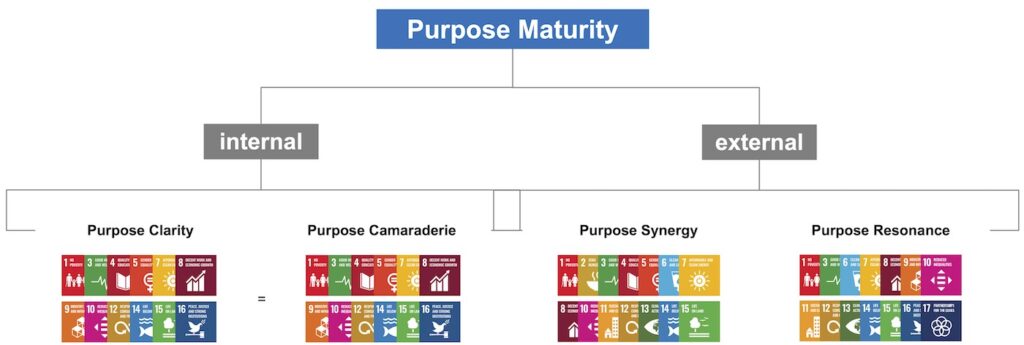
Existing management methods enable companies to work towards the four purpose targets and thereby improve their competitive situation at the same time. The two dimensions of purpose clarity and camaraderie are used to determine the extent to which an internal purpose exists. External purpose is measured using the dimensions of purpose synergy and purpose resonance.
Purpose clarity iscreated among stakeholders and especially among employees when companies communicate their purpose clearly. Guiding principles are an effective means of doing this. A complete guiding principle consists of five building blocks: mission, vision, guidelines, values and purpose. Purpose plays a central role here and is in harmony with the other four building blocks. The normative goals that are defined in this way can then be woven into the strategy process.
In this process, iterative analyses are carried out and sub-goals are defined, which are then cascaded down the company’s hierarchy. According to Gartenberg et al. [14], middle management plays a key role here by acting as a link between top management and employees and breaking down abstract strategic goals into tangible sub-goals. The tool we have developed measures the extent to which the purpose is known within the company and by external stakeholders.
Purpose camaraderie refers to the cohesion of the workforce within a company. This also includes the relationship between employees and managers. To this end, we have formulated items that are based on existing cultural measurement methods and which ask, for example, to what extent fair pay exists in the company, how decision-making processes are organized or how the working atmosphere is perceived.
In the case of purpose synergy, two aspects are evaluated based on a framework construct developed by Schuh [15]. The first aspect are the criteria used to select suppliers and cooperation partners. Secondly, it is examined whether the design, management and development of relationships with ongoing suppliers and cooperation partners are coherent with the corporate purpose. The aim is to check whether a collaboration contributes to the purpose or conflicts with it. This requires an expansion of the basis for decision-making beyond price, quality and delivery capability. To date, such factors have significantly influenced the outcome of the selection process and are now being supplemented by components that check the value compatibility between partners and the company’s own organization.
Purpose resonance is based on a framework construct for measuring reputation using the three components of functional, expressive and social reputation [16]. Together, these ensure a good reputation, provided that none of the three components is neglected or predominates. Functional reputation describes the actual pursuit of the organization, which is fulfilled by the company’s products or services. These are the classic corporate requirements such as satisfactory quality, innovative offers or good service.
The expressive reputation ensures competitive differentiation on the one hand and stakeholder identification on the other. It manifests itself in the brand and the corporate identity. Social reputation is created through morally correct behavior, compliance with legal requirements and by making contributions towards the common good. As a result, companies are perceived as benevolent.
In the measurement methodology we developed, the current status is determined by answering over 50 items. We have embedded these in an online tool. Tool users answer the questions on a seven-point Likert scale, where answers range from “strongly disagree” to “strongly agree”. By converting the answers into a score from 0 to 6, a maturity level is calculated for each dimension depending on the maximum number of points that can be achieved.
The overall result in the Purpose Score is determined by the lowest score in each of the four measurement dimensions of Purpose Clarity, Camaraderie, Purpose Synergy and Purpose Resonance. A subjective maturity level of purpose is therefore measured. More objective measurements can be attained by including as many types of stakeholders as possible and using a large sample. However, the measurement methodology also enables the status quo to be determined comparatively quickly without extensive surveys, for example by having a panel of experts carry out the measurement together.
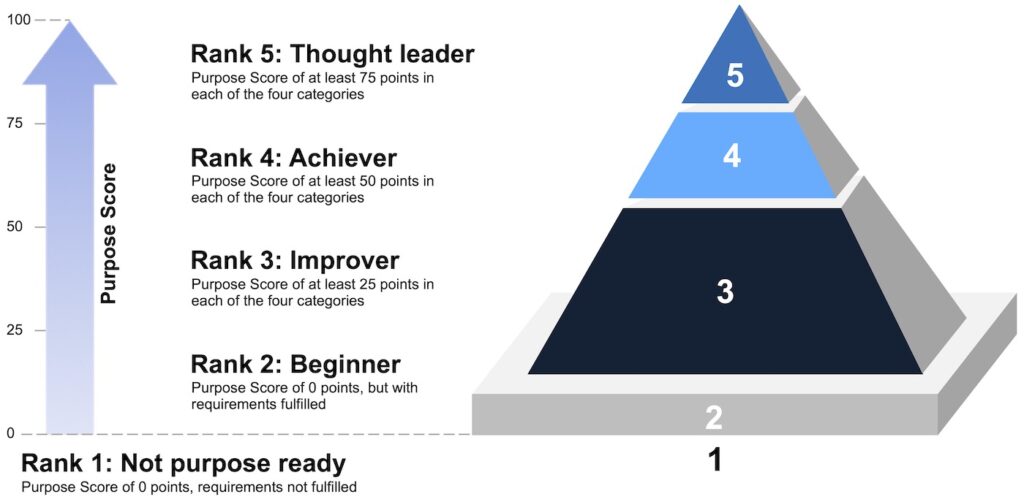
The first step is to check the level of Purpose Readiness. To this end, we analyzed possible criteria based on existing literature and validated them through discussions with experts. For example, persistently poor media coverage or human rights violations at the company or in its supply chains prevent a purpose from being authentic or credible. The formulation, introduction and communication of a corporate purpose can do more harm than good in such instances. The result would be a disconnect between stakeholders and the company, loss of trust and reputational damage.
This state leads to unfulfilled purpose readiness and a purpose maturity level (or rank) of 1. As soon as all purpose readiness criteria in the tool are affirmed, this results in a maturity level of 2, still with 0 points. Companies then collect points on a scale that goes up to level 5 and 100 points (Figure 1). Companies can achieve the next rank once 25 points have been reached. The highest rank is reached once a score of 75 points is attained.

Sustainability makes a corporate purpose credible and measurable. As purpose suggests a long-term perspective, in addition to measuring current stakeholder perception, we have integrated a measurement of the degree of achievement of the 17 United Nations Sustainable Development Goals (SDGs) into the tool. The SDGs were adopted in 2015 and outline an agenda intended to enable economically, socially and environmentally sustainable development at local, regional and national levels by 2030. These include goals such as No Poverty (Goal 1), Zero Hunger (Goal 2), Quality Education (Goal 4) and Reduced Inequalities (Goal 10).
Consequently, we have linked the UN Sustainable Development Goals to the four measurement dimensions using a logic that assigns the SDGs to the respective stakeholders (Figure 2) [17]. Individual SDGs can therefore contribute to several of the four purpose dimensions (Figure 3). The integration of the SDGs results in a more comprehensive picture of the purpose maturity level in companies. The 17 Sustainability Goals were converted into items based on the four purpose dimensions in order to make the SDGs measurable depending on the sector.
The measurement results from the stakeholder surveys are offset in the tool against the results of the sustainability measurement in order to determine the final purpose score. The method then provides company- and sector-specific recommendations for action to improve performance in the individual measurement areas.
On the path to sustainable transformation
It seems inevitable that companies will have to fulfill their obligation to greater sustainability. We want to support companies in this by providing them with a tool to measure the maturity of their purpose. One limitation of our assessment basis lies in the measurement of perceptions. Perceptions are subject to biases, for example when current experiences are evaluated disproportionately positively or negatively. Such distortions can be counteracted by adding in objective control variables.
Furthermore, no field studies have yet been conducted with the tool. It is therefore not possible to predict how the companies who use it will be distributed across the individual maturity levels. The boundaries between the levels must therefore be adjusted as necessary. Through our research work, we would like to support the acceleration of the sustainability transformation and contribute to the further development of the concept of corporate purpose.
This article was created as part of the “Return on Purpose” project, which is funded by the German Federal Ministry for Economic Affairs and Climate Protection under the reference number IGF 22338 N. The online tool for measuring maturity will be available from April 2024 at www.corporate-purpose.com.
Funding reference number: 22338 N
(Funded by the German Federal Ministry of Economic Affairs and Climate Protection/IGF)
Bibliography
[1] Schuh, G.; Patzwald, M.; Krebs, L.: Resilienz in der Strategiearbeit: Eine Bestandsaufnahme. Aachen 2021.[2] Brosch, N.: Corporate purpose: from a ‘Tower of Babel’ phenomenon towards construct clarity. In: Journal of Business Economics 93 (2023), S. 567-595.
[3] Bartlett, C. A.; Ghoshal, S.: Changing the role of top management: Beyond strategy to purpose. In: Harvard Business Review 72 (1994) 6, S. 79-88.
[4] Battilana, J.; Obloj, T.; Pache, A.; Sengul, M.: Beyond shareholder value maximization: Accounting for financial/social trade-offs in dual-purpose companies. In: Academy of Management Review 47 (2022) 2, S. 237-258.
[5] Rehwaldt, R.; Kortsch, T.: Happiness & Work – Glück bei der Arbeit, 1. Auflage. Berlin Heidelberg 2023.
[6] Henderson, R.: Innovation in the 21st Century: Architectural Change, Purpose, and the Challenges of Our Time. In: Management Science 67 (2021) 9, S. 5479-5488.
[7] Rother, J.: Kein New Normal ohne Purpose. In: Bihler, U.; Müller, F. (Hrsg): Modernes Reputationsmanagement, S. 91-110. Wiesbaden 2021.
[8] Gartenberg, C. M.: Purpose-driven companies and sustainability. In: Social Science Research Network Electronic Journal (2021).
[9] Michaelson, C.; Pratt, M. G.; Grant, A.: Meaningful Work: Connecting Business Ethics and Organization Studies. In: Journal of Business Ethics 121 (2014) 1, S. 77-90.
[10] Porter, M. E.; Kramer, M. R.: Creating Shared Value. In: Harvard Business Review 89 (2011), S. 62-77.
[11] Kirchgeorg, M.; Meynhardt, T.; Pinkwart, A.; Suchanek, A.; Zülch, H.: Führung neu denken: Das Leipziger Führungsmodell, 2. Auflage. Leipzig 2017.
[12] Baumgartner, R. J.: Managing Corporate Sustainability and CSR: A Conceptual Framework Combining Values, Strategies and Instruments Contributing to Sustainable Development. In: Corporate Social Responsibility and Environmental Management 21 (2014) 5, S. 258-271.
[13] Gulati, R.: Deep Purpose – The heart and soul of high-performance companies, 1. Auflage. New York 2022.
[14] Gartenberg, C. M.; Prat, A.; Serafeim, G.: Corporate Purpose and Financial Performance. In: Social Science Research Network Electronic Journal (2021).
[15] Schuh, G.: Einkaufsmanagement, 2. Auflage. Dordrecht 2013.
[16] Fleischer, A.: Reputation in der Postmoderne. In: Bihler, U.; Müller, F. (Hrsg): Modernes Reputationsmanagement, S. 1-17. Wiesbaden 2021.
[17] Humanistic Management Practices gGmbH; Kasper, M.; Hofielen, G.: Business act for the Common Good and the SDGs. URL: www.ecogood.org/apply-ecg/sustainable-development-goals, Abrufdatum 18.11.2023.
You might also be interested in