Challenges of Digitalization in Intermodal Transport

Data models for the exchange of planning data for regional freight tram transportation

JournalIndustrie 4.0 Management
Issue Volume 38, 2022, Edition 6, Pages 59-62
Bibliography Share Cite Download

Abstract

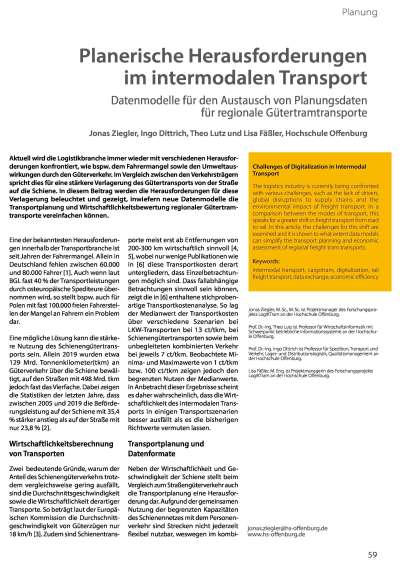
The logistics industry is currently being confronted with various challenges, such as the lack of drivers, global disruptions to supply chains and the environmental impact of freight transport. In a comparison between the modes of transport, this speaks for a greater shift in freight transport from road to rail. In this article, the challenges for this shift are examined and it is shown to what extent data models can simplify the transport planning and economic assessment of regional freight tram transports. (Only in German)

Access limited

You are currently not logged in / not yet registered.

In order to download the desired file(s), you must be logged in and have an appropriate inclusive subscription. Alternatively, you can also obtain access by paying a one-off fee.

Subscription included Purchase
without 29,00 €
Digital 27,55 €
Expert 26,10 €
Professional 0,00 €

Download for one time 29,00 €

All prices include 7% VAT

After purchasing access rights, you will automatically be redirected back to this page.

You might also be interested in

Digital Twins for Emission Reduction

Digital Twins for Emission Reduction

Ex-ante case study on a pump test bench in industrial production
Felix Bischoff, Ingela Tietze ORCID Icon, Peter Hertweck, Nina van Hasz
Digital twins are frequently referred to as a promising approach for reducing greenhouse gas (GHG) emissions in industrial production; however, robust empirical evidence of their benefits under real-world conditions is largely lacking. In this case study, the emission reduction potential of a digital twin—as a conceptually described target system—is quantified ex-ante via the example of a test bench for hydraulic pumps. To this end, the GHG emissions of the original test plan for the year 2025 are determined based on actual measured energy consumption of the tested pumps and time-resolved grid electricity emission intensities. This is followed by a rule-based rescheduling, in which energy-intensive test processes are shifted to time intervals with lower emissions. The rescheduling takes operational constraints into account so that processes and equipment remain unchanged. The savings potential is determined by comparing the GHG emissions of the reference and the optimized case.
Industry 4.0 Science | Volume 42 | 2026 | Edition 3 | Pages 16-24 | DOI 10.30844/I4SE.26.3.2
Has the Time Come for an Energy Revolution in Intralogistics?

Has the Time Come for an Energy Revolution in Intralogistics?

The current status of hydrogen fuel cell-powered MHE
Joseph W. Dörmann
Hydrogen fuel cells promise to be a sustainable alternative to fossil fuel or battery-electric material handling equipment (MHE) in various production or warehouse contexts. Short refuelling times, an absence of carbon emissions, and constant power input put fuel cell-powered MHE at an advantage in high-intensity work environments. However, various barriers to the adoption of fuel cells remain, including considerations surrounding cost and efficiency.
Industry 4.0 Science | Volume 41 | 2025 | Edition 6 | Pages 74-80
Loam Construction and Wooden Shelving

Loam Construction and Wooden Shelving

A contribution to sustainability in warehouse logistics
Viviano De Giacomo ORCID Icon, Nathalie Fritsch ORCID Icon, Jakob Kennert ORCID Icon, Dieter Uckelmann ORCID Icon
This study examines the contribution of natural building materials, in particular loam and wood, to the sustainable development of logistics infrastructure, assessing ecological, economic, and technical dimensions across the entire life cycle. Potentials, restrictions, and supportive framework conditions are identified based on literature analyses and expert interviews. Wood proves to be technically mature and ecologically advantageous, especially in high rack construction, while loam offers high potential for energy- and resource-efficient construction. The study concludes with recommendations for research, policy, and practice to establish circular construction methods in logistics.
Industry 4.0 Science | Volume 41 | Edition 6 | Pages 82-89
The Bias of “Instructional Systems for the Disabled”

The Bias of “Instructional Systems for the Disabled”

Ethnographic insights from deploying augmented reality in a sheltered workshop
David Kostolani ORCID Icon, Annemarie Ploss, Sebastian Schlund ORCID Icon
The rehumanization of industrial work has emerged as a key focus in Industry 4.0 research, emphasizing the empowerment of human workers amidst advancing automation. Within this re-search, supporting workers with disabilities through digital assistance technologies serves as a prime example of a human-centric approach to industrial engineering. These technologies often claim to enhance productivity, which aims to promote the integration of workers with disabili-ties in industrial roles. But can they genuinely improve their work experience? This ethnograph-ic study presents insights from two years of developing and deploying augmented reality in a sheltered woodworking workshop. Over this period, we engaged in conversations and facilitat-ed over 30 technology sessions with workers with diverse disabilities. Our experiences chal-lenge the narrative of industrial research, in particular with digital instructional systems serving as “enabler technology” to help them work “better.” ...
Industry 4.0 Science | Volume 41 | 2025 | Edition 5 | Pages 102-110 | DOI 10.30844/I4SE.25.5.102
Machine Learning to Promote Sustainability 

Machine Learning to Promote Sustainability 

Company analysis based on expert interviews
Matthias Weigold
This article outlines the results of ten expert interviews on the use of machine learning to promote corporate sustainability and then compares them with relevant literature. The study shows that economic factors drive the use of machine learning, the introduction of which is initiated by both top management and specialist departments. However, grounded strategies for implementing machine learning are rarely available and use cases are often based on supervised learning. The environmental impact (the reduction of emissions, for example) outweighs the social impact, though quantification is difficult. Additionally, a lack of trust, expertise, and communication hinders the adoption of machine learning, while some technical challenges regarding data requirements also pose problems.
Industry 4.0 Science | Volume 41 | Edition 4 | Pages 44-51
Real-Time Monitoring of the Carbon Footprint for SMEs

Real-Time Monitoring of the Carbon Footprint for SMEs

Sustainability in real time — from operation to finished products
Henning Strauß ORCID Icon, Julian Sasse ORCID Icon
Although SMEs are not directly affected by the statutory reporting obligations for carbon accounting, as suppliers they are obliged to meet the requirements of sustainability reporting. In addition to a holistic life cycle analysis, this requires a high-quality database within production in order to determine the specific CO₂ footprint. A central element is the implementation of a Machine Carbon Footprint (MCF). This article aims to develop and implement an MCF focusing on its applicability for SMEs. For this purpose, data is recorded and visualized in real time on a machine tool. The measurement data is then processed, stored and visualized using open-source low-code platforms. Real-time data flows enable the precise determination of the production-specific carbon footprint and, in conjunction with order data, the Product Carbon Footprint.
Industry 4.0 Science | Volume 41 | Edition 3 | Pages 102-109