Digital Representations as Basis for Digital Twins in Plant Industry

Fundamentals, Particularities, Challenges and Possible Solutions

JournalIndustrie 4.0 Management
Issue Volume 38, 2022, Edition 5, Pages 21-24
Open Accesshttps://doi.org/10.30844/IM_22-5_21-24
Bibliography Share Cite Download

Abstract

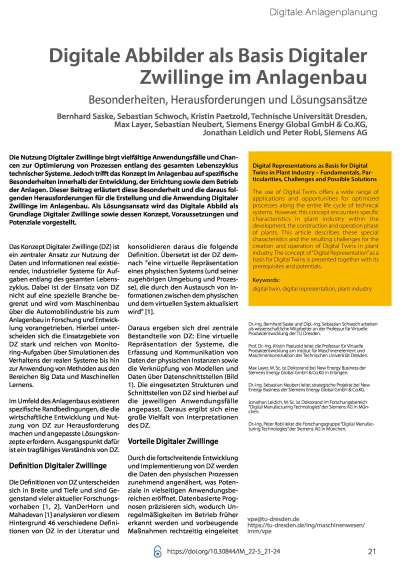
The use of Digital Twins offers a wide range of applications and opportunities for optimized processes along the entire life cycle of technical systems. However, this concept encounters specific characteristics in plant industry within the development, the construction and operation phase of plants. This article describes these special characteristics and the resulting challenges for the creation and operation of Digital Twins in plant industry. The concept of “Digital Representation” as a basis for Digital Twins is presented together with its prerequisites and potentials.

Keywords


Bibliography

[1] VanDerHorn, E.; Mahadevan, S.: Digital Twin: Generalization, characterization and implementation. In: Decision Support Systems 145 (2021). DOI: https://doi.org/10.1016/j.dss.2021.113524
[2] Stark, R.; Anderl, R.; Thoben, K.-D.; Wartzack, S.; Krause, F.-L.; Grässler, I.; Pottebaum, J.; Schleich, B.; Stelzer, R.; Hick, H.; Klein, P.; Saske, B.; Gerhard, D.; Czwick, C.; Gogineni, S.; Klimmeck, L.; Bajzek, M.; Jacobs, G.; Berroth, J.; Zimmermann, T.; Kranabitl, P.; Kirchner, E.; Göckel, N.: WiGeP-Positionspapier: „Digitaler Zwilling “. Zeitschrift für wirtschaftlichen Fabrikbetrieb 115 (2020). DOI: https://doi.org/10.1007/978-3-64235950-7_16870-1
[3] Melesse, T.Y.; Di Pasquale, V.; Riemma, S.: Digital Twin models in industrial operations: State‐of‐the‐art and future research directions. In: IET collob. intell. manuf. 3 (2021) 1. S. 37 – 47. DOI: https://doi.org/10.1049/cim2.12010
[4] Uhlemann, T.H.-J.; Lehmann, C.; Steinhilper, R.: The Digital Twin: Realizing the Cyber-Physical Production System for Industry 4.0. In: Procedia CIRP 61 (2017). S. 335 – 340. DOI: https://doi.org/10.1016/j.procir.2016.11.152
[5] Rasheed, A.; San, O.; Kvamsdal, T.: Digital Twin: Values, Challenges and Enablers From a Modeling Perspective. In: IEEE Access 8 (2020). S. 21980 – 22012. DOI: https://doi.org/10.1109/ AC – CESS.2020.2970143
[6] Güntner, G.; Hoher, S.: Digital Twins im Anlagen-Lebenszyklus. White Paper. Digital Transfer Zentrum–Salzburg (2020). URL: https://www.salzburgresearch.at/publikation/digital-twins-im-anlagen-lebens-zyklus/
[7] Alves de Araujo Junior, C.A.; Mauricio Villanueva, J.M.; Almeida, R.J.S.de; Azevedo de Medeiros, I.E.: Digital Twins of the Water Cooling System in a Power Plant Based on Fuzzy Logic. In: Sensors (Basel, Switzerland) 21 (2021). DOI: https://doi.org/10.3390/s21206737
[8] Lu, Q.; Xie, X.; Parlikad, A.K.; Schooling, J.M.: Digital twin-enabled anomaly detection for built asset monitoring in operation and maintenance. In: Automation in Construction 118 (2020). DOI: https://doi.org/10.1016/j.autcon.2020.103277
[9] Dawes, W.N.; Meah, N.; Kudryavtsev, A.; Evans, R.; Hunt, M.; Tiller, P.: Digital Geometry to Support a Gas Turbine Digital Twin. In: AIAA Scitech 2019 Forum (2019). DOI: https://doi.org/10.2514/6.2019-1715
[10] Wagner, C.; Grothoff, J.; Epple, U.; Drath, R.; Malakuti, S.; Gruner, S.; Hoffmeister, M.; Zimermann, P.: The role of the Industry 4.0 asset administration shell and the digital twin during the life cycle of a plant. In: 2017 22nd IEEE International Conference on Emerging Technologies and Factory (2017). DOI: https://doi.org/10.1109/ET-FA.2017.8247583
[11] Bergs, T.; Gierlings, S.; Augspurger, T.: Mit dem Digitalen Zwilling Prozessgrenzen überwinden. In: Internet of Production – Turning Data into Value: Statusberichte der Produktionstechnik (2020). S. 81 – 113. DOI: https://doi.org/10.24406/ipt-n-589615
[12] Pettey, C.: Prepare for the impact of digital twins. Gartner (2017). URL: https://www.gartner.com/smarterwithgartner/prepare-for-the-impact-of-digital-twins, Abrufdatum 17.08.2022
[13] Siltanen, P.; Karhela, T.; Woodward, C.; Savioja, P.: Augmented Reality for Plant Life cycle Management. In: 2007 IEEE International Technology Management Conference (ICE) (2007). S. 1 – 8.
[14] Siltanen, P.; Pärnänen, A.: Comparison of data models for plant lifecycle information management. In: Leading the Web in Concurrent Engineering (2006). S. 346 – 353.

Your downloads


You might also be interested in
Interoperable Data Access in Automotive Body Manufacturing

Interoperable Data Access in Automotive Body Manufacturing

Deterministic integration of structured target parameters into tact-time production
Tim Richter ORCID Icon, Robert Weidner ORCID Icon
AI has long been capable of analyzing production processes, yet why is it still so difficult to bring its insights back into production without intermediate steps? In automotive body-in-white mass production, the challenge is less a lack of data than the absence of holistic integration concepts that extend all the way to the machines. This paper demonstrates why bidirectionally communicative information systems are critical to addressing this challenge and identifies the design principles required to effectively integrate AI-generated results into production processes in the future.
Industry 4.0 Science | Volume 42 | 2026 | Edition 5 | Pages 34-42 | DOI 10.30844/I4SE.26.5.4
Explaining AI in Industrial Production in an Accessible Way

Explaining AI in Industrial Production in an Accessible Way

Requirements for AI demonstrators to promote acceptance
Jennifer Link ORCID Icon, Markus Harlacher ORCID Icon, Colin Srebny, Sascha Stowasser ORCID Icon
Artificial intelligence (AI) offers a wide range of possibilities in industrial production, but it also presents challenges regarding employee acceptance. AI demonstrators are therefore of central importance, as they enable hands-on experience with AI. However, there has been a lack of systematically identified requirements for demonstrators that specifically promote acceptance and address negative emotions. Using a multi-stage research design, 69 requirements were identified, structured into functional requirements, quality requirements, and boundary conditions.
Industry 4.0 Science | Volume 42 | 2026 | Edition 5 | Pages 6-14 | DOI 10.30844/I4SE.26.5.1
AI-Based Building Inspection for Large Structures

AI-Based Building Inspection for Large Structures

A new approach to construction progress monitoring
Jan Sender, Konrad Jagusch, Michael Geist ORCID Icon, David Jericho ORCID Icon, Christian Scharr ORCID Icon
Monitoring construction progress, as required in the one-off production of large structures, is very time- and labor-intensive due to a high level of complexity and individuality. The goal of this article is to develop a sensor-based approach for capturing and evaluating multiple inspection characteristics. The use of machine learning models to detect objects and derive relevant information forms the basis for linking current condition to construction schedule. This enables a significant increase in efficiency during construction progress monitoring and a well-founded assessment of progress.
Industry 4.0 Science | Volume 42 | 2026 | Edition 5 | Pages 78-84 | DOI 10.30844/I4SE.26.5.9
Inclusive Work System Design

Inclusive Work System Design

Automation, standardization, and adaptability
Sebastian Schlund ORCID Icon
The design of inclusive work systems is gaining importance due to demographic change and the increasing digital penetration of value creation processes. While traditional ergonomic approaches are based primarily on percentile logic and thus address only a portion of the user population, the integration of digital technologies opens up new possibilities for the dynamic and individualized adaptation of work systems. This article presents a conceptual framework for inclusive work system design that integrates standardization, automation, and adaptability. Methodologically, the article is based on a conceptual analysis of existing approaches from ergonomics and human-centered design. The article makes a theoretical contribution to the systematization of inclusive work system design and identifies areas of focus for further research and industrial practice.
Industry 4.0 Science | Volume 42 | 2026 | Edition 5 | Pages 70-76 | DOI 10.30844/I4SE.26.5.8
Work Design in the Use of Autonomous Systems

Work Design in the Use of Autonomous Systems

Addressing the shortage of skilled workers
Tim Jeske ORCID Icon, Sascha Stowasser ORCID Icon, Nicole Ottersböck, Sebastian Terstegen, Rasmus Adler ORCID Icon
Companies are increasingly challenged to address shortages of skilled workers while meeting rising demands for productivity, flexibility, and innovation. Because labor supply can only be expanded to a limited extent, there is a growing focus on designing work systems with productivity in mind. Autonomous systems offer significant potential in this regard. Their implementation requires not only technical adjustments but, above all, changes in organization, skills, and work design. This article analyzes empirically grounded change requirements in existing work systems as well as associated economic potential.
Industry 4.0 Science | Volume 42 | 2026 | Edition 5 | Pages 44-50 | DOI 10.30844/I4SE.26.5.5
Cooperation Routines of Complementors in Digital Ecosystems

Cooperation Routines of Complementors in Digital Ecosystems

A microfoundation of integrative dynamic capability
Christian Zabel ORCID Icon, Tahir Schmidt ORCID Icon
Complementors are central to value creation in digital ecosystems yet have limited leverage and must adapt through dynamic capabilities. Building on the Profiting From Innovation Framework, this study examines how integrative capabilities manifest for complementors through cooperative routines. Based on a systematic literature review of Scopus-indexed studies from 2020 to mid-2025 focusing on the microfoundation “orchestrating ecosystem actors”, we identify two routine clusters. Complementors cooperate with other complementors via partner sensing, scouting, coalitions, resource sharing, and risk allocation while protecting critical assets. They cooperate with platform owners via multichannel boundary spanning, quality signaling, governance compliance, boundary resource integration, and co-development, while facing the risk of owner entry. Research gaps concern the formalization of cooperation routines, taxonomy, and B2B contexts.
Industry 4.0 Science | Volume 42 | 2026 | Edition 4 | Pages 22-28 | DOI 10.30844/I4SE.26.4.3