Introduction of Digital Twins

Development of a procedure for technology migration

JournalIndustrie 4.0 Management
Issue Volume 36, 2020, Edition 4, Pages 40-44
Share Cite Download

Abstract

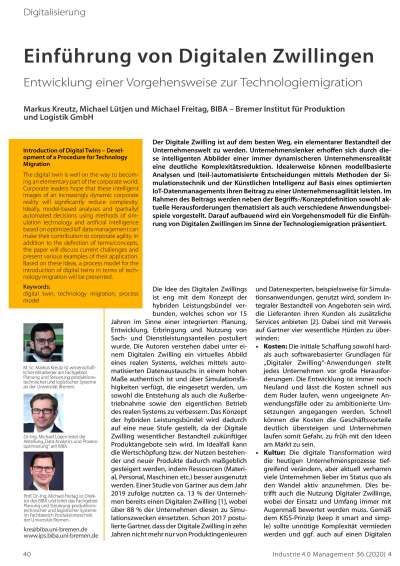
The digital twin is well on the way to becoming an elementary part of the corporate world. Corporate leaders hope that these intelligent images of an increasingly dynamic corporate reality will significantly reduce complexity. Ideally, model-based analyses and (partially) automated decisions using methods of simulation technology and artificial intelligence based on optimized IoT data management can make their contribution to corporate agility. In addition to the definition of terms/concepts, the paper will discuss current challenges and present various examples of their application. Based on these ideas, a process model for the introduction of digital twins in terms of technology migration will be presented.

Keywords

Access limited

You are currently not logged in / not yet registered.

In order to download the desired file(s), you must be logged in and have an appropriate inclusive subscription. Alternatively, you can also obtain access by paying a one-off fee.

Subscription included Purchase
without 29,00 €
Digital 27,55 €
Expert 26,10 €
Professional 0,00 €

Download for one time 29,00 €

All prices include 7% VAT

After purchasing access rights, you will automatically be redirected back to this page.


You might also be interested in

Serious Games as a Training Tool

Serious Games as a Training Tool

Game mechanics design to promote resilience
Annika Lange ORCID Icon, Thomas Knothe ORCID Icon
Unforeseen events are increasingly challenging manufacturing companies. Being resilient during crises is becoming a key competence. Serious games (SG) can help make resilience-building processes more transparent. This article derives specific requirements for SG from different phases of resilience and shows how these can be implemented in game mechanics in order to effectively support the training of resilience.
Industry 4.0 Science | Volume 42 | 2026 | Edition 2 | Pages 98-104
Experiencing Digital Twins in Production and Logistics

Experiencing Digital Twins in Production and Logistics

The fischertechnik® Learning Factory 4.0 as a development platform for possible expansion stages
Deike Gliem ORCID Icon, Sigrid Wenzel ORCID Icon, Jan Schickram, Tareq Albeesh
The fischertechnik® Learning Factory 4.0 has proven to be a suitable experimental environment for testing digital twins. Depending on the targeted maturity stage, the functions of a digital twin range from status monitoring and forecasting to the operational control of production and logistics systems. To systematically classify these functions, this article presents a maturity model that serves as a framework for the development of a digital twin. Building on this, selected use cases are implemented in a test and development environment based on a system architecture with multi-layered logic structure. These initial implementations serve to highlight application purposes, relevant methods, and typical challenges and potentials in the transfer to real factory environments.
Industry 4.0 Science | Volume 42 | Edition 2 | Pages 30-37 | DOI 10.30844/I4SE.26.2.30
From Brownfield to Industry 4.0

From Brownfield to Industry 4.0

Learning factories as training and testing environment for digital transformation
Jakob Weber, Sven Völker ORCID Icon
To succeed in their digital transformation, manufacturing companies need engineers with in-depth knowledge of key technologies and concepts, and a profound understanding of the transition from Industry 3.0 to Industry 4.0. This article describes the concept of a learning factory that is continuously subjected to a digital transformation, thereby creating an environment for the development of transformation competencies. The concept of digital transformation is based on digital worker assistance systems and multi-agent systems for production control. These enable the incremental integration of existing resources into the digitalized factory. The learning factory is not presented to students as a completed solution. Instead, it is continuously developed further as part of student projects. This way, it contributes directly to the qualification of personnel for the implementation of Industry 4.0.
Industry 4.0 Science | Volume 42 | 2026 | Edition 2 | Pages 88-96
AI Colleagues?

AI Colleagues?

Competence requirements and training for AI use in industry
Swetlana Franken ORCID Icon
Artificial intelligence is fundamentally changing tasks, roles, and skills in (industrial) companies. Increasingly, it acts as a colleague, preparing decisions, supporting processes, and interacting with people. This article highlights key competence requirements for AI use in industry, presents an integrated competence model, and outlines practical strategies for the transfer of skills. The aim is to prepare companies and employees for humane, competence-oriented AI implementation that combines technological efficiency with human creativity and judgment.
Industry 4.0 Science | Volume 42 | 2026 | Edition 2 | Pages 78-86
Operationalizing Ethical AI with tachAId

Operationalizing Ethical AI with tachAId

Validating an interactive advisory tool in two manufacturing use cases
Pavlos Rath-Manakidis, Henry Huick, Björn Krämer ORCID Icon, Laurenz Wiskott ORCID Icon
Integrating artificial intelligence (AI) into workplace processes promises significant efficiency gains, yet organizations face numerous ethical challenges that stakeholders are often initially unaware of—from opacity in decision-making to algorithmic bias and premature automation risks. This paper presents the design and validation of tachAId, an interactive advisory tool aimed at embedding human-centered ethical considerations into the development of AI solutions. It reports on a validation study conducted across two distinct industrial AI applications with varying AI maturity. tachAId successfully directs attention to critical ethical considerations across the AI solution lifecycle that might be overlooked in technically-focused development. However, the findings also reveal a central tension: while effective in raising awareness, the tool’s non-linear design creates significant usability challenges, indicating a user preference for more structured, linear guidance, especially ...
Industry 4.0 Science | Volume 42 | 2026 | Edition 1 | Pages 50-59 | DOI 10.30844/I4SE.26.1.48
AI Implementation in Industrial Quality Control

AI Implementation in Industrial Quality Control

A design science approach bridging technical and human factors
Erdi Ünal ORCID Icon, Kathrin Nauth ORCID Icon, Pavlos Rath-Manakidis, Jens Pöppelbuß ORCID Icon, Felix Hoenig, Christian Meske ORCID Icon
Artificial intelligence (AI) offers significant potential to enhance industrial quality control, yet successful implementation requires careful consideration of ethical and human factors. This article examines how automated surface inspection systems can be deployed to augment human capabilities while ensuring ethical integration into workflows. Through design science research, twelve stakeholders from six organizations across three continents are interviewed and twelve sociotechnical design requirements are derived. These are organized into pre-implementation and implementation/operation phases, addressing human agency, employee participation, and responsible knowledge management. Key findings include the critical importance of meaningful employee participation during pre-implementation, and maintaining human agency through experiential learning, building on existing expertise. This research contributes to ethical AI workplace implementation by providing guidelines that preserve human ...
Industry 4.0 Science | Volume 42 | 2026 | Edition 1 | Pages 120-127 | DOI 10.30844/I4SE.26.1.112