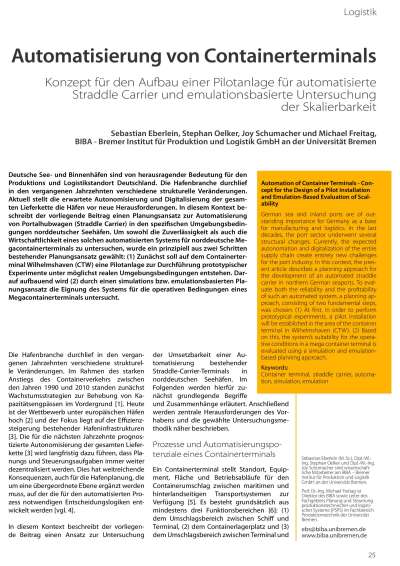
Automation of Container Terminals

Concept for the Design of a Pilot Installation and Emulation-Based Evaluation of Scalability

JournalIndustrie 4.0 Management
Issue Volume 34, 2018, Edition 6, Pages 25-29
Share Cite Download

Abstract

German sea and inland ports are of outstanding importance for Germany as a base for manufacturing and logistics. In the last decades, the port sector underwent several structural changes. Currently, the expected autonomation and digitalization of the entire supply chain create entirely new challenges for the port industry. In this context, the present article describes a planning approach for the development of an automated straddle carrier in northern German seaports. To evaluate both the reliability and the profitability of such an automated system, a planning approach, consisting of two fundamental steps, was chosen: (1) At first, in order to perform prototypical experiments, a pilot installation will be established in the area of the container terminal in Wilhelmshaven (CTW). (2) Based on this, the system’s suitability for the operative conditions in a mega container terminal is evaluated using a simulation and emulationbased planning approach.

Keywords

Access limited

You are currently not logged in / not yet registered.

In order to download the desired file(s), you must be logged in and have an appropriate inclusive subscription. Alternatively, you can also obtain access by paying a one-off fee.

Subscription included Purchase
without 29,00 €
Digital 27,55 €
Expert 26,10 €
Professional 0,00 €

Download for one time 29,00 €

All prices include 7% VAT

After purchasing access rights, you will automatically be redirected back to this page.


You might also be interested in

Optimized Manual Processes in Automotive Production

Optimized Manual Processes in Automotive Production

A module-based approach for the efficient creation of work system simulations
Barbara Brockmann, Tobias Jurk, Beate Stoffels, Jochen Deuse ORCID Icon
In the manufacturing industry, the integration of digital human models into the product development and manufacturing process is becoming increasingly important. Particularly in assembly, which is characterized by a high proportion of manual tasks, motion simulations enable a realistic representation of human work and thus make a significant contribution to the evaluation of motion economy, process validation, and efficiency improvement. However, widespread application in production planning faces various challenges, such as the high initial effort required to create human simulations as well as volatile planning conditions. This article presents a practice-oriented solution from the automotive assembly sector that enables the creation of simulations with reduced effort as well as their early and consistent use in the planning process.
Industry 4.0 Science | Volume 42 | 2026 | Edition 3 | Pages 48-55
XAI for Predicting and Nudging Worker Decision-Making

XAI for Predicting and Nudging Worker Decision-Making

Feasibility and perceived ethical issues
Jan-Phillip Herrmann ORCID Icon, Catharina Baier, Sven Tackenberg ORCID Icon, Verena Nitsch ORCID Icon
Explainable artificial intelligence (XAI)-based nudging, while ethically complex, may offer a favorable alternative to rigid, algorithmically generated schedules that simultaneously respects worker autonomy and improves overall scheduling performance on the shop floor. This paper presents a controlled laboratory study demonstrating the successful nudging of 28 industrial engineering students in a job shop simulation. The study shows that the observed concordance between students’ sequencing decisions and a predefined target sequence increases by 9% through nudging. This is done by using XAI to analyze students’ preferences and adjusting task deadlines and priorities in the simulation. The paper discusses the ethical issues of nudging, including potential manipulation, illusory autonomy, and reducing people to numbers. To mitigate these issues, it offers recommendations for implementing the XAI-based nudging approach in practice and highlights its strengths relative to rigid, ...
Industry 4.0 Science | Volume 42 | 2026 | Edition 1 | Pages 70-78
Improving Documentation Quality and Creating Time for Core Activities

Improving Documentation Quality and Creating Time for Core Activities

Success factors for implementing AI-based documentation systems in nursing care
Sophie Berretta ORCID Icon, Elisabeth Liedmann ORCID Icon, Paul-Fiete Kramer ORCID Icon, Anja Gerlmaier, Christopher Schmidt
Demographic change is accompanied by both a growing demand for care and a shortage of qualified nursing staff. Consequently, AI-based technologies are increasingly becoming a focus of care-related innovations. Their aim is to reduce workload pressure, save time, and enhance the attractiveness of the nursing profession. Using the example of AI-supported documentation systems for admission interviews, this article examines to what extent such systems can contribute to improvements in work processes and care quality, focusing on the perspectives of nursing professionals and nursing experts. The results indicate potential for workload relief, enhanced documentation quality, and the reallocation of time resources toward direct patient care. However, realizing these potentials requires a human-centered and context-sensitive implementation approach.
Industry 4.0 Science | Volume 42 | 2026 | Edition 1 | Pages 154-160 | DOI 10.30844/I4SE.26.1.146
Applied Knowledge and Augmented Reality

Applied Knowledge and Augmented Reality

Bridging the gap between learning and application
Jana Gonnermann-Müller ORCID Icon, Philip Wotschack, Martin Krzywdzinski ORCID Icon, Norbert Gronau ORCID Icon
The increasing complexity of industrial environments demands new competencies from workers, particularly the ability to interact with advanced digital systems. Traditional training methods often fall short in supporting the effective transfer of applied knowledge to such contexts, and the effectiveness of this transfer, as measured by performance-based outcomes, remains to be investigated. To address this gap, the present study employed a between-subjects experimental design comparing augmented reality- and paper-based instructions within a realistic production training scenario. The results show that participants who learned with augmented reality completed the production process significantly faster and with fewer errors than those using paper instructions. In addition, learners using augmented reality reported higher usability and experienced lower cognitive load during training. These findings suggest that augmented reality can enhance the transfer of practical skills in industrial ...
Industry 4.0 Science | Volume 41 | 2025 | Edition 5 | Pages 22-29 | DOI 10.30844/I4SE.25.5.22
Camera-Based Ergonomics Assessment

Camera-Based Ergonomics Assessment

Developing a method for use in manual assembly
Jannik Liebchen ORCID Icon, Burak Vur, Michael Freitag ORCID Icon
Targeted ergonomic design of workplaces and processes can counteract the challenges of manual assembly and improve working conditions. However, current expert ergonomics assessments are time-consuming and resource-intensive. This article presents an automated assessment method based on the Rapid Upper Limb Assessment (RULA). Results from a laboratory study within an assembly scenario are consistent with expert evaluations.
Industry 4.0 Science | Volume 41 | 2025 | Edition 5 | Pages 120-126 | DOI 10.30844/I4SE.25.5.116
Automation of Production Planning and Control

Automation of Production Planning and Control

A deep dive into production control with intelligent agents
Jonas Schneider, Peter Nyhuis ORCID Icon, Matthias Schmidt
How can artificial intelligence (AI) automate production planning and control? This study examines its potential to enhance efficiency in modern production environments. The focus is on establishing a robust data infrastructure that integrates real-time, historical, and contextual data to create a solid basis for AI models. Reinforcement learning (RL) is applied to aid automation. A roadmap for implementation, focusing on practical application, is presented. This roadmap incorporates simulation-based training methods and outlines strategies for continuous improvement and adaptation of production processes.
Industry 4.0 Science | Volume 41 | 2025 | Edition 5 | Pages 86-93 | DOI 10.30844/I4SE.25.5.84
This entry was posted in Uncategorized and tagged .