Urban Factory - Potentials of a New Factory Typology

JournalIndustrie Management
Issue Volume 30, 2014, Edition 4, Pages 11-15
Share Cite Download

Abstract

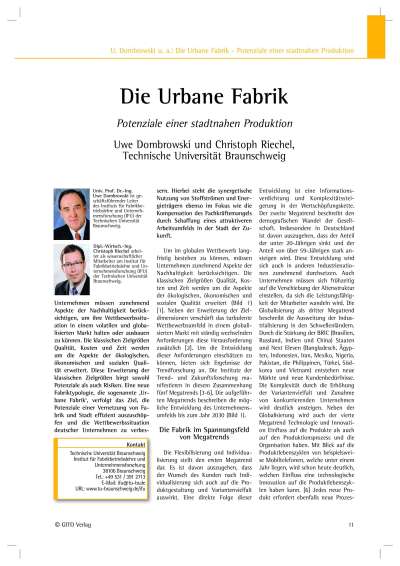
To remain competitive in a globalized market, enterprises must consider sustainably aspects. The classic aims of quality, costs and time are extended by aspects of the ecological, economic and social quality. The challenge to cope with these new dimensions aiming at long term success is raised by the turbulent influences in a global market with varying demands. A new factory typology, the so called urban factory, pursues the aim to exhaust the potentials of an interlinking of factory and town efficiently. The aim of this topology is to improve the competitive situation of enterprises. In this case the synergetic use of material and energy sources is in focus.

Keywords

Access limited

You are currently not logged in / not yet registered.

In order to download the desired file(s), you must be logged in and have an appropriate inclusive subscription. Alternatively, you can also obtain access by paying a one-off fee.

Subscription included Purchase
without 29,00 €
Digital 0,00 €
Expert 0,00 €
Professional 0,00 €

Download for one time 29,00 €

All prices include 7% VAT

After purchasing access rights, you will automatically be redirected back to this page.


Potentials: Profitability
Solutions: Production Control

You might also be interested in

Systematically Planning Vertical Factories

Systematically Planning Vertical Factories

Developing factory types as a foundation for intelligent planning support
Nikolaus Kremslehner ORCID Icon, Sebastian Schlund ORCID Icon, Wilfried Sihn
Vertical factories reduce land use and harness the advantages of urban production. However, their multi-story structure significantly increases planning complexity. To counter such effects, this paper presents a typology that combines proven solutions for recurring challenges in the planning and operation of vertical factories. Relevant characteristics were examined using real-world case studies and structured within a morphological framework. This framework was consolidated into factory types that provide guidance for conceptual planning and serve as the foundation for intelligent planning support.
Industry 4.0 Science | Volume 42 | 2026 | Edition 5 | Pages 68-76 | DOI 10.30844/I4SE.26.5.6
AI-Based Building Inspection for Large Structures

AI-Based Building Inspection for Large Structures

A new approach to construction progress monitoring
Jan Sender, Konrad Jagusch, Michael Geist ORCID Icon, David Jericho ORCID Icon, Christian Scharr ORCID Icon
Monitoring construction progress, as required in the one-off production of large structures, is very time- and labor-intensive due to a high level of complexity and individuality. The goal of this article is to develop a sensor-based approach for capturing and evaluating multiple inspection characteristics. The use of machine learning models to detect objects and derive relevant information forms the basis for linking current condition to construction schedule. This enables a significant increase in efficiency during construction progress monitoring and a well-founded assessment of progress.
Industry 4.0 Science | Volume 42 | 2026 | Edition 5 | Pages 78-84 | DOI 10.30844/I4SE.26.5.9
Enabling Digital Trust in Green Hydrogen Markets

Enabling Digital Trust in Green Hydrogen Markets

Trust-Building Information Systems and Mechanisms
Johanna Voß, Jens Pöppelbuß ORCID Icon
Building a global hydrogen economy requires more than technology and investment; it requires trust. As information systems (IS) increasingly mediate collaboration among unfamiliar, distributed actors, the question of how trust can be deliberately built becomes critical. This study systematically maps how IS enable different types of trust and reveals how these mechanisms can support trusting collaboration in emerging hydrogen value chains.
Industry 4.0 Science | Volume 42 | 2026 | Edition 4 | Pages 82-90 | DOI 10.30844/I4SE.26.4.9
Classification of Digital Supply Chain Management Platforms

Classification of Digital Supply Chain Management Platforms

Review of existing classification approaches from a circular economy perspective
Sophia Botsch ORCID Icon, Eva Mante ORCID Icon, Marcel Papert ORCID Icon, Alexander Pflaum ORCID Icon
Assessing the impact of digital industrial platforms on the dynamics and resilience of supply chains requires clear classification of such platforms. This article examines the extent to which a current classification proposal from the field of supply chain management must be further developed in the context of digital platforms for implementing the circular economy (CE). The authors conclude that a fundamental revision is not necessary, as the digital CE platforms under consideration fit well into the existing classification system. However, new research questions arise regarding the distinction between digital service platforms and digital data-oriented platforms, as well as the link between the circular economy and supply chain management—particularly in connection with supply chain control towers, which are becoming increasingly established in supply chain management practice.
Industry 4.0 Science | Volume 42 | 2026 | Edition 4 | Pages 62-70 | DOI 10.30844/I4SE.26.4.7
Site Assessment for Flexible Intralogistics in Brownfield Sites

Site Assessment for Flexible Intralogistics in Brownfield Sites

Innovative decision support in practice
Jolanda Schierbaum, Carsten Feldmann, Lars Renhof
Due to its dynamic environment, space planning in intralogistics is not a one-time task but a recurring decision-making process subject to numerous constraints imposed by existing infrastructure. Decisions are often based on incomplete data, resulting in a high risk of poor planning decisions and inefficient use of space. This paper presents a practice-oriented process model for space evaluation in brownfield projects. The proposed approach improves the standardization and consistency of space evaluation and promotes best practices among all stakeholders. By supporting systematic decision-making, the process model contributes to optimized planning and resource allocation, thereby reducing risks and avoiding costly implementation errors.The process model is demonstrated through a case study conducted at a commercial vehicle manufacturer.
Industry 4.0 Science | Volume 42 | 2026 | Edition 3 | Pages 124-133
Digital Twins for Emission Reduction

Digital Twins for Emission Reduction

Ex-ante case study on a pump test bench in industrial production
Felix Bischoff, Ingela Tietze ORCID Icon, Peter Hertweck, Nina van Hasz
Digital twins are frequently referred to as a promising approach for reducing greenhouse gas (GHG) emissions in industrial production; however, robust empirical evidence of their benefits under real-world conditions is largely lacking. In this case study, the emission reduction potential of a digital twin—as a conceptually described target system—is quantified ex-ante via the example of a test bench for hydraulic pumps. To this end, the GHG emissions of the original test plan for the year 2025 are determined based on actual measured energy consumption of the tested pumps and time-resolved grid electricity emission intensities. This is followed by a rule-based rescheduling, in which energy-intensive test processes are shifted to time intervals with lower emissions. The rescheduling takes operational constraints into account so that processes and equipment remain unchanged. The savings potential is determined by comparing the GHG emissions of the reference and the optimized case.
Industry 4.0 Science | Volume 42 | 2026 | Edition 3 | Pages 16-24 | DOI 10.30844/I4SE.26.3.2