Audio-Immersive Learning in Continuing Vocational Education |
From linear audio playback to AI-supported conversational learning companions

| Journal | Industry 4.0 Science |
| Issue | Volume 42, 2026, Edition 5, Pages 102-108 |
| Open Access | https://doi.org/10.30844/I4SE.26.5.12 |
| Bibliography | Share | Cite | Download |
Abstract
Keywords
Article
Continuing professional development has gained significant importance in recent years, and both research and practice are focusing on the question of how to structure skills development for current or future jobs. Accordingly, this issue is continually driven by trends and technological advances and, as such, gives rise to new debates [1]. Artificial intelligence (AI) is particularly noteworthy in this context [2, 3], as it influences future competency requirements (“future skills”) within organizations [4, 5].
In particular, digital competencies and the ability to use AI applications are increasingly prioritized in their portrayal as key topics for the future [5]. Furthermore, AI is also changing the requirements for continuing education formats and strategies [3] and is thus becoming an important companion and coach in the learning process, with whom one can discuss questions and topics [5, 6]. This, in turn, has implications for the future role of human instructors, who are being somewhat forced to address this technological shift in the learning process and adapt their offerings accordingly.
In addition to AI, the field of continuing vocational education is showing growing interest in audio-based microlearning formats [5, 7, 8]. Audio-based learning is particularly well-suited to work-integrated learning, enabling training on-the-job. Since it is screen-, hands-, and eyes-free, learners can engage with audio content while performing manual tasks—for example, in production—without interrupting the work process itself. In this way, learning becomes readily integrated into everyday work and can be seamlessly integrated in professional practice, thereby creating new opportunities for acquiring skills in the workplace [7, 8].
Empirical findings from the e-learning study reported in [8] also demonstrate that audio-supported learning formats outperform text-based formats, resulting in better knowledge retention, faster task completion, and greater transfer of acquired knowledge to the workplace [8]. Furthermore, audio narratives activate emotional and linguistic processing mechanisms that foster deeper mental representations, which are associated with enhanced long-term retention [9].
Discussing informal learning, [10] also show that, depending on the target group, setting, and design, audio can support comprehension and knowledge retention as effectively as—or even more effectively than—text. Furthermore, exploratory interview studies involving employees performing routine tasks indicate that speech- and audio-based learning formats are particularly well-received when they are embedded in work processes, can be accessed through voice interaction, and support different listening and learning modes, such as background listening and focused listening [7]. Against this backdrop, the use of generative AI—particularly in voice-controlled, conversational audio formats—appears to hold considerable potential for enabling an immersive yet work-integrated approach to competence development.
This article explores this interplay between audio-based learning and AI in vocational continuing education, presenting audio-immersive learning as a key future technology for work-integrated competency development.
The traditional linear approach to audio playback
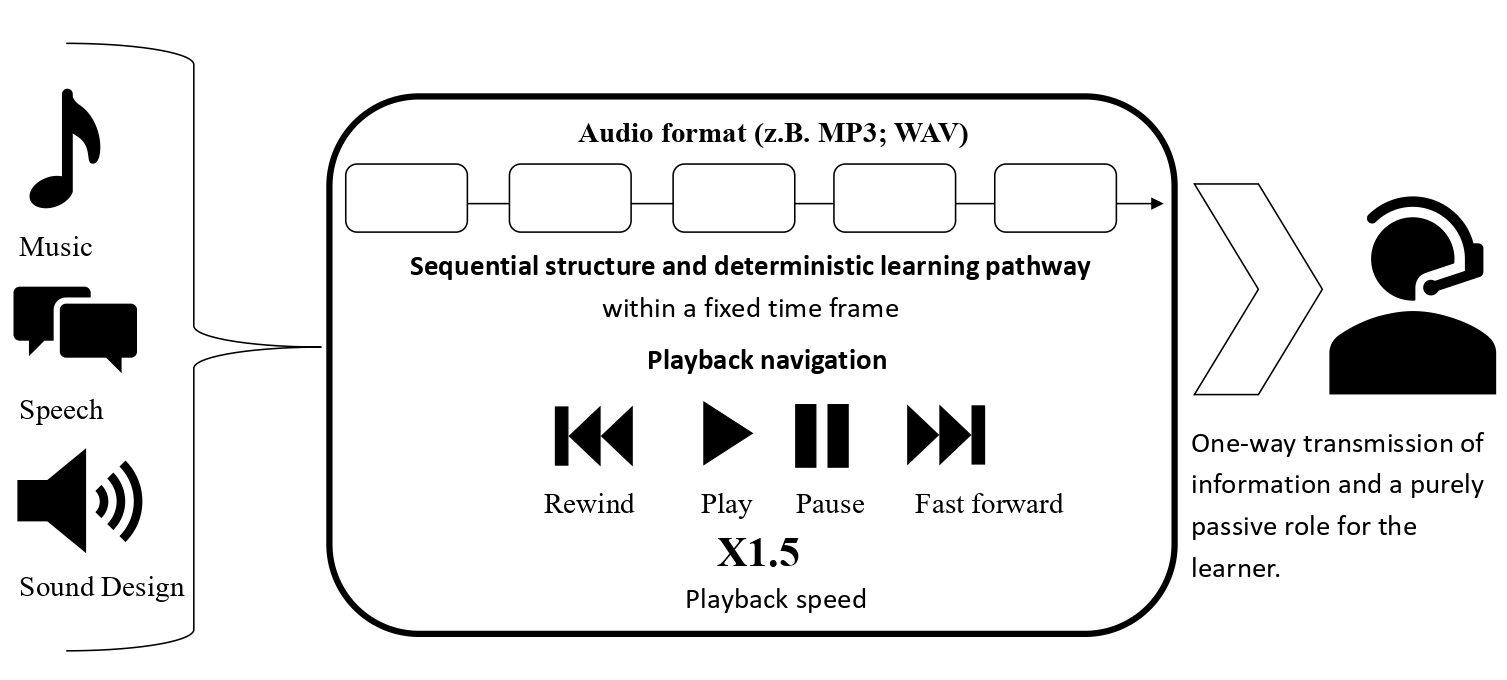
The current standard for audio-based continuing education is based primarily on linear approaches to audio playback. Within this traditional linear framework, audio content (speech, music, sound design) is compiled into a static audio file (e.g., MP3 or WAV format) within a fixed time frame—ranging from a few minutes for microlearning modules to hours for audiobooks [11].
The learner’s interaction with this traditional format is primarily limited to controlling the playback timeline. Users interact with the content through conventional playback controls, such as play, pause, and fast-forward or rewind navigation within the audio track. Additionally, adjusting the playback speed using time-stretching allows for individual regulation of the listening pace without affecting the pitch, thereby adapting information processing to the learner’s individual pace [12].
A key feature of this classical linear approach is the sequential chaining of learning units [13, 14]. The content is arranged in a fixed hierarchy (e.g., Chapter 1 follows the introduction, Chapter 2 follows Chapter 1, etc.). The learning path is thus deterministically predetermined. The structure of the information itself is therefore rigidly linked to the medium [14]. In this model, the audio format functions as a one-way information channel. The medium cannot respond to the user’s specific questions or level of knowledge, which leaves the learner with a largely receptive role [11]. The audio file remains unchanged throughout its entire usage period without any adaptation of the content taking place beyond the selection of the file.
Artificial Intelligence as a conversational learning companion
AI is evolving from a supportive tool into an active, conversational learning companion. In particular, the use of conversational agents, adaptive learning systems, and generative AI is enabling new forms of interaction in which learning is no longer merely one-sided but is continuously accompanied, reflected upon, and individually guided.
A key driver for this development is the ability of AI systems to personalize learning processes and respond in real time to individual needs. A qualitative literature review in [15] shows that AI-supported learning environments lead to improved learning outcomes among adults, particularly due to individualized learning pace and immediate feedback [15]. This form of responsive support is further enhanced by conversational AI: learners can ask questions at any time, delve deeper into content, and adapt their learning speed as needed.
The conversational nature of AI is particularly evident in the use of chatbots and intelligent tutoring systems. A scoping review by [16] demonstrates that conversational agents are primarily used as tutors and support learning processes through rapid access to information and increased interactivity [16]. These systems enable continuous, low-threshold interaction that integrates learning more effectively into everyday work life.
Furthermore, experimental studies show that conversational AI not only supports learning but can also significantly improve learning outcomes. In a randomized controlled trial, [17] evaluated an AI-supported tutor based on generative AI and evidence-based principles from educational and learning sciences, which offers personalized support and immediate feedback. Compared to an in-person course, the students achieved significantly greater learning gains in less time and reported higher engagement and stronger motivation. The authors mainly attribute these effects to personalized feedback and individual learning pace—key features of conversational learning assistants [17].
In addition to cognitive effects, conversational interaction with AI systems also influences affective factors in learning. A comprehensive meta-analysis by [18] demonstrates a strong positive effect of AI on learners’ self-confidence (Cohen’s d ≈ 1.24). AI systems promote self-efficacy, particularly through individualized scaffolding, continuous feedback, and the ability to autonomously manage learning processes [18]. At the same time, they create psychological safety by allowing learners to ask questions without fear of social judgment. This conversational interaction reduces anxiety, while also promoting active engagement with learning content.
In the context of vocational education and training, it is also evident that AI acts as a systemic driver of transformation. An international analysis by [19] identifies key areas of application such as personalized training delivery, automated competency assessment, and AI-supported learning guidance [19]. Evidence is particularly compelling in authentic learning contexts: learners who work with AI tools achieve significantly higher competence in performing complex tasks and benefit from improved transitions into the labor market.
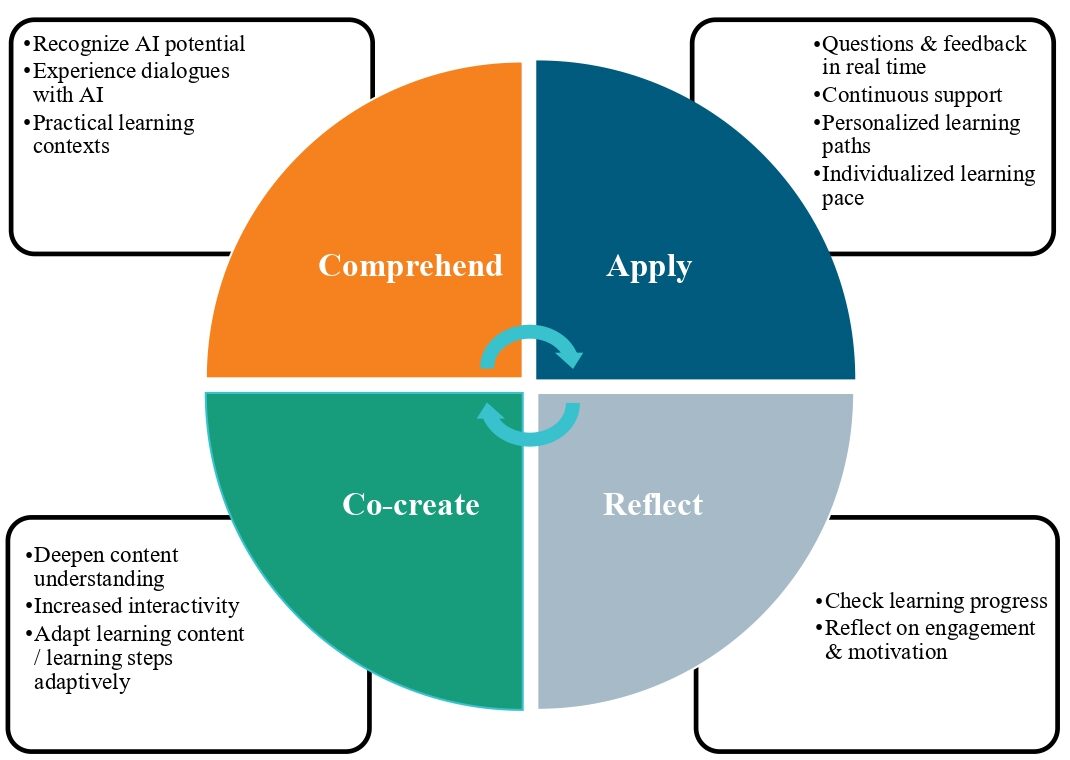
In summary, the studies presented illustrate that AI, as a conversational learning companion—particularly through personalization, immediate feedback, adaptive support, and continuous interaction—has the potential to positively influence both cognitive and affective learning processes [14, 16, 17]. Particularly in the field of continuing vocational education, AI has the potential to create new opportunities for self-directed, work-integrated, and needs-based learning [15, 18].
As Figure 2 shows, AI as a conversational learning companion can support learners throughout the entire learning process—from understanding and applying knowledge, through reflection, to actively shaping learning content. The potential lies primarily in the individual adaptation of learning processes, the promotion of engagement and motivation, and the continuous support of learning through conversational interaction.
AI-supported audio learning in continuing vocational education
A comparison of the traditional linear audio approach and conversational AI learning highlights a paradigm shift in continuing vocational education. While the conventional audio format is characterized by its linear structure and narrative coherence, AI learning guides offer the adaptability and interactivity necessary to overcome individual learning barriers.
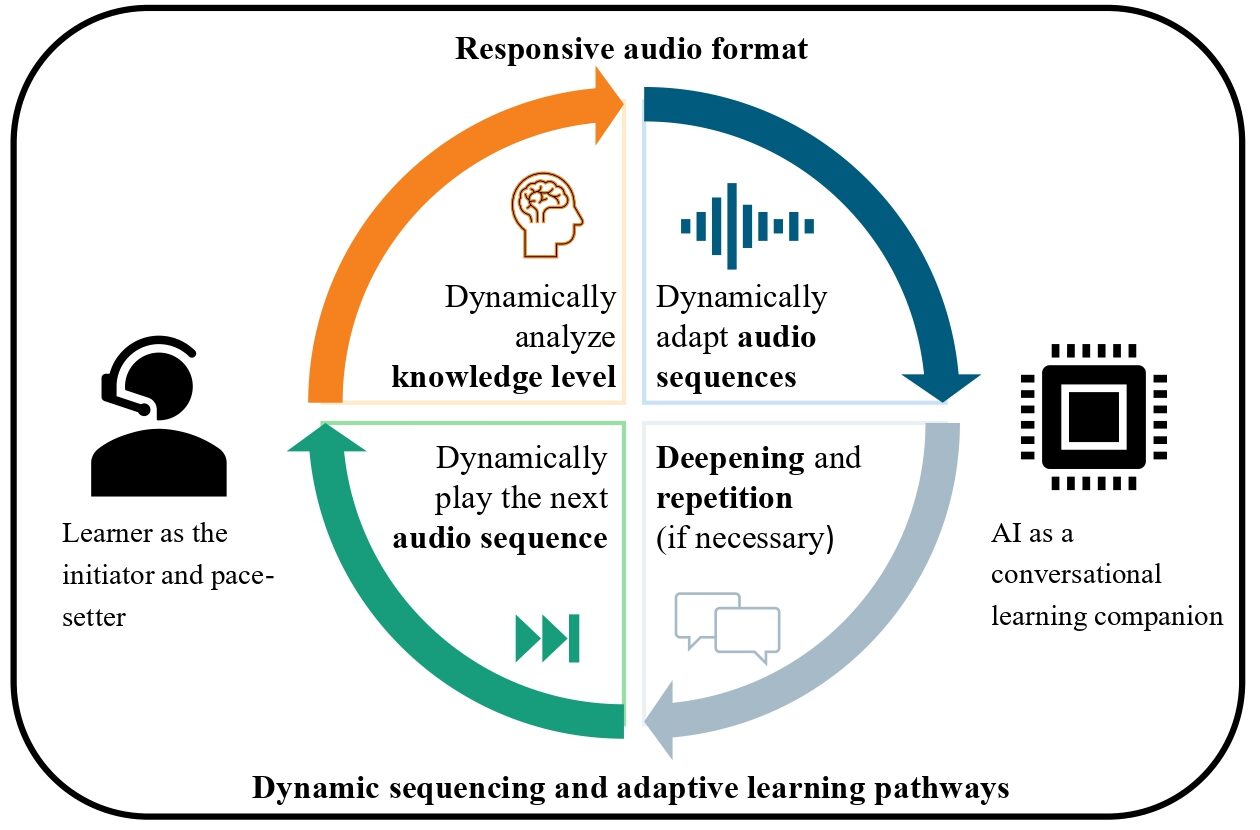
The synthesis of both approaches gives rise to the concept of AI-supported audio learning, illustrated in Figure 3. In this model, passive reception is thereby transformed into an active, adaptive, and interactive learning process. The primarily receptive role of the listener in the traditional linear model is expanded to include active participation in shaping their individual auditory learning path. Instead of a fixed, sequential arrangement of learning units and chapters, AI-supported audio formats enable dynamic sequencing.
Based on the user’s level of knowledge or questions, the system can adjust the sequence of audio nuggets in real time or generate in-depth explanations that were not originally included in the source file. This transforms audio from a static repository of content into a dynamic, responsive ecosystem that not only makes professional learning more efficient but also more accessible by reducing barriers to participation and technological complexity. Building on this conceptual framework, Figure 4 illustrates exemplary dimensions of the potential of AI-supported learning companions in the context of audio-based learning.
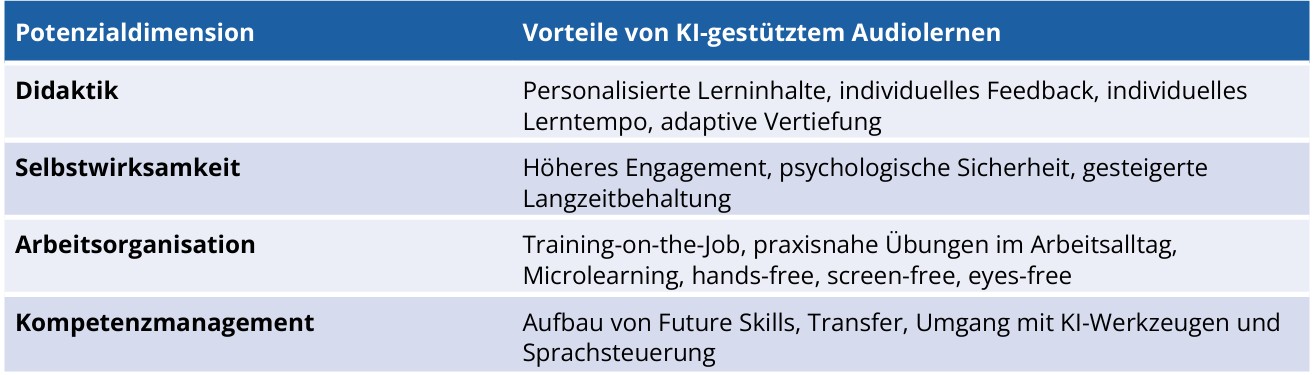
In summary, the convergence of audio training and artificial intelligence marks a turning point for work-integrated competency development. While conventional audio formats have long supported the flexibility required for training-on-the-job, integrating AI overcomes the remaining limitation of static content. As a result, audio evolves from a passive medium for information delivery into a proactive conversational learning companion.
In a working world increasingly shaped by future skills and the confident use of AI systems, dialog-based audio learning offers low-threshold access to complex content. It transforms microlearning from an isolated episode into continuous, voice-guided support that can be integrated into the workflow. This makes the vision of immersive, personalized learning a reality—one that not only enhances knowledge retention but also empowers learners to retrieve knowledge in context and deepen their understanding through direct conversational interaction. Ultimately, AI-supported audio learning is emerging as a key enabling technology capable of meeting the growing demands for dynamic, efficient, and learner-centered continuing vocational education and training.
Bibliography
[1] Beichter, T; Kaiser, M.: The Future of Upskilling: Human- and Technology Centered. 14th International Multi-Conference on Complexity, Informatics and Cybernetics. In: Callaos, N; Callaos, N; Hashimoto, S; Lace, N; Sánchez, B; Savoie, M. (Hrsg.): Proceedings of the 14th International Multi-Conference on Complexity,Informatics and Cybernetics: IMCIC 2023. International Institute of Informatics and CyberneticsWinter Garden, Florida, United States 2023, S. 190–193.
[2] Ersanlı, C; Çelik, F; Barjesteh, H; Duran, V; Manoochehrzadeh, M.: A review of global reskilling and upskilling initiatives in the age of AI. AI Ethics 5 (2025) 6, S. 5719–5728.
[3] Muehlemann, S.: Artificial intelligence adoption and workplace training. Journal of Economic Behavior & Organization 238 (2025), S. 107206.
[4] World Economic Forum: The Future of Jobs Report 2025 2025.
[5] Bitkom; HR Pepper: Weiterbildung im Wandel–Wie KI und Weiterbildung im Wandel – Wie KI und Digitalisierung das Lernen verändern 2025.
[6] Wang, S; Wang, F; Zhu, Z; Wang, J; Tran, T; Du, Z.: Artificial intelligence in education: A systematic literature review. Expert Systems with Applications 252 (2024), S. 124167.
[7] Ogunyemi, A; Bauters, M.: Audio-based learning at work: preliminary results of an exploratory interview study. 14th International Conference on Education and New Learning Technologies. In: Gómez Chova, L; López Martínez, A; Candel Torres, I.
(Hrsg.): EDULEARN22 Proceedings. IATED 2022, S. 1780–1787.
[8] Rautela, V.: Enhanced Learning Outcomes with Audio in E-learning: An Analysis. Int. J. Adv. Corp. Learn. 17 (2024) 4, S. 69–79.
[9] Palanisamy, B; V, R.: The listening renaissance: a theoretical exploration of audio-based digital narratives in literature. Humanit Soc Sci Commun 12 (2025) 1.
[10] Lewalter, D; Neubauer, K.: Informelles Lernen. In: Urhahne, D; Dresel, M; Fischer, F. (Hrsg.): Psychologie für den Lehrberuf. Springer Berlin Heidelberg, Berlin, Heidelberg 2025, S. 169–187.
[11] Şendağ, S; Gedik, N; Toker, S.: Impact of repetitive listening, listening-aid and podcast length on EFL podcast listening. Computers & Education 125 (2018), S. 273–283.
[12] Reichert, R.: Im Kino der Humanwissenschaften. Studien zur Medialisierung wissenschaftlichen Wissens. transcript 2007.
[13] Twyman, J.: The Evidence is in the Design. Perspectives on behavior science 44 (2021) 2-3, S. 195–223.
[14] Valle Torre, M; Oertel, C; Specht, M.: The Sequence Matters in Learning – A Systematic Literature Review. LAK ‘24: The 14th Learning Analytics and Knowledge Conference: Proceedings of the 14th Learning Analytics and Knowledge Conference. ACM, New York, NY, USA 2024, S. 263–272.
[15] Ritter, L.: The Impact of AI Tools on Adult Learning Outcomes in Online Education. International Journal of Research and Review (2026), S. 132.
[16] Pereira, D; Falcão, F; Costa, L; Lunn, B; Pêgo, J; Costa, P.: Here’s to the future: Conversational agents in higher education- a scoping review. International Journal of Educational Research 122 (2023), S. 102233.
[17] Kestin, G; Miller, K; Klales, A; Milbourne, T; Ponti, G.: AI tutoring outperforms in-class active learning: an RCT introducing a novel research-based design in an authentic educational setting. Scientific reports 15 (2025) 1, S. 17458.
[18] English, V.: The Effect of Artificial Intelligence on Student Confidence in Online Adult Learning: A Meta-Analysis and Systematic Review. 2641-533X 8 (2025) 8, S. 1–10.
[19] Leong, W.: Artificial Intelligence, Automation, and Technical and Vocational Education and Training: Transforming Vocational Training in Digital Era. ECEI 2025: ECEI 2025. MDPI, Basel Switzerland 2025, S. 9.
Your downloads
You might also be interested in