Tacit Talk |
A speech-based hybrid AI system for capturing tacit maintenance knowledge
 , Philipp Besinger, Joscha Zaremba
, Daniel Valtiner
, Michael Necemer
, Safa Omri
, Jens Neuhüttler
, Fazel Ansari, Katharina Hölzle
, Philipp Besinger, Joscha Zaremba
, Daniel Valtiner
, Michael Necemer
, Safa Omri
, Jens Neuhüttler
, Fazel Ansari, Katharina Hölzle
| Journal | Industry 4.0 Science |
| Issue | Volume 42, 2026, Edition 5, Pages 82-90 |
| Open Access | https://doi.org/10.30844/I4SE.26.5.16 |
| Bibliography | Share | Cite | Download |
Abstract
Keywords
Article
Much of the expertise that keeps industrial maintenance running is never written down. Experienced technicians rely on intuition, sensory cues, and improvised workarounds—knowledge that is deeply personal and context-dependent. Whether as a result of retirement, turnover, or increasing specialization, organizations face a compounding risk: critical know-how disappears when the people who hold it do. Beyond demographic change, rising system complexity means that even stable teams struggle to document expertise that resists formalization [1]. Conventional approaches such as wikis, static documentation, or informal mentoring have shown limited success in capturing this experiential knowledge [2].
Existing AI-assisted knowledge management approaches presuppose that knowledge already exists in a structured form; systematically capturing new tacit knowledge from workers without disrupting operational workflows remains largely unaddressed. Speech-based interaction, however, offers a promising path, lowering the documentation threshold for hands-occupied workers and enabling knowledge capture at the moment of greatest relevance.
Building on prior work on AI-assisted knowledge management in maintenance [3], this article presents Tacit-TALK, a speech-based system that enables technicians to externalize tacit knowledge through natural, AI-guided conversation. Recognizing that knowledge capture in operational settings is as much an organizational challenge as a technical one, the system design adopts a sociotechnical lens throughout, balancing automation with human agency and individual contribution with collective benefit. The system was designed following a design science research methodology and is instantiated as a proof-of-concept in semiconductor maintenance.
The article’s primary contributions are:
- sociotechnical design principles for AI-supported tacit knowledge capture,
- a reference architecture combining LLMs with a persistent knowledge graph for operational maintenance settings, and
- preliminary prototyping insights into user acceptance and organizational implications.
Tacit knowledge and knowledge loss in organizations
The distinction between tacit and explicit knowledge, rooted in Polanyi’s observation that “we can know more than we can tell,” remains foundational to knowledge management research [4, 5]. Knowledge loss through employee exit leads to measurable declines in productivity and organizational capability [6].
Knowledge Management 4.0 reframes this challenge, making it a strategic function of smart factories to balance knowledge generation and utilization across human-machine collectives [7]. While behavioral approaches such as gamification and nudging have been explored to incentivize knowledge sharing [8], they do not address the fundamental difficulty of externalizing embodied, context-specific expertise in operational maintenance environments.
Recent advances in large language models (LLMs) and retrieval-augmented generation (RAG) have opened new avenues for knowledge management (KM) in industrial maintenance. RAG-grounded generation reduces hallucination in maintenance instructions and actions, and domain-specific LLMs have been developed for semiconductor applications [9, 10]. However, all these approaches presuppose that knowledge already exists in a structured form—none address the capture of new tacit knowledge through natural interaction. Our prior work laid the groundwork by identifying requirements for integrating LLM-based extraction into organizational knowledge bases [3].
Most KM systems rely on text-based input, posing a barrier for technicians whose hands are occupied. Prior work on voice annotation in CAD environments has shown that speech provides a more natural, low-barrier modality [11], but the concrete extraction of structured tacit knowledge from unstructured speech is yet to be addressed. This is the gap that Tacit-TALK aims to fill.
Design science research methodology
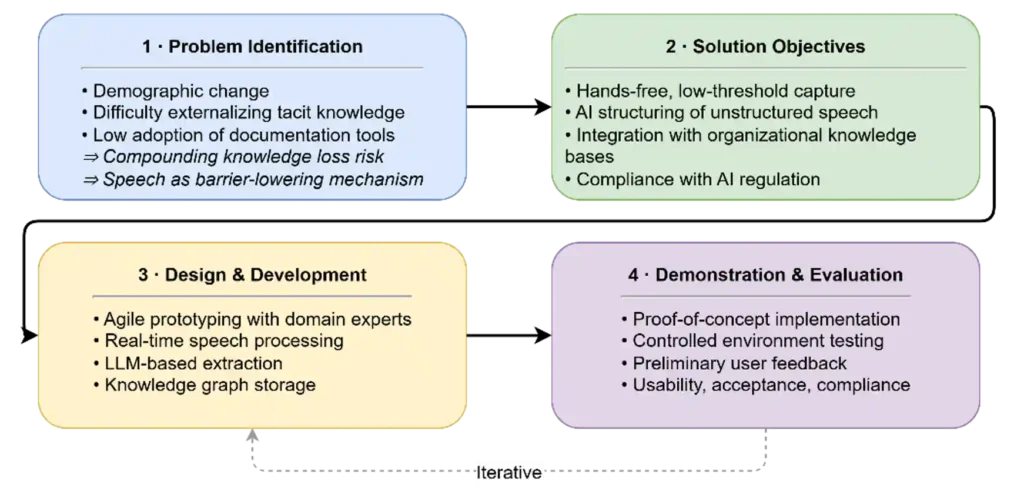
This research follows the design science research (DSR) paradigm [12, 13], chosen because an artifact that must function within a complex sociotechnical work system requires iterative cycles of design, demonstration, and evaluation rather than purely explanatory research. The process comprises four iterative phases (see Fig. 1).
We adopted a value-based engineering approach to prioritize stakeholder values and business objectives in the requirements elicitation process [14].
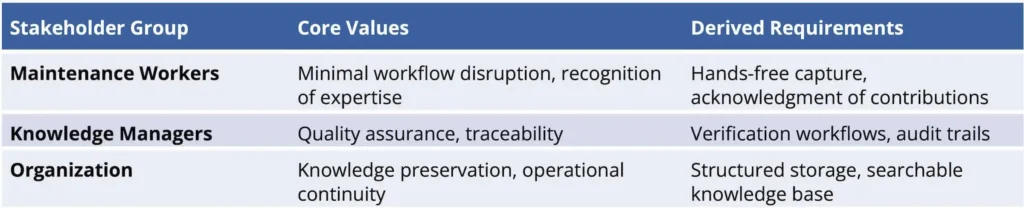
The mapping (Fig. 2) revealed three inherent tensions:
- ease of use versus data quality (simplified input may reduce granularity),
- automation versus control (AI structuring may introduce errors), and
- openness versus privacy (sharing must respect data concerns).
Applying a value-weighted prioritization, we identified four critical requirements in descending priority:
- speech-based input with real-time transcription feedback,
- human-in-the-loop verification before knowledge becomes official,
- transparent AI processing with explainable outputs, and
- role-based access control with clear data ownership.
To translate identified values into concrete design decisions, we constructed four representative personas based on role profiles identified during structured workshops with maintenance managers and team leads at the semiconductor partner site. Each persona synthesizes observed characteristics, constraints, and motivations of actual user groups:
- a maintenance worker with limited documentation time and concerns about surveillance,
- a generic user wishing to record spontaneous insights,
- a verifier responsible for validating entries against consistent standards, and
- a new user focused on confident onboarding.
Using these personas, we conducted user journey mapping sessions to identify interaction touchpoints and design requirements across five journey phases. Goals, pain points, and design responses are summarized in Figure 3.
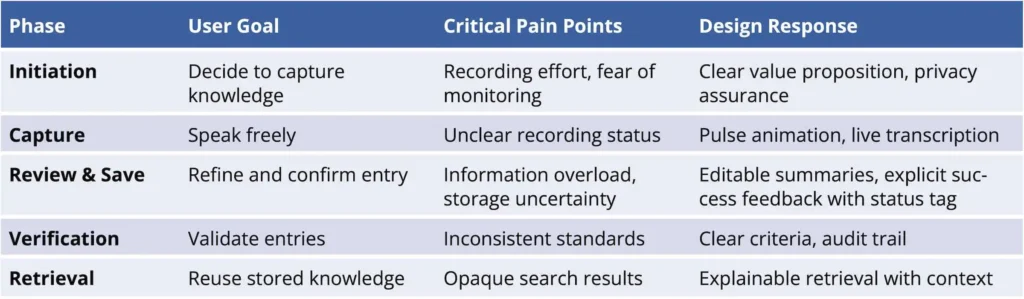
Three cross-cutting insights shaped the subsequent design. Users require immediate visual feedback during speech capture to trust that the system is working. The distinction between unverified and verified status must be communicated transparently to prevent anxiety about lost or rejected contributions.
Finally, the retrieval phase must provide transparent reasoning for suggested connections so that users understand why certain entries are surfaced. These design choices are described in more detail later on.
System design
The system extends existing maintenance ontologies to accommodate tacit knowledge artifacts captured through conversational interaction. The data model is implemented as a labeled property graph, enabling both structured queries and semantic similarity search. The traditional maintenance ontology is extended with concepts specifically designed to capture implicit, experience-based knowledge:
Insight
├── problem_context # Trigger
├── action_taken # Response
└── lesson_learned # Takeaway
TacitCategory
├── Deviation # Differs from SOP
├── Intuition # Gut feeling
├── Hack # Workaround
├── Info_Gap # Undocumented
└── Hot_Fix # Emergency solution
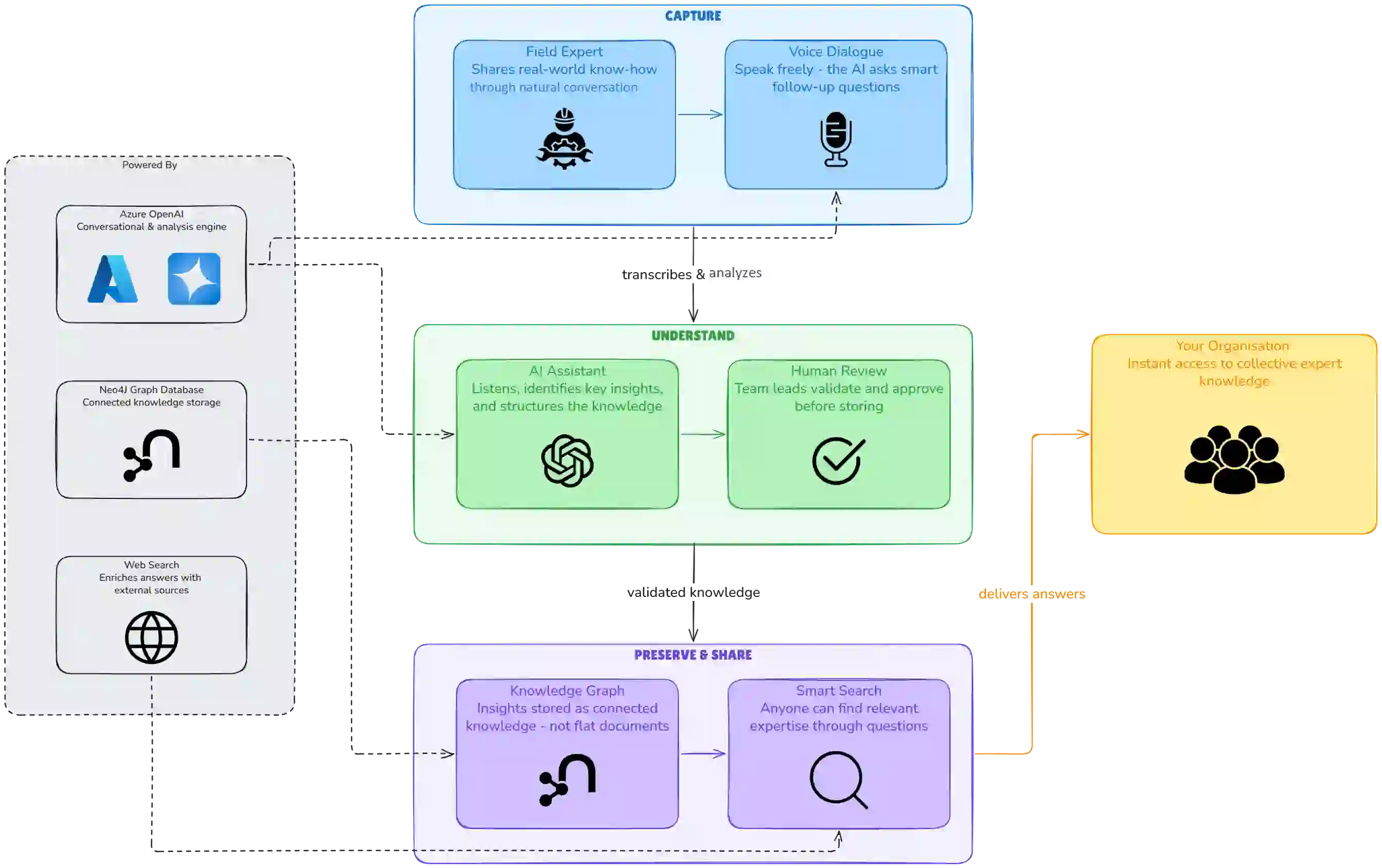
The architecture integrates three subsystems (see Fig. 4):
- a speech processing pipeline for real-time transcription and voice dialogue;
- an LLM orchestration layer managing dialogue state, elicitation technique selection, and structured extraction;
- a knowledge graph persistence layer linking new insights to existing organizational data through embedding-based entity matching.All nodes carry vector embeddings, enabling Graph RAG retrieval: query-matched nodes and their graph neighborhoods are fused as contextually enriched input for answer generation.
All nodes carry vector embeddings, enabling Graph RAG retrieval: query-matched nodes and their graph neighborhoods are fused as contextually enriched input for answer generation.
Proof of concept
The proof-of-concept implementation of Tacit-TALK is deployed as a web application (see Fig. 5).
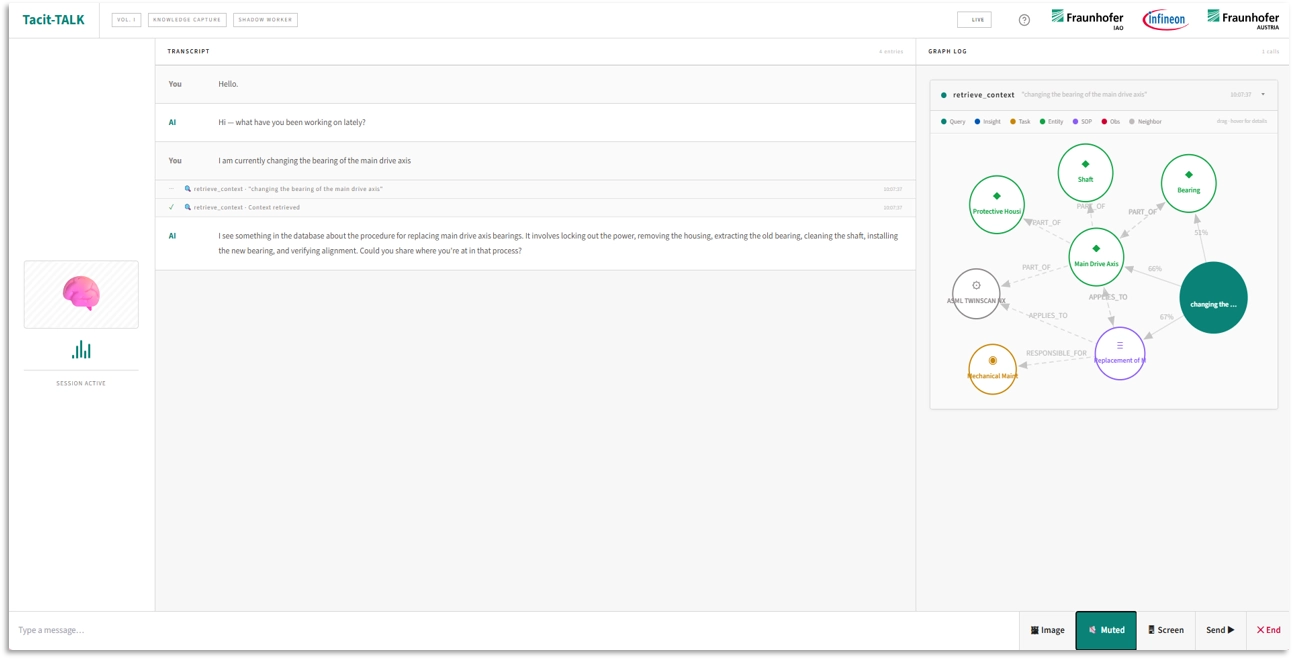
A typical capture session begins when a technician initiates a new recording after completing a maintenance task. The system greets the user by voice with an open-ended prompt. As the technician speaks, live transcription is displayed on screen, providing continuous feedback. The conversational agent then guides the dialogue as described in the remainder of this section.
Upon completion, the system generates a structured summary for review and editing, reinforcing the human-in-the-loop principle. The resulting Insight node is stored with the status Unverified. For example, a captured entry might document an emergency bearing replacement, classified as an Intuition-type insight, containing the triggering condition (e.g., sensor flag), the action taken, and a transferable lesson about lubrication alignment.
Tacit-TALK’s AI-guided conversation systematically elicits tacit knowledge while preserving the natural feel of a spoken exchange. The dialogue design follows four principles:
- posing one question at a time to prevent cognitive overload,
- adapting follow-ups based on conversation state and knowledge gaps,
- intervening only when genuinely needed to avoid the feeling of an interrogation, and
- allowing graceful termination at any point so that partial captures remain valuable.
A prompt sequencer operationalizes these principles by rotating through empirically grounded elicitation techniques spanning situational recall, reasoning and decision-making, and knowledge transfer. The sequencer selects techniques based on which dimensions—problem context, action rationale, transferable lesson—remain sparse. A state machine transitions the dialogue from an open-ended narrative phase through a follow-up loop, including clarification and graph-based context retrieval, to summary generation and user confirmation.
The proof of concept demonstrates how captured insights are woven into the organization’s existing knowledge graph. The extraction module identifies references to machines, components, and tools and matches them against existing graph nodes using embedding-based cosine similarity, accounting for the inherent imprecision of spoken language. A new entity node is created only when no match exceeds a high confidence threshold, preventing both duplicate proliferation and erroneous merges. Every entry is linked to its authenticated creator, enabling expertise discovery while restricting worker-identifying details to appropriate access roles.
Each new Task is automatically compared to embeddings of existing SOP documents. When similarity is sufficiently high, a RELATED_SOP relationship is created, subject to verifier confirmation. Over time, this produces an SOP enrichment effect: formal procedures are progressively augmented with experiential annotations, capturing what documentation alone does not convey.
Discussion, limitations, and conclusion
Tacit-TALK demonstrates that speech-based, AI-guided interaction is viable for tacit knowledge capture in industrial maintenance. This gap was identified but unaddressed in existing AI-assisted KM research, which presupposes already-structured input [9, 10]. Unlike prior voice annotation work, which was limited to explicit design artifacts [11], our system employs LLM-guided elicitation to surface knowledge that workers themselves may not recognize as documentable.
The value-based requirements engineering process revealed that the central design challenge is not technical feasibility but sociotechnical balance: users are willing to share knowledge when the system is perceived as a tool for recognition rather than surveillance, and when documentation effort remains below the threshold of workflow disruption. This aligns with Knowledge Management 4.0 principles that position knowledge processes as collaborative human-machine functions [7].
Deploying speech-based capture in semiconductor maintenance introduces domain-specific challenges that extend beyond standard speech recognition. Technicians routinely mix languages—German syntax interspersed with English technical terms produces utterances such as “Fehler am Platen behoben” or “Crash nach Aligner Error”—requiring robust multilingual and code-switching capabilities in the transcription pipeline. High ambient noise levels on the factory floor and the use of clean room suits, which muffle speech and obscure facial cues, further degrade recognition accuracy. Addressing these constraints will likely require targeted evaluation and architectural adaptations such as noise-robust speech models and domain-specific vocabulary fine-tuning.
Several additional limitations must be acknowledged. The current proof of concept has not yet undergone structured empirical evaluation; findings regarding user acceptance and knowledge quality remain preliminary. Furthermore, the system’s graph integration presupposes existing structured organizational data such as equipment registers, SOPs, and work orders; organizations with sparse knowledge bases may see limited benefit. Future work will address empirical evaluation with technicians, multimodal input combining speech with sensor data, and an ontology refinement based on field experience.
To conclude the findings of this article for now, it can be argued that effective externalization of tacit maintenance knowledge requires not only technical capability but deliberate sociotechnical design. Tacit-TALK offers a replicable, DSR-grounded approach for organizations seeking to preserve operational expertise amid demographic change and increasing system complexity.
Bibliography
[1] Fenoglio, E.; Kazim, E.; Latapie, H.; Koshiyama, A.: Tacit knowledge elicitation process for industry 4.0. In: Discov Artif Intell 2 (2022) 1, doi: 10.1007/s44163-022-00020-w.[2] Lin, Y.; Shahhosseini, A. M.; Badar, M. A.; Foster, T.; Dean J.: A concept map-based cognitive framework for acquiring expert knowledge in industrial environment. In: 2016 IEEE frontiers in education conference (FIE) (2016), pp. 1–5.
[3] Guhl, J. et al.: Integrating Knowledge Graphs and Large Language Models for Enhanced Human-Centered Knowledge Management in Industrial Maintenance: A Case Study. In: Human-Computer Interaction – Part III. HCII 2026. Lecture Notes in Computer Science 16703. Springer, 2026.
[4] Mohajan, H.: A Comprehensive Analysis of Knowledge Management Cycles. In: Journal of Environmental Treatment Techniques 4 (2016), pp. 121–129.
[5] Olomolaiye A.; Egbu, C.: Tacit vs. explicit knowledge – the current approaches to knowledge management. 2005. URL: https://api.semanticscholar.org/CorpusID:85554607
[6] Massingham, P.: Measuring the Impact of Knowledge Loss: A Longitudinal Study. In: Journal of Knowledge Management 2018, doi: 10.1108/jkm-08-2016-0338.
[7] Ansari, F.: Knowledge Management 4.0: Theoretical and Practical Considerations in Cyber Physical Production Systems. In: IFAC-PapersOnLine 52 (2019) 13, pp. 1597–1602, doi: 10.1016/j.ifacol.2019.11.428.
[8] Shi, S. J.; Li, J. W.; Zhang, R.: A study on the impact of Generative Artificial Intelligence supported Situational Interactive Teaching on students’ ‘flow’ experience and learning effectiveness — a case study of legal education in China. In: Asia Pacific Journal of Education 44 (2024) 1, pp. 112–138, doi: 10.1080/02188791.2024.2305161.
[9] Tao L. et al.: LLM-R: A Framework for Domain-Adaptive Maintenance Scheme Generation Combining Hierarchical Agents and RAG. 2024.
[10] Nguyen C. et al.: SemiKong: Curating, Training, and Evaluating A Semiconductor Industry-Specific Large Language Model. 2024.
[11] Camba, J. D.; Naya, F.; Perez-Lopez, D.; Contero, M.: From Voice to Knowledge: A Proposal for a Voice Annotation System to Support Collaborative Engineering Design Processes. In: Proceedings of the 53rd Hawaii International Conference on System Sciences (2020).
[12] Hevner A. et al.: Design Science in Information Systems Research. In: Management Information Systems Quarterly 28 (2004), p. 75.
[13] Peffers, K.; Tuunanen, T.; Rothenberger, M.; Chatterjee, S.: A design science research methodology for information systems research. In: Journal of Management Information Systems 24 (2007), pp. 45–77.
[14] Spiekermann, S.: Value-Based Engineering. De Gruyter 2023.
Potentials: Management
You might also be interested in