
AI-Based Recommender Systems in Product Development |
A framework for knowledge discovery from multimodal data in industrial applications

| Journal | Industry 4.0 Science |
| Issue | Volume 41, 2025, Edition 5, Pages 94-101 |
| Open Access | https://doi.org/10.30844/I4SE.25.5.94 |
| Bibliography | Share | Cite | Download |
Abstract
Keywords
Article
Challenges for efficient product development
Engineering design is a complex, knowledge-intensive and iterative process, typically divided into conceptual and detailed design [1]. It is part of the broader product development process, including tasks inter alia requirements management, variant configuration, and cost estimation [2]. These processes are particularly demanding in engineer-to-order (ETO) environments, where high product customization limits the potential for economies of scale and increases engineering effort due to individualized steps. In times of increased competition, ETO companies must reduce development time while preserving quality and cost targets to remain competitive [3].
Design reuse has emerged as a key strategy in this context, since reusing existing models can reduce development time by 30 to 80% compared to designing a product from scratch [4]. However, especially in early design phases, the practical implementation of reuse strategies remains challenging, as they are characterized by heterogeneous and often incomplete data inputs such as textual requirements or schematic drawings [5].
The absence of a unified repository of reusable design elements often leads to manual search efforts for historical data including past requirements, bill of materials (BOM), Computer Aided Design (CAD) models and design rationales. Such data is often fragmented, inconsistently stored across systems, or available only in unstructured formats such as drawings, scanned documents, or PDFs [6]. These conditions complicate the analysis and retrieval of useful design knowledge and limit the potential for reuse [7].
Recent advancements, especially in artificial intelligence (AI), offer promising pathways to address these issues in data collection and provision [8]. AI enables the analysis of unstructured data, the combination of multiple data sources and the recognition of patterns in historical projects [9]. Leveraging these capabilities facilitates the generation of time-saving recommendations, including the reuse or adaptation of existing designs, for product development [10].
This paper builds upon these initiatives by introducing a methodological framework for an AI-based recommender system combining multiple data sources to support design reuse and reduce development time. The remainder of this paper is structured as follows: Section 2 provides an overview of the current state of the art regarding the integration of AI in the product development process. Section 3 proposes a methodological framework for the integration of a recommender system, while Section 4 illustrates its application in a selected use case. Finally, Section 5 discusses the results and outlines future research potential.
State of the art in AI integration in product development
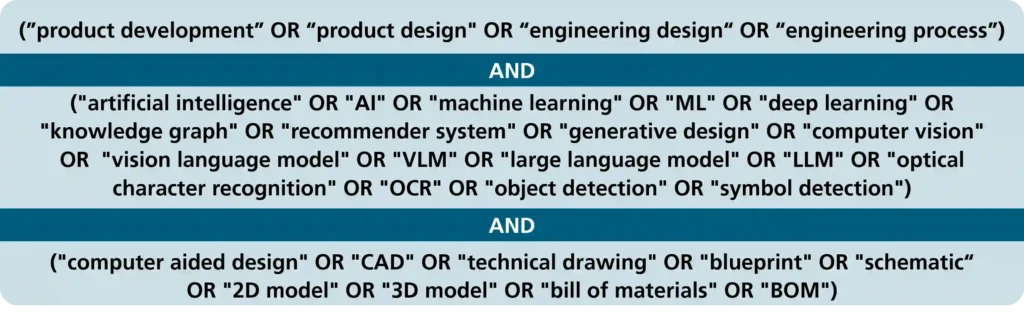
To gain an overview of the current AI applications for product development, the methodology proposed by Zonta et al. [11] is employed. The review aims to identify AI techniques that support key engineering tasks across various stages of the product development process. The search string (see Fig. 1) is designed to capture the intersection of AI technologies, engineering artifacts (for example CAD models, technical drawings) and product development activities across key stages including conceptual design, detailed design and documentation.
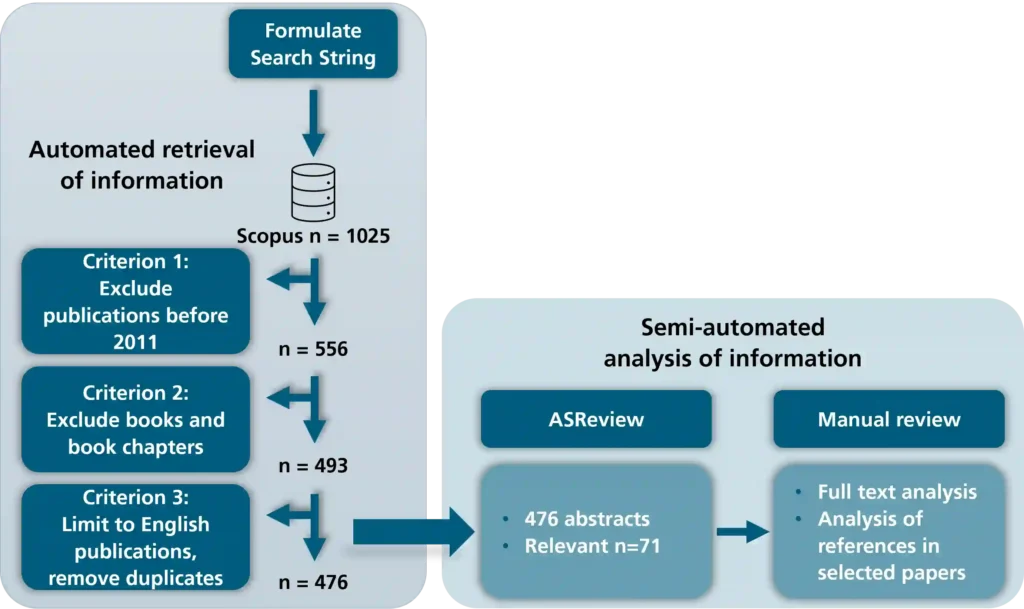
Additionally, filter criteria (see Fig. 2) are applied to ensure the relevance and quality of the literature. Publications written before 2011 are excluded to focus on modern AI methods, as deep learning gained significant attention around this time. Further, books and book chapters are excluded, and the search is limited to papers written in English.
The search, executed in the Scopus database, returned 1,025 results, which are reduced to 476 by applying the filter criteria and removing duplicates. The abstracts of these 476 are systematically screened and labelled using the tool ASReview [12] to identify studies that apply AI to functional representations, excluding those focused on simulations or visual content generation (for example image creation to explore design options). Applying a data-based strategy [12] led to the selection of 71 publications for full text analysis after encountering 60 consecutive irrelevant results. The full screening process is shown in Figure 2.
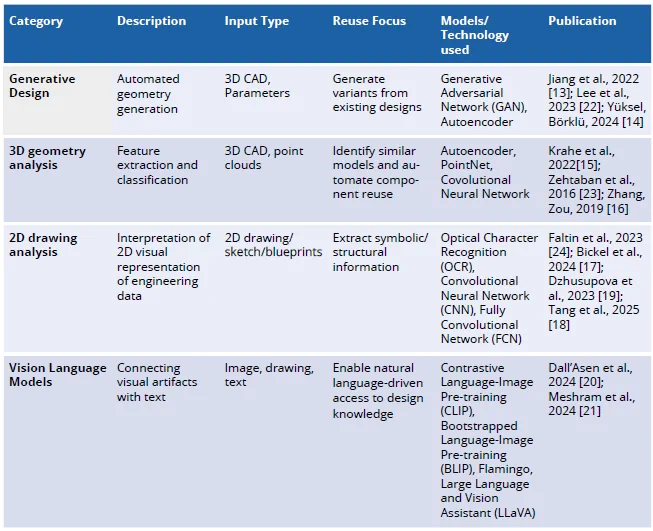
From the 71 relevant sources, three main categories of AI applications emerged: i) generative design, ii) 3D geometry analysis, and iii) 2D drawing and image analysis. These categories were derived based on clustering the identified contributions by type of input data, AI technique used and reuse potential. Figure 3 provides a subset of the nine most representative publications, selected from the 71 relevant sources, that exemplify key methods and technologies.
Generative design methods aim to automatically generate geometry based on input constraints and user-defined goals [13,14,22]. While powerful, these methods typically require complete, parametric input and are oriented toward geometry creation rather than knowledge reuse. 3D geometry analysis focuses on identifying and retrieving geometrically similar parts within CAD databases using deep learning or feature-based methods [15,16,23]. These methods support standardization and component reuse but are often format-specific and context-independent.
2D analysis, including symbol and drawing interpretation, employs Optical Character Recognition (OCR) and Convolutional Neural Networks (CNN) for component recognition, error detection and vector extraction [17-19]. Recently, Vision Language Models (VLMs) have emerged to enable multimodal understanding and natural language interaction with visual data [20, 21].
While these approaches represent significant progress and show promising results in isolated application domains, most solutions suffer from limited interoperability and a lack of data integration across modalities. Moreover, they often fail to incorporate feedback mechanisms or handle typical ETO conditions, with incomplete, fragmented input and inconsistent formats, effectively. Although standards like STEP (Standard for the Exchange of Product model data) exist, data exchange is often limited to 2D images or PDFs. Software dependencies, incompatible formats and partial data exchange remain key barriers to broadly applicable AI-based recommender systems [25,26]. These limitations reveal a gap in terms of the lack of an integrated, multimodal recommender system for early-stage design reuse in ETO environments.
Recommender system for product development
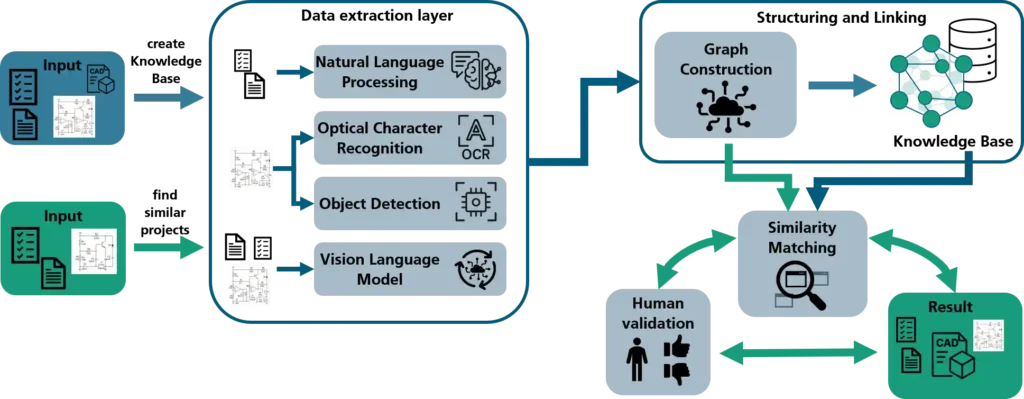
To address the fragmentation and modality-specific nature of current AI applications in design reuse, this section presents a methodological framework for a multimodal AI-based recommender system, facilitating early-stage design reuse. It operationalizes insights from the literature by building on methods used for symbol detection [17-19], geometry analysis [15,16] and multimodal understanding [20,21] and combining them into an integrated, feedback-enabling system. Figure 4 illustrates the framework, which is based on three core pillars: i) the use of neutral data formats, ii) semantic structuring and linking, and iii) similarity-based retrieval.
A data extraction layer processes geometric, visual and textual information in complementary processing paths, each addressing different challenges. Information from textual data in PDF format is extracted using Natural Language Processing (NLP), while visual and geometric information from images is processed using OCR and object detection. OCR is used to extract text and the corresponding bounding boxes of the text elements, enabling the creation of links between text and visual elements based on the position. For object detection, a neural network is used to classify, for example, components and their connections and the result is linked to the textual data. The extracted elements are stored in a graph-based structure to support semantic querying and similarity comparisons.
In parallel, a VLM encodes the same raw inputs and generates multi-modal embeddings that allow abstract and flexible similarity matching, even when symbolic methods fail due to incomplete or noisy data. In comparison to the structured graph representation, the VLM provides a complementary, sub-symbolic view of the project.
The outputs are combined using a hybrid approach to support explainable semantic reasoning via graph-based matching and flexible pattern recognition thanks to the VLM’s generalization ability across modalities. To ensure adaptability in practical settings, the framework also includes a human-in-the-loop mechanism, where domain experts can validate and refine recommendations, contributing to system improvement over time.
Together, these components form an extendable knowledge base of historical projects and design solutions. For each new product development case, incoming data (for example drawings, BOM, requirements, regulations) is processed, matched to the knowledge base via the different paths and ranked recommendations are returned. This enables faster identification of suitable past designs, reduces redundancy and improves knowledge reuse.
Use case: Application within the electronic industry
To illustrate the application of the proposed methodological framework, this section presents a hypothetical use case scenario in the electronic industry. The objective is to demonstrate how the system components interact in a realistic ETO setting. The process for this use case is analogous to the visualization in Figure 4.
In this scenario, a manufacturer handles project-specific requests and develops components based on textual specifications and schematic drawings of circuit diagrams. Requirements and BOM are provided in PDF format, and the textual data is processed using NLP methods to extract key requirements, components and constraints. The visual input in the form of schematic drawings originates from CAD tools and is converted to images before being processed. OCR is used to extract labeled text regions while, in preparation for object detection, endpoints of lines are detected as potential candidates for components (for example motor, switch, sensor). A neural network trained on electronic symbols [27] then classifies the candidates to determine the type of component.
Further, lines are interpreted as electrical connections between components. Connections and components are stored in a graph as edges and nodes, capturing the functional connectivity to enable structural matching and reasoning. In parallel, all input data is embedded using a VLM to produce a unified multimodal vector representation. Both symbolic and sub-symbolic representations are stored in the knowledge base alongside historic design cases. When a new request is processed, the graph and embedding are matched against the database, leading to reduced manual search effort, accelerated identification of suitable designs and increased reuse of existing components. In addition, fewer duplicate designs are created and, ultimately, engineering costs are reduced.
Although no technical implementation and evaluation was conducted at this stage, the use case highlights the system’s expected ability to handle heterogeneous and incomplete input data. Structured discussions with domain experts confirmed the relevance and applicability of the proposed framework, supporting its alignment with recurring practical challenges in early-stage design reuse.
Conclusion and Outlook
This paper introduced a methodological framework for AI-supported design reuse in early-stage product development by combining symbolic graph representations and sub-symbolic multi-modal embeddings. The literature review revealed that existing solutions are limited to isolated modalities and constrained by data heterogeneity and a lack of interoperability. The proposed framework addresses these limitations by systematically integrating key techniques into a modular architecture. This is, to the best of the author’s knowledge, the first unified framework integrating VLMS, symbolic reasoning and human feedback for early-stage design reuse.
While the framework has not been implemented or empirically evaluated, the conceptual use case and expert feedback outlined its potential functionality and industrial relevance. Future work should focus on implementing the architecture, developing domain-specific training data [21] and evaluating its performance in real-world settings. Beyond the presented use case, the framework could be extended to other domains such as plant design or building systems, where early design relies on partial input and structured reuse can reduce effort. Future developments may also enable downstream effect prediction, smarter data management, and AI-supported design reasoning for more efficient product development.
This is an original article. The German translation can be accessed via DOI: 10.30844/I4SD.25.5.94
Bibliography
[1] Zhao, S.; et al.: Knowledge structure generation and modularization based on binary matrix factorization in engineering design. In: Journal of Mechanical Science and Technology 34 (2020), pp. 4657–4673.[2] Pahl, G.; Beitz, W.; Wallace, K.: Engineering Design. London 1996.
[3] Fortes, C.; et al.: Engineer-to-Order Challenges and Issues: A Systematic Literature Review of the manufacturing industry. In: Procedia Computer Science 219 (2023), pp. 1727–1734.
[4] Aberdeen Group. The Design Reuse Benchmark Report: Seizing the Opportunity to Shorten Product Development. URL: https://www.plm.automation.siemens.com/zh_cn/Images/aberdeen_designReuse_tcm78-23392.pdf.
[5] Baxter, D.; et al.: An engineering design knowledge reuse methodology using process modelling. In: Research in Engineering Design 18 (2007), pp. 37–48.
[6] Madreiter, T.; et al.: Knowledge-graph based approach for automated selection of spare parts suitable for additive manufacturing: a railway use-case. 12th International Conference on Through-life Engineering Services (2024).
[7] Ansari, F.; et al.: Using data analysis for discovering improvement potentials in production process. IEEE International Conference on Industrial Technology (2011), pp. 281-286.
[8] Gronvald, J.M.; et al.: AI-Based Retrieval to Encourage Reuse of CAD-Designs: A Methodological Study and Future Perspectives. In: Proceedings of NordDesign (2024), pp. 277–283.
[9] Madreiter, T.; et al.: A Text Understandability Approach for Improving Reliability-Centered Maintenance in Manufacturing Enterprises. In: Advances in Production Management Systems. Artificial Intelligence for Sustainable and Resilient Production Systems (2021), pp.161-170.
[10] Sharma, A.: Product design and development using Artificial Intelligence (AI) techniques: A review (2023).
[11] Zonta, T.; et al.: Predictive maintenance in the Industry 4.0: A systematic literature review. In: Computers & Industrial Engineering 150 (2020).
[12] ASReview LAB: Active learning for Systematic Reviews. URL: https://asreview.readthedocs.io/en/latest/index.html, accessed 19.03.2025.
[13] Jiang, Z.; et al.: Data-driven generative design for mass customization: A case study. In: Advanced Engineering Informatics 54 (2022).
[14] Yüksel, N.; Börklü, H.: A Generative Deep Learning Approach for Improving the Mechanical Performance of Structural Components. In: Applied Sciences 14 (2024) 9.
[15] Krahe, C.; et al.: AI based geometric similarity search supporting component reuse in engineering design. In: Procedia CIRP 109 (2022), pp. 275–280.
[16] Zhang, C.; Zhou, G.: A view-based 3D CAD model reuse framework enabling product lifecycle reuse. In: Advances in Engineering Software 127 (2019), pp. 82–89.
[17] Bickel, S.; et al.: Symbol Detection in Mechanical Engineering Sketches: Experimental Study on Principle Sketches with Synthetic Data Generation and Deep Learning. In: Applied Sciences 14 (2024) 14.
[18] Tang, Z.; et al.: Vector Extraction from Design Drawings for Intelligent 3D Modeling of Transmission Towers. In: Computers, Materials and Continua 82 (2025) 2, pp. 2813–2829.
[19] Dzhusupova, R.; et al.: Using artificial intelligence to find design errors in the engineering drawings. In: Journal of Software Evolution and Process 35 (2023) 12.
[20] Dall’Asen, N.; et al.: Retrieval-enriched zero-shot image classification in low-resource domains. 2024.
[21] Meshram, P.S.; et al.: ElectroVizQA: How well do Multi-modal LLMs perform in Electronics Visual Question Answering? 2024.
[22] Lee, H.; et al.: Simplification of 3D CAD Model in Voxel Form for Mechanical Parts Using Generative Adversarial Networks. In: Computer-Aided Design 163 (2023).
[23] Zehtaban, L.; et al.: A framework for similarity recognition of CAD models. In: Journal of Computational Design and Engineering 3 (2016) 3, pp. 274–285.
[24] Faltin, B.; et al.: Improving Symbol Detection on Engineering Drawings Using a Keypoint-Based Deep Learning Approach. In: Proceedings of the 2023 International Conference on Intelligent Computing in Engineering, EG-ICE (2023), pp. 1-10.
[25] Joshua, M.; et al.: Advanced Knowledge Extraction of Physical Design Drawings, Translation and conversion to CAD formats using Deep Learning. In: Advanced in Creative Technology-added Value Innovations in Engineering, Materials and Manufacturing (2024), pp. 343-356.
[26] Wang, J.; et al.: Industrial Big Data Analytics: Challenges, Methodologies, and Applications, 2018.
[27] Bhanbhro, H.; et al.: Single Line Electrical Drawings (SLED): A Multiclass Dataset Benchmarked by Deep Neural Networks. In: IEEE 13th International Conference on System Engineering and Technology (2023), pp. 66-71.
Your downloads
Potentials: Profitability
Solutions: Product Development
You might also be interested in