Computer Use in Industrial Business Processes |
A systematic literature review of the last 40 years

| Journal | Industry 4.0 Science |
| Issue | Volume 41, 2025, Edition 1, Pages 8-14 |
| Open Access | https://doi.org/10.30844/I4SE.25.1.8 |
| Bibliography | Share | Cite | Download |
Abstract
Keywords
Article
The article expands on previous research by focusing on how the relevant subject areas have developed over the last 20 years. Which topics are currently being discussed in science? Are they the same as those discussed in the late 1990s or have they completely changed? Are there topics that were discussed 25 years ago that are still relevant today? Can umbrella terms be identified that summarize what remains exciting about today’s use of computers in production-related business processes?
Methodology: Keyword analysis
Typically, to assess the trend character of a topic, articles published at a single point in time are counted [1]. A study using this methodology [4] was carried out in Gronau 2014 [3]. It revealed the trends of automation, flexibilization and globalization shown in Figure 1.
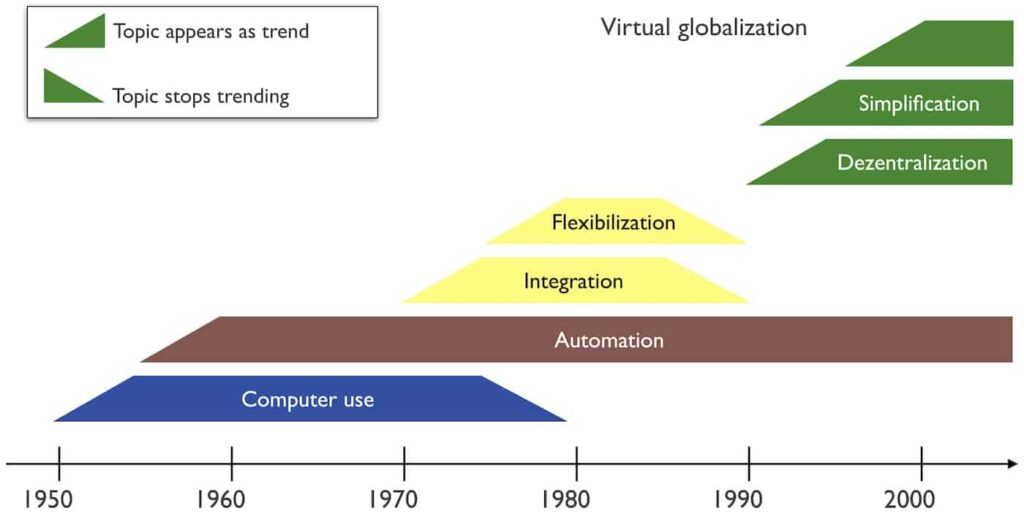
The use of computers was an important topic in the first 30 years of observation, with manual processes gradually being replaced by computer-aided processes. The trend towards automation is the only one that is consistent in literature since the beginning of the study. With the emergence of the CIM discussion, questions of flexibilization and the integration of different application systems came to the fore for the first time.
Parallel to discussions on business process reengineering and lean production, organizational topics were widely discussed in the literature. With the availability of the Internet and the elimination of numerous trade and customs barriers, virtual globalization was discussed from the beginning of the 2000s. The study summarized here ends shortly after the year 2000. This article examines the focal points of scientific discussion in the years that followed up to the present.
The full texts and metadata of 2,049 German-language articles published since 2001 were used to achieve the aforementioned aims. After removing articles with incomplete metadata, 1,853 articles, to which 3,121 different authors contributed, were available for analysis. The authors and keywords were isolated from these contributions and the keywords standardized according to the following criteria:
- singular
- in German
- no abbreviations
- multi-word keywords separated (e.g. the keyword “robotics in make-to-order production” becomes the two keywords “robotics” and “make-to-order production”)
- no names of organizations or places.
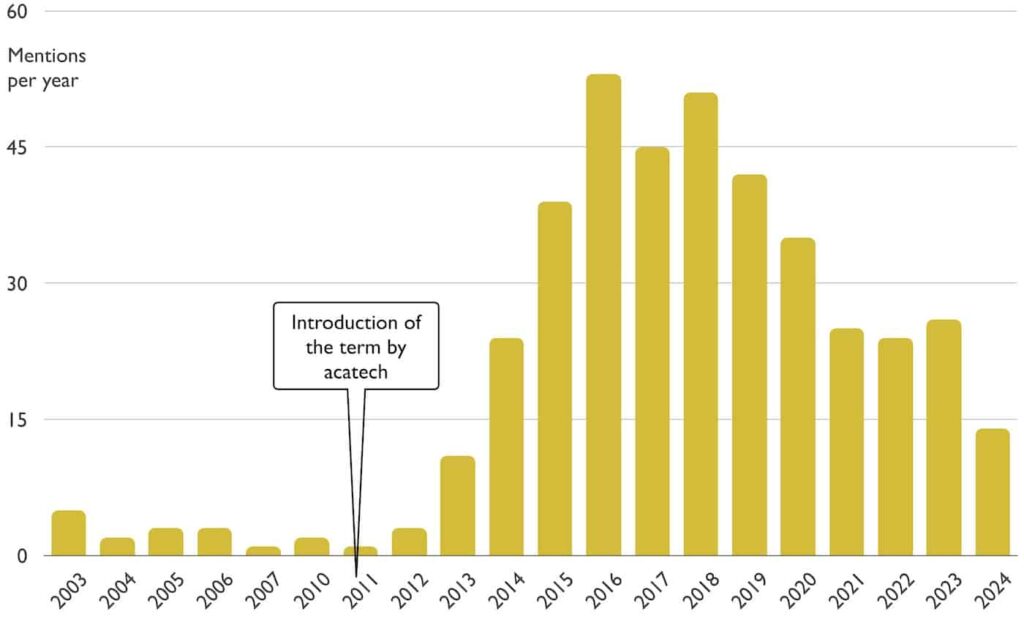
This yielded a total of 8,491 keywords, each of which was assigned to an article and a publication year. As over 3,300 keywords appeared only once during the period under review and only two keywords were mentioned more than 100 times, it was necessary to group the keywords under broader terms. Although this is the same technique used in the previous study, the frequency with which the categories were mentioned has shifted considerably, and some categories (such as ecology) have been newly included. The article focuses on the analysis of the keywords because these were specified by the authors themselves. An example of a keyword is Industry 4.0, the development of which is depicted in Figure 2.
Ascending and declining categories with some surprising developments
The terms were sorted according to their frequency of occurrence in 2024, assigned to their counterparts in 1998 and divided into categories as follows: If the proportion of all publications had remained roughly the same between 1998 and 2024, the term was identified as an ongoing topic. If the term was also one of the ten most frequently mentioned terms, it was identified as a leading topic. A term was a declining topic if it was no longer recorded in 2024 or was recorded with a significantly lower frequency than in 1998. Conversely, a term was declared ascending if it was not mentioned in 1998 and was mentioned with a measurable frequency in 2024.
A comparison with the 1998 study allows us to draw some conclusions about the evolution of the topics tackled in the literature.
Figure 3 shows the ten most frequently mentioned categories in 1998 and 2024. It is striking that the ten most frequent keywords are much more similar to each other in 2024 than in 1998. While the gap between positions 1 and 10 was still 12.4% in 1998, it shrinks to just 1.4% in 2024! It is also clear that the focus of contributions has shifted significantly. Of the ten most frequent and therefore most important keywords, only process orientation and machining (of workpieces) have been consistently important over the last 40 years.
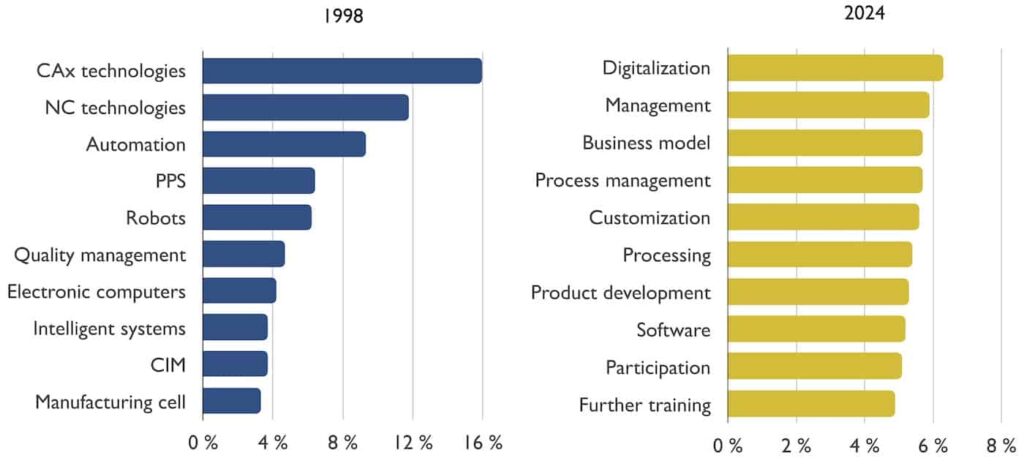
A detailed look at the categories from 1998 and 2024 shows the changes in research on software-supported production. These changes can be divided into three categories: the terms that are no longer the subject of scientific publications (“decliners”), the topics that have risen sharply (“ascenders”) and the topics that have been discussed in scientific publications throughout the entire 40-year period (“leading topics”).
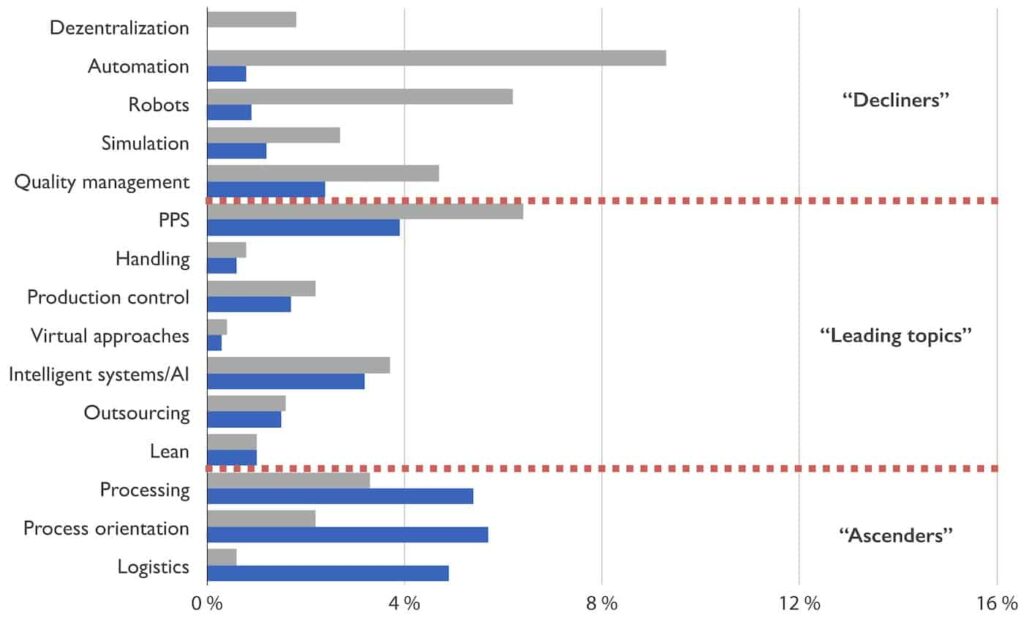
The graph shows that topics such as computer support for manufacturing tasks, which were still being discussed in scientific publications 25 years ago, play almost no role today (decline in CAx technologies from more than 16% to less than 1%). The role of software in automation is also much less important today than it was 25 years ago, as is robotics. In terms of scientific methods, simulation is less in focus today but still has a significant number of mentions. The proportion of articles on quality management has decreased considerably, albeit to a lesser extent than the other keywords in this group.
The category of leading topics includes those that have played a major role in production-oriented science for 40 years now. The most important topic is production planning and control, which still appears in almost 4% of all articles. This is certainly due to the fact that the production planning polylemma of combining high adherence to schedules with high-capacity utilization and low inventories has not yet been solved. It is noteworthy that intelligent systems/AI have also consistently played an important role in publications for over 40 years. In view of the current hype surrounding generative AI, this trend is likely to continue. Issues surrounding outsourcing and globalization or their reversal are also constantly being discussed.
One ascender is the category of processing methods, which have been made possible via new materials and new processes such as biotechnology or additive manufacturing, for example. The “winner” in this analysis is process orientation, which already played an important role in the 1998 study and has more than doubled in frequency since then.
Logistics plays a special role in this survey. At first glance, this category has grown the most. However, unlike in the other categories, the former editor-in-chief of this journal played a key role here. His chair at the University of Bremen dealt with logistics systems and processes and it is largely thanks to his influence that many articles in the journal dealt with logistics topics.
Overall, a trend shifting away from the isolated consideration of individual phenomena towards the holistic examination of processes or production systems is recognizable.
Authors
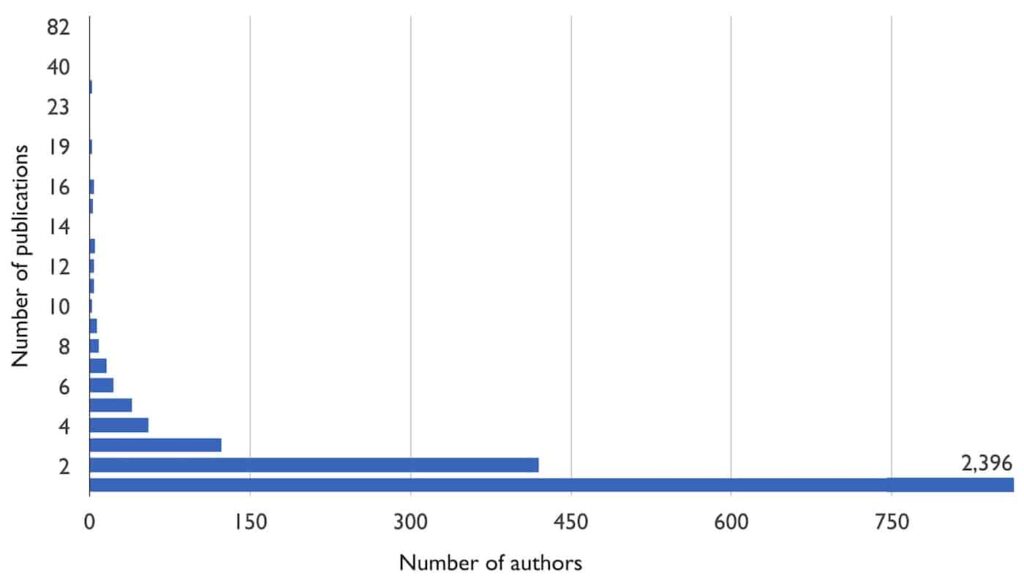
A total of around 3,000 authors have been published in the journal over the course of 20 years. Among the most frequent authors are leading members of the Academic Society for Work and Industrial Organization (WGAB) e.V., who have published more than ten articles in 20 years.
Prof. Scholz-Reiter, formerly of the University of Bremen, who was editor-in-chief of the journal during the entire evaluation period, is at the top of the list with 82 articles. His successor in the professorship in Bremen contributed 55 publications, while the current editor has published 40 articles. More than 2,400 authors submitted only one article in the evaluation period. The frequency distribution of publication figures per author can be seen in Figure 5.
Restrictions
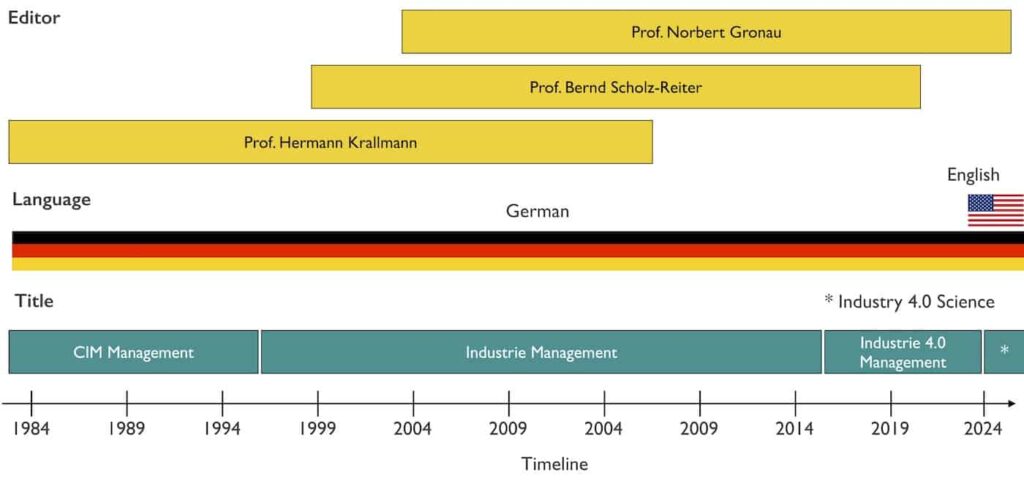
In contrast to typical literature reviews, only one journal is examined in detail here. This is beneficial for the results, however, as it entails a high degree of continuity in terms of the editors and, above all, editors-in-chief over a very long period of time (Fig. 6).
Conclusion
When new technology or methodologies emerge, it is usually not possible to tell whether they will become the subject of intensive discussion among experts. The study presented here offers an initial indication of how potential trend topics can be identified. An intensive debate in the scientific community over a longer period is an important indicator of a trend that is worth investigating further.
Deriving further research questions from network analysis
From the author’s point of view, there are some further interesting questions that could not be elaborated on within the frame of this article. For example, how do the keywords relate to each other? Methods of social network analysis could be used to create a thematic network that might show the proximity of certain terms to each other. A need for further research could be derived from these as yet lacking connections and correlations.
Furthermore, a geographical atlas of the authors could be created to show which research locations in German-speaking countries have made a significant contribution to the body of knowledge on Industry 4.0 and industrial business processes.
Bibliography
[1] Umer, M.; Razi, S.: Analyzing research methodologies and publication trends in service marketing literature. In: Cogent Business & Management 5 (2018) 1, 1446265. DOI: 10.1080/23311975.2018.1446265.[2] Gronau, N.: Wandlungsfähige Informationssystemarchitekturen-Nachhaltigkeit bei organisatorischem Wandel 1 (2006) 2. GITO mbH Verlag.
[3] Gronau, N.: Die Forschung zu industriellen Geschäftsprozessen im Wandel der Zeit. In: Industrie Management 30 (2014) 1, pp. 9-14.
[4] Solaro, R.: Trends und Strömungen bei Rechnereinsatz und Organisation im Industrieunternehmen. Diploma thesis TU Berlin 1998 (unpublished).
Your downloads
Potentials: Business Models Innovation
Solutions: Logistics Production Planning
You might also be interested in