
Double Transformation as the Key to Sustainability |
Methodology for evaluating an AI application in manufacturing companies

| Journal | Industry 4.0 Science |
| Issue | Volume 40, 2024, Edition 5, Pages 82-89 |
| Open Access | https://doi.org/10.30844/I4SE.24.5.82 |
| Bibliography | Share | Cite | Download |
Abstract
Keywords
Article
The importance of sustainability for companies is growing. This trend is reinforced by new EU regulations that encourage companies to intensify their sustainability practices and make them more transparent [1]. Artificial Intelligence (AI) and digital technologies offer innovative ways to achieve sustainability goals [2]. For manufacturing companies, it is crucial to make operational processes and products sustainable in order to achieve economic goals as well as assume social and environmental responsibility [3]. For the twin transformation (digital and sustainable) to succeed, it is equally important to develop methods that assess the impact of AI applications on operational sustainability. This allows companies to implement AI and digital technologies while taking all areas of sustainability into consideration.
This article initially shows examples of AI’s potential to increase the sustainability of work systems and companies. The article focuses on Weak AI methods, i.e. systems that are currently market-ready and can perform specific tasks efficiently using pre-programmed algorithms and data-supported models. The potential risks and challenges relating to sustainability are then identified. A method for assessing the sustainability of AI applications in the manufacturing industry is subsequently presented, which initially focuses on the assessment of sustainability in the selection phase of AI implementation projects. The method is based on a literature-derived AI-specific catalog of criteria, which is also presented. The results of the method application can be used to evaluate AI systems according to the principles of sustainability.
AI for sustainability in the manufacturing industry
A recent study shows that the importance of sustainability is rated highly by manufacturing companies of all sizes in Germany. The role of AI is seen as promising here. Across various business areas, the potential of AI to promote sustainability is highly rated. In the same study, participants from companies that already use AI report, that these systems contribute to achieving their sustainability goals [4]. Several studies confirm the respondents’ assessments: AI can contribute to achieving sustainability goals in the manufacturing industry [5-7].
A concrete example of the ecological potential of AI is the saving of resources and the associated reduction of environmental damage: intelligent algorithms enable companies to reduce the consumption of electrical energy, materials and greenhouse gas emissions [7]. From an economic perspective, AI enables, among other things, an increase in productivity, which results in a more efficient use of resources and an optimization of operational processes [6]. From a social perspective, AI can, for example, contribute to improving working conditions by reducing monotonous activities and increasing physical safety in the workplace [8]. From a technological perspective, AI offers the potential to make processes more transparent and increase product quality [9].
Despite these promising potentials, the implementation of AI is also associated with risks. In environmental terms, the training of AI models can entail considerable energy consumption [10]. Economic risks include, for example, high ongoing operating costs and high investment costs at the start of an AI project [9]. Socially, a lack of data protection and employee control [11] as well as technical stress [12] can pose a risk. In a technical context, the lack of data [13] and insufficient specialist knowledge of AI [9] can become an obstacle.
Given the broad spectrum of opportunities and possible risks, it is essential to develop assessment methods for an efficient consideration of the sustainability impact of AI applications [14]. These should enable companies to quantify the impact AI has on operational sustainability in a detailed yet compact manner. These methods are essential when selecting a planned AI application and are also useful for risk assessment during further development. Although it is challenging to assess the impact on sustainability in the early stages, it is a necessary prerequisite for the long-term implementation of responsible and effective technology solutions [5].
Dimensions and evaluation criteria of sustainability
A literature review was conducted to identify the opportunities, risks and challenges of using AI with regard to sustainability in the manufacturing industry [15]. This approach enables a deep understanding and analysis of the complex interactions that AI technologies can have on sustainability in the manufacturing industry.
In general, sustainability comprises economic, social and ecological aspects according to the three-pillar model [16]. At the operational level, the technology/knowledge component serves as the foundation to achieve the three pillars of sustainability. This encompasses the existing technologies and know-how required for the development and implementation of sustainable solutions [17].
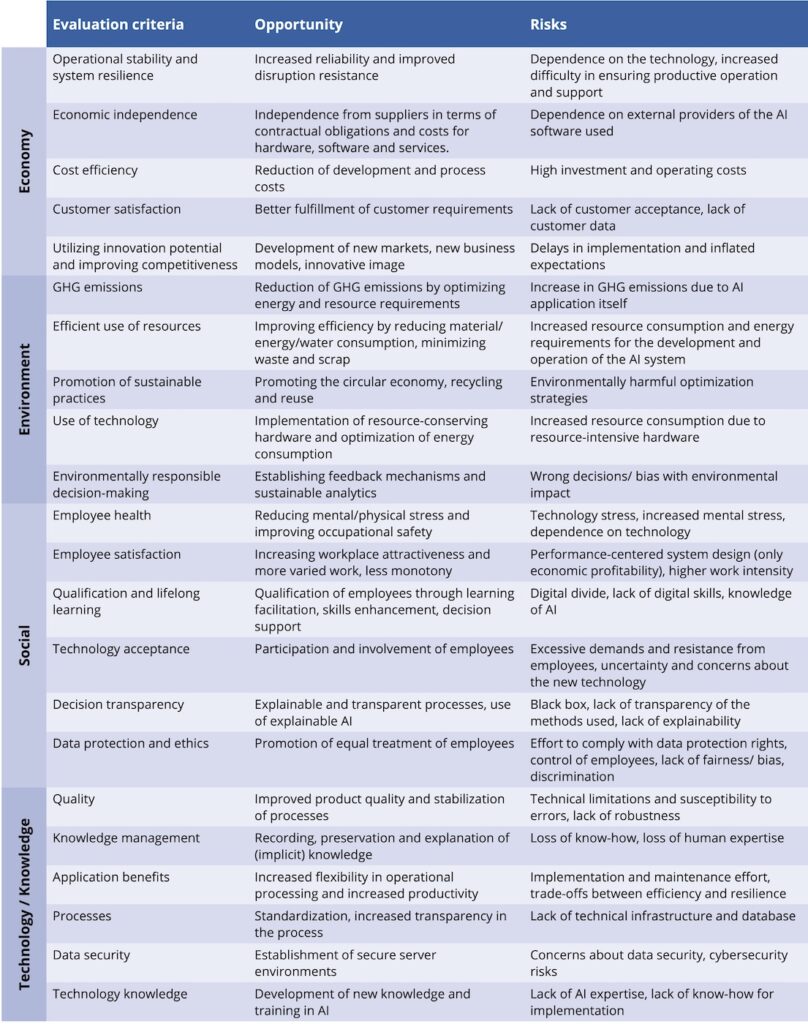
The potentials arising from literary research along with challenges and risks were assigned to the four sustainability dimensions. Subsequently, the opportunities, challenges and risks per dimension were grouped into evaluation criteria (see Figure 1). In order to develop an efficient and manageable evaluation method, a maximum of six evaluation criteria were established for each dimension.
Procedure to assess sustainability
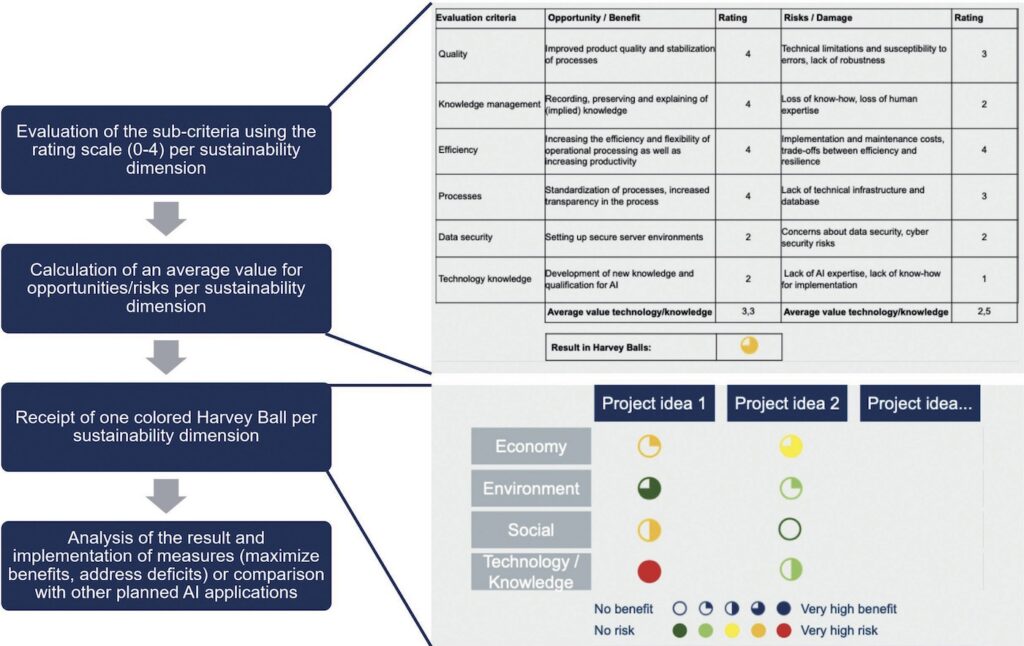
To assess the sustainability of possible project ideas, a four-stage procedure is presented below. For each evaluation criterion, the first step is to assess the corresponding opportunity. A scale of 0 to 4 is used, with 0 indicating no benefit and 4 indicating a very high benefit. Next, the risk is also assessed on a five-point scale (0: no risk to 4: very high risk).
This assessment scale is used to provide a quantified representation. Based on this data, an average value is calculated for the opportunities and risks for each dimension in the second step. In the third step, results are visualized using Harvey balls for each dimension by rounding the previously determined averages. The degree of filling indicates the opportunity of the dimension, while a color scale is used for the risk, based on traffic light colors (green: no risk, red: very high risk).
This form of presentation provides a clear and intuitively understandable overview of the opportunities and risks associated with the individual sustainability dimensions. This visual presentation enables company management, project managers and stakeholders to quickly and effectively identify key areas for potential interventions and improvements in the fourth step.
Applying the method using the example of AI projects
The method that has been developed based on three use cases in which AI is introduced into production will be tested below. In the first use case, the introduction of a (partially) automated and AI-supported grinding solution for fiber composite workpieces is considered. The grinding process, which was previously carried out entirely manually, is set to be mainly taken over by a robot in the future. The use of AI serves to optimize the robot’s grinding paths. Furthermore, an AI-supported camera system is planned, which shows the worker the areas on the component that need to be reworked manually [18].
In the second use case, an AI-supported system is introduced in the surface processing department of a metalworking company in order to collect the knowledge of experienced employees and make it available to new, inexperienced colleagues. The focus here is on the hanging process before painting metal components [19].
The third use case involves the development of a suggestion system to set machine parameters in the production of textiles. It is an AI system that, based on historical data and with the help of machine learning, provides suggestions for setting a laminating machine. The aim is to increase product quality and make the production process more transparent [20].
The assessment of opportunities and risks within the four sustainability dimensions was carried out by internal experts at the institute during this development phase. The assessment was initially carried out independently of one another. There were no significant deviations that differed by more than one evaluation level in the evaluation of the individual criteria. While reflecting on the application, a joint assessment of the use cases was derived. The result is summarized in Figure 3.
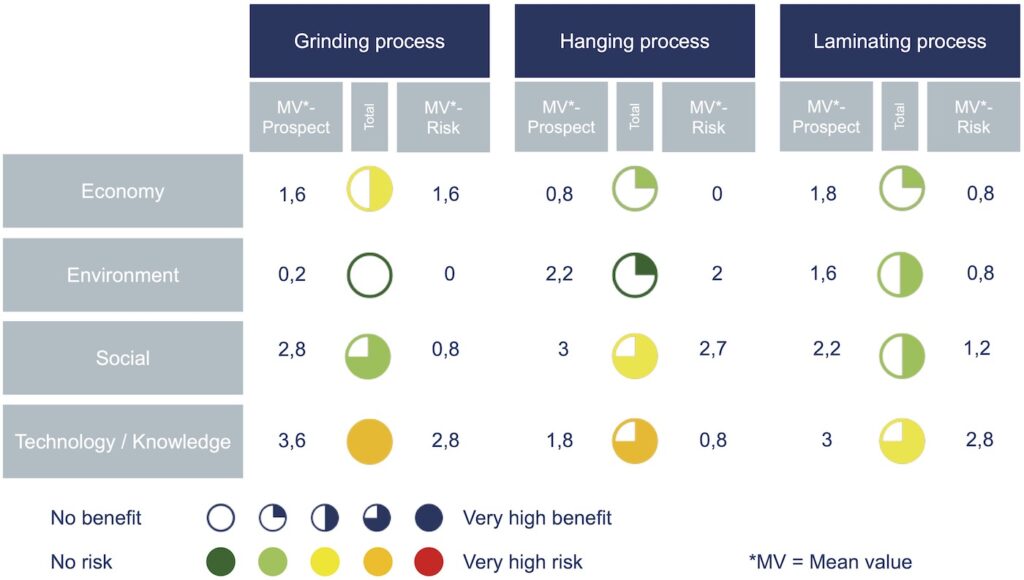
For the grinding process and hanging process use cases, the environmental sustainability aspect is considered to have little to no benefit, but also poses no risk. In contrast, the benefit of the laminating process is classified as medium, however the risk is also slightly higher compared to the other environmental use cases. The economic dimension shows a medium benefit with a medium risk for the AI-supported grinding process.
For the project idea of AI-supported knowledge management in the hanging process as well as the decision support in the laminating process, the benefit and risk in the economic aspect are classified as low. High benefits are expected for the sanding process and the hanging process in the social dimension, while the risk is rated as low to medium. For the laminating process in the social dimension, a medium benefit and a low risk are expected. The technical dimension shows a high to very high benefit for all project ideas, but also a medium to high risk.
The analysis reveals that technologies and methods for minimizing risks should be used for all applications in order to exploit the full potential of technical innovations. In the environmental area, the laminating process shows a higher risk and medium benefit, which suggests that the environmental risks should be analyzed in more detail and minimized. The high rating of the social benefit of the grinding and hanging process at low to medium risk indicates that investments in these areas can be beneficial not only technologically but also socially.
Challenges and prospects
With a maximum of six criteria per sustainability dimension, the method presented allows a quick overall assessment of the sustainability of an AI application. However, the compact form also means that environmental aspects such as material efficiency and energy efficiency cannot be considered individually, but only as a collective resource efficiency. In addition, the evaluation is based heavily on subjective assessments and therefore requires the involvement of several people.
Finally, it should be noted that the AI projects considered here as examples are already in the implementation phase. Although the method was tested using the examples mentioned, its universal applicability cannot be guaranteed. In further evaluations in operational practice, it is necessary to investigate to what extent the criteria can be adequately answered in the selection phase of projects. In addition, examples to explain the evaluation criteria appear to be expedient in order to achieve a more congruent evaluation. Further evaluations with operational decision-makers are essential to ensure practical relevance.
Future development work should address the visualization of the results in a balanced scorecard. Possibilities for aggregating the assessments need to be tested and different presentation variations should be evaluated with operational users. It would also be possible to extend the method to carry out the risk assessment for a project in the same documents. To this end, the degree of opportunity and risk could be quantified by multiplying the probability of occurrence of the event with the potential damage.
The WIRKsam competence center (FKZ: 02L19C600) is funded by the Federal Ministry of Education and Research (BMBF) as part of the “Regionale Kompetenzzentren der Arbeitsforschung” funding measure and is supervised by the Projektträger Karlsruhe (PTKA). The responsibility for this article lies with the authors.
Bibliography
[1] The European Parliament and the Council of the European Union. Directive (EU) 2022/2464 Corporate Sustainability Reporting Directive. CSRD 2022.[2] Vinuesa, R. et. al.: The Role of Artificial Intelligence in Achieving the Sustainable Development Goals. In: Nature Communications 11 (2020), p. 233. https://doi.org/10.1038/s41467-019-14108-y
[3] Scharmer, V. M. et. al.: Sustainable Manufacturing: A Review and Framework Derivation. In: Sustainability 16 (2024), p. 119. https://doi.org/10.3390/su16010119
[4] Link, J., Harlacher, M., Feggeler, N.: Trendbarometer: Themenschwerpunkt Künstliche Intelligenz. URL: www.arbeitswissenschaft.net/fileadmin/user_upload/KI-Trendbarometer-2023.pdf, accessed: 26.06.24.
[5] Koch, D. et. al.: Nachhaltigkeit durch KI. Potenziale und Handlungsleitfaden für produzierende Unternehmen. 2022.
[6] Plathottam, S. J. et. al.: A Review of Artificial Intelligence Applications in Manufacturing Operations. In: Journal of Advanced Manufacturing and Processing 5 (2023). https://doi.org/10.1002/amp2.10159
[7] Friedrich, R. et. al.: Potenziale der schwachen Künstlichen Intelligenz für die betriebliche Ressourceneffizienz. 2021.
[8] Milanez, A.: The Impact of AI on the Workplace: Evidence from OECD Case Studies of AI Implementation. OECD Social, Employment and Migration Working Papers, No. 289, Paris 2023.
[9] Kutz, J. et. al.: Implementation of AI Technologies in Manufacturing: Success Factors and Challenges: The Human Side of Service Engineering. AHFE International 2022.
[10] Strubell, E.; Ganesh, A.; McCallum, A.: Energy and Policy Considerations for Deep Learning in NLP. In: Proceedings of the 57th Annual Meeting of the Association for Computational Linguistics. Association for Computational Linguistics 2020.
[11] Berg, A.; Dehmel, S.: Künstliche Intelligenz. URL: www.bitkom.org/sites/default/files/2020-09/bitkom-charts-kunstliche-intelligenz-28-09-2020_final.pdf, accessed: 26.06.24.
[12] Kumar, A.; Krishnamoorthy, B.; Bhattacharyya, S. S.: Machine Learning and Artificial Intelligence-Induced Technostress in Organizations: A Study on Automation-Augmentation Paradox With Socio-Technical Systems as Coping Mechanisms. In: International Journal of Organizational Analysis 32 (2024), pp. 681–701. https://doi.org/10.1108/IJOA-01-2023-3581
[13] Peres, R. S. et.al.: Industrial Artificial Intelligence in Industry 4.0: Systematic Review, Challenges and Outlook. In: IEEE Access 8 (2020), pp. 220121–220139. https://doi.org/10.1109/ACCESS.2020.3042874
[14] Stowasser, S.; Harlacher, M.: Künstliche Intelligenz (KI) und Arbeit: Leitfaden zur soziotechnischen Gestaltung von KI-Systemen. Berlin, Heidelberg 2023.
[15] Link, J.: Künstliche Intelligenz und Nachhaltigkeit: Zahlen, Daten, Fakten. URL: wwww.arbeitswissenschaft.net/zdf-ki-nachhaltigkeit, accessed: 14.06.24.
[16] Enquete-Kommission Künstliche Intelligenz: Gesellschaftliche Verantwortung und wirtschaftliche, soziale und ökologische Potenziale. Bericht der Enquete-Kommission Künstliche Intelligenz – Gesellschaftliche Verantwortung und wirtschaftliche, soziale und ökologische Potenziale, 2020.
[17] Eisele, O.: Nachhaltigkeit in Zahlen: Situation auf globaler, nationaler und betrieblicher Ebene. URL: www.arbeitswissenschaft.net/zdf-nachhaltigkeit, accessed: 21.02.24.
[18] Hansen-Ampah, A. et. al.: Nutzung einer Mensch-Roboter-Kollaboration zum Erlernen komplexer motorischer Fertigkeiten für Tätigkeiten in der Faserverbundherstellung. In: Kompetenzzentrum WIRKsam: Wirtschaftlichen Wandel in der rheinischen Textil- und Kohlerregion mit Künstlicher Intelligenz gemeinsam gestalten. 2023, pp. 22–24.
[19] Ottersböck, N. et. al.: Entlastung von Beschäftigten in komplexen Produktionsumgebungen durch informatorische, KI-basierte Assistenztechnologien. In AI:MAG: The World of Tomorrow. 2023, pp. 27–28.
[20] Köse, H. et. al.: Lernförderliches KI-Varianzmanagement für die Produktion von Geweben mit kundenspezifisch veränderlich ausgeprägten Prüfmerkmalen. In: Kompetenzzentrum WIRKsam: Wirtschaftlichen Wandel in der rheinischen Textil- und Kohlerregion mit Künstlicher Intelligenz gemeinsam gestalten. 2023.
Your downloads
You might also be interested in