Training

Assistant for Reliable Configurations of Robot Units

Assistant for Reliable Configurations of Robot Units

Christian Peemöller, Roman Korf, Gerd Grube, Christian Mankopf
The rise of the complexity of products and the product development process in addition to shorter development cycles and the customers’ high demands on quality, increase the pressure on producing as accurately and economically as possible. Hence, it is necessary to avoid errors in the early phases of development instead of fixing them at a later stage, which can be costly. This article uses the product configuration of milling robot units to show an innovative solution for the early development phase. This approach uses established technologies from the area of semantic technologies and problem solving methods. It also shows how to improve the reliability of product configuration by making use of the expertise from later phases in the development.
Industrie Management | Volume 27 | 2011 | Edition 5 | Pages 37-40
Open Innovation in the Pharmaceutical Small Firm Sector

Open Innovation in the Pharmaceutical Small Firm Sector

Mit dem PharmaInnovationsLotsen offene Innovationsprozesse gestalten
Norbert Gronau ORCID Icon, Andreas Braun, Gergana Vladova
Innovation is a central determinant of the competitiveness of a company. The discovery, development and realization of innovative ideas are, however, bound up with challenges and risks. Against this backdrop, new paths and resources must be demonstrated, particularly for small and mid-sized enterprises (SME). This article is concerned with the open-innovation approach in the pharmaceutical industry and describes the interaction between research and practice to open the existing innovation processes in three SME.
Industrie Management | Volume 27 | 2011 | Edition 5 | Pages 9-12
Flexible Use of Employees

Flexible Use of Employees

Ergebnisse einer deutschlandweiten Unternehmensbefragung
Cynthia Sende, Nathalie Galais, Klaus Moser, Katharina Hasenau
Flexibility becomes increasingly the crucial success factor. This is the result of a current survey on small and medium-sized enterprises in Germany. More than a quarter of the participants indicated that flexibility was their most important business goal. What this result means for the personnel policy of a company and in the end for its employees is the focus of this article. The here presented survey is part of the BMBF project “FlexPro” that investigates different strategies of internal flexibilization as well as determinants of using external workers, especially temporary agency workers.
Industrie Management | Volume 27 | 2011 | Edition 4 | Pages 52-56
Skills Development and Leadership

Skills Development and Leadership

The continuous improving process in lean manufacturing systems
Eberhard Abele, Jan Cachay, Jan Wennemer
Sustainability in lean production systems arises when the relevant lean principles are addressed by preferably all stakeholders in the context of permanent improvement processes. For this purpose a skills development of all employees is necessary, even for managers, as they convey the CIP position by their people skills and set an example. If this succeeds, improvement processes will develop into a sustainable learning process, which in turn serves as a self-reinforcing factor for the further development of staff skills. An approach to skills development and to the corresponding leadership system for improvement processes is presented and supported by preliminary results of an empirical study.
Industrie Management | Volume 27 | 2011 | Edition 4 | Pages 14-18
Strategy of Facing a Lack of Skilled Employees

Strategy of Facing a Lack of Skilled Employees

Katrin Schickhoff, Ellen Uloth
Getting qualified and motivated employees and high potentials for companies and keeping them is going to be an important issue in leadership in the years to come. Employees achieve the most if they have a clear understanding of their working tasks and claims by using their talents and resources to their best. Not following these in house policies will lead to a high fluctuation, high status of employee´s illness and burn out. Implementing those resourceful strategies will lead to higher strength and better use of talents in business.
Industrie Management | Volume 27 | 2011 | Edition 4 | Pages 27-30
Need for Vocational Training and Intelligent Cargo

Need for Vocational Training and Intelligent Cargo

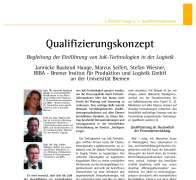
Begleitung der Einführung von IuK-Technologien in der Logistik
Jannicke Baalsrud Hauge, Marcus Seifert, Stefan Wiesner
It is expected that employment will increase in the next 5 years. Furthermore, several surveys examining the training needs state that there is a large need for improving the qualification of employees working at all different positions within the supply chain. The need for qualified persons cannot only be fulfilled by motivating the employees in continuous learning. This article shows an approach used for vocational training in the field of Intelligent Cargo.
Industrie Management | Volume 27 | 2011 | Edition 4 | Pages 77-81
Knowledge Transfer with Projects

Knowledge Transfer with Projects

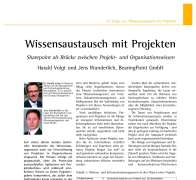
SharePoint as a Bridge to the Organisation
Harald Voigt, Jens Wunderlich
Knowledge management around projects has been supported for a long time by a host of software applications. But still the knowledge exchange between organisation and projects is weak throughout the project cycle: from project inception where company knowledge is ignored to transfer of results to the dump of collective company data. Social media bring about a sense of communication which may help to solve some of these problems - if it can be successfully implemented. We explore how SharePoint can be employed to enhance the knowledge transfer between organisations and their projects.
Industrie Management | Volume 27 | 2011 | Edition 4 | Pages 23-26
Knowledge Management for Small and Medium Sized Enterprises

Knowledge Management for Small and Medium Sized Enterprises

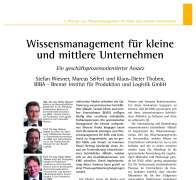
A Business Process Oriented Approach
Stefan Wiesner, Marcus Seifert, Klaus-Dieter Thoben ORCID Icon
The handling of customer-individual requirements, product variants and a worldwide market requires the professionalization of knowledge-intense processes. Small and Medium sized Enterprises (SME) often have excellent individual competencies, but lack a systematic management of the associated knowledge. IT-solutions for Knowledge Management in SMEs provide limited functionalities and are thus rarely used. Therefore, a need exists for the business process oriented approach for Knowledge Management in SMEs, featured in this article. Implemented in a portal for information management, it supports optimization of knowledge-intense processes.
Industrie Management | Volume 27 | 2011 | Edition 4 | Pages 31-34
Knowledge Management of Product Development

Knowledge Management of Product Development

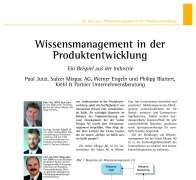
an Industry Example
Paul Jutzi, Werner Engeln, Philipp Blattert
Today knowledge is the company’s main resource. To be competitive, companies need qualified employees who are able to use their knowledge for solving problems. Especially in the field of product development it is essential that relevant knowledge is available. Knowledge Management is one important module of the concept of Lean Development. The Sulzer Mixpac AG has established Lean Development in its structure, while knowledge management has been introduced to the organization. This article provides background information. Sulzer Mixpac has followed the Toyota principle: “Before we build cars, we build people!”
Industrie Management | Volume 27 | 2011 | Edition 4 | Pages 43-46
Creating the Corporate Future Using Management Development

Creating the Corporate Future Using Management Development

Karlheinz Schwuchow
No longer does the shortage of qualified employees represent a regional or sector specific problem. It has become an issue impacting the whole economy - in particular in times of an economic recovery. In today’s knowledge society, people are the most important asset as they determine corporate performance as well as the capability of an organization to innovate and change. Thus, the anticipation and proactive response to future qualification needs is crucial and defines the capability to outpace the competition in a time-based environment. The capability to learn and to unlearn faster than others defines the ability to change - this, however, is not an issue of technology but culture - a culture that nurtures the role of leaders as teachers.
Industrie Management | Volume 27 | 2011 | Edition 4 | Pages 61-64
1 13 14 15 20