Technologie: Training

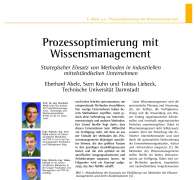
Process Optimization Using Knowledge Management

Process Optimization Using Knowledge Management

Strategic Employment of Methods for Medium-Sized Enterprises
Eberhard Abele, Sven Kuhn, Tobias Liebeck
Although medium sized enterprises ascribe high importance to knowledge management and its impact on company’s success, they have rarely undertaken steps to introduce respective methods. Only a small share of companies applies selected methods, usually rather sporadic and without connection to corporate strategy or other management techniques. The reason lies in the lack of a tool for choosing the most suitable methods. Out of the multitude of instruments available for knowledge management, it is difficult to decide about a method mix fitting best to respective business processes, initial situation and specific demands of the company. This paper presents a concept to manage these shortcomings.
Industrie Management | Volume 21 | 2005 | Edition 1 | Pages 13-16
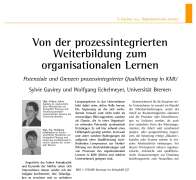
From Process Integrated Education to Organizational Learning

From Process Integrated Education to Organizational Learning

Potenziale und Grenzen prozessintegrierter Qualifizierung in KMU
Sylvie Gavirey, Wolfgang Echelmeyer
Organizational Learning offers a good possibility for enterprises to compete with the dynamics of the market. Under certain conditions, process integrated education not only leads to process optimization in firms, but also to the beginning of organizational learning. This is of great importance particularly to small and medium sized enterprises, since they normally lack appropriate structures.
Industrie Management | Volume 21 | 2005 | Edition 1 | Pages 45-48
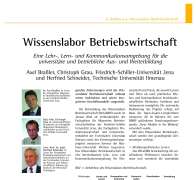
Business Administration Knowledge Laboratory

Business Administration Knowledge Laboratory

Eine Lehr-, Lern- und Kommunikationsumgebung für die universitäre und betriebliche Aus- und Weiterbildung
Axel Braßler, Christoph Grau, Herfried M. Schneider
The internet-based teaching, learning and communication system “Business Administration Knowledge Laboratory” (WiLabBW) is developed and continuously expanded within a cooperation project of Thuringian universities. The paper gives a survey of the basic goals and explains its architecture and business model.
Industrie Management | Volume 21 | 2005 | Edition 1 | Pages 9-12
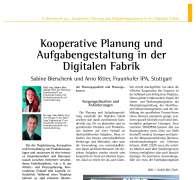
Co-operative planning in the context of Digital Factory

Co-operative planning in the context of Digital Factory

Sabine Bierschenk, Arno Ritter
An intensive co-operation and data exchange between members of different disciplines are necessary in planning, conception and development of production plants and processes. Planning failures that are identified too late or different understanding of contents can lead to significant effects, e.g. during starting or ramp-up. In the context of the Digital Factory the Fraunhofer IPA develops organizational and technological solutions for co-operative planning on the base of workflow and knowledge management as well as solutions for interaction, data and tool integration. The aim is the optimisation of planning quality and planning costs.
Industrie Management | Volume 20 | 2004 | Edition 3 | Pages 71-73
Personnel Development Planning Based upon the Technology Calendar Concept

Personnel Development Planning Based upon the Technology Calendar Concept

Gert Zülch, Sven Rottinger
In the face of constantly changing market conditions and the associated product and technology changes the available personnel structures must be considered in particular during the further development of manufacturing sys-tems. Experiences from operational practice show that personnel development measures are usually reactive and are often carried out in an improvised, ad-hoc manner. In order to counteract such reactive measures, the technology calendar, with which a timely and targeted personnel development planning can be initiated, is presented.
Industrie Management | Volume 20 | 2004 | Edition 2 | Pages 58-61
Changeability by Holistic Competence Management

Changeability by Holistic Competence Management

Günter Warnecke, Christian M. Thurnes
Changeable enterprises are sustainably focussing market and technology changes ranging from a short term up to long term view to maintain market success under changing market and environment conditions. The specific addressing of competence development can provide a significant contribution to changeable conditions. For these both, adaptive reactions to present changes as well as preventative planning addressing future changes are needed. To support the changeability of an enterprise holistic competence management approaches can be used. They allow to match supply and demand of competence and to design corresponding concepts for competence development.
Industrie Management | Volume 20 | 2004 | Edition 2 | Pages 9-11
K_MOBILE—Enabling Mobile Access to Information and Knowledge

K_MOBILE—Enabling Mobile Access to Information and Knowledge

An approach for extending enterprise information infrastructures
Norbert Gronau ORCID Icon, Frank Laskowski, Sonja Martens
Software supporting knowledge management and knowledge intensive business processes is mainly planned and deployed for stationary use. The average time needed to process information can effectively be reduced by adding a mobile channel to existing knowledge management software, e.g. when negotiating with business partners or maintaining individual technical installations. In this paper the authors describe K_MOBILE, a concept enabling access to knowledge management services through the mobile channel in a situation aware manner. Access to information systems can be truly adopted to mobile use, with help of a user specific context built by combining available information with respect to time and location. This is a benefit especially when carrying out intensive tasks in sale, consulting, technical services, because it is difficult to estimate the actual need for information and hence the costs of access to this information is potentially very high.
Industrie Management | Volume 19 | 2003 | Edition 6 | Pages 21-24
Optimisation of Knowledge Transfer in R&D Projects

Optimisation of Knowledge Transfer in R&D Projects

Peter Müller-Baum
Knowledge transfer is critical for the success of R&D projects in terms of supply, usage and multiplication of knowledge within and between projects. However, possibilities to opti-mise knowledge transfer do hardly exist since the application of structured methods appears to be hard to realise because of criteria specific for R&D projects like creativity, incertitude and little structuring. In the following, a concept is introduced that establishes transparency according to knowledge transfer in R&D projects and creates a basis to use potentials for optimising knowledge transfer by specific application of knowledge management methods.
Industrie Management | Volume 19 | 2003 | Edition 5 | Pages 54-57
Engineering Knowledge Networks

Engineering Knowledge Networks

Efficient problem solving and competence development
Kristina Wagner, Daniel Mirtschink
The company-spanning collaboration offers companies the chance to exhaust new market potentials by in- creasing their innovation capability and productivity. An important prerequisite therefore is to optimally support knowledge networks and especially the corresponding knowledge exchange and problem solving processes. In the context of the project TRUST an approach was developed to enable companies and respectively their employees on the one hand to provide knowledge needed for problem solving. On the other hand the employees have access within an integrated working environment to experiences, know-how and competences of the knowledge network to solve their specific problems and to develop their individual domain competence.
Industrie Management | Volume 19 | 2003 | Edition 5 | Pages 41-44
Communities of Practice in Industrial Enterprises

Communities of Practice in Industrial Enterprises

Dieter Spath, Martin Müller, Marc Rüger
Knowledge Management has become one of the most recognized management concepts in the last decade. Knowledge is the critical success factor to sustain the competitive ability in companies but changes rapidly in today’s dynamic business environment. Therefore, companies are obliged to foster the knowledge transfer and development. “Community of Practice” is a team-building method to support the efficient use, communication and creation of knowledge in industrial and manufacturing enterprises.
Industrie Management | Volume 19 | 2003 | Edition 3 | Pages 14-17
1 … 18 19 20