Autor: Gert Zülch

Using Simulation for Working Time Configuration

Using Simulation for Working Time Configuration

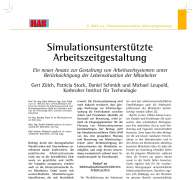
Ein neuer Ansatz zur Gestaltung von Arbeitszeitsystemen unter Berücksichtigung der Lebenssituation der Mitarbeiter
Gert Zülch, Patricia Stock, Daniel Schmidt, Michael Leupold
Many companies are challenged to consider in the planning process for working times not only current laws, labour contracts and their operative goals but also the time-related wishes of their employees. One can identify different types of employees which differ in their working time preferences as well as in the work load they have to deal with in their private lifes. Therefore, the working time configuration has to take the specific situation of the employees into account. Consequently, the process of the working time configuration becomes highly complex. But there are currently no tools available that allow decision-makers of a company to evaluate an intended working time model prospectively (i.e. before its realization) while taking dynamic aspects of their operations as well as the work-life balance of the employees into account. At best, the work-life balance of the employees is a key figure for the evaluation of a working time model but not a parameter during the planning ...
Industrie Management | Volume 29 | 2013 | Edition 3 | Pages 29-33
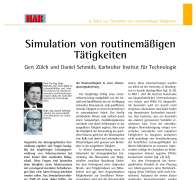
Simulation of Routine Activities

Simulation of Routine Activities

Gert Zülch, Daniel Schmidt
In view of the demographic changes, questions arise about the long-term development of the performance of work systems with an aging workforce. These questions are especially urgent if work systems with predominantly mental demands should be operated for many years. The simulation tool ESPE-AS can help to forecast the development of the performance of a work system with the given workforce for future periods. This paper describes a first approach of this simulation-based planning method and illustrates it using the routine activities for creating operations plans.
Industrie Management | Volume 28 | 2012 | Edition 3 | Pages 17-20
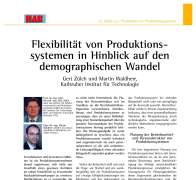
Flexibility Quantification of Production Systems in Light of Demographic Change

Flexibility Quantification of Production Systems in Light of Demographic Change

Gert Zülch, Martin Waldherr
In turbulent and innovative markets it is important for any production enterprise to have a high level of robustness within a specific range of output quantities vis-à-vis any changes it will be affected by. In fact, it is necessary to provide a planning routine for the adaptability of production systems as early as during the planning stage. In this way it will be able to respond to unforeseeable developments. Due to the demographic development in particular, it is no longer appropriate to consider the staff structure after the configuration of the machinery equipment has been planned. It is much more important to design manufacturing systems to be productive during the whole usage phase of the production system without a change of the permanent staff. The aim is to enhance the planning task in such a way that the production system can be adapted technically and organisationally as well as in a personnel-oriented manner to a changing performance of an ageing workforce.
Industrie Management | Volume 27 | 2011 | Edition 3 | Pages 65-68
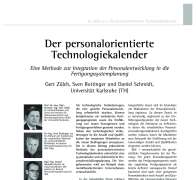
Personnel-oriented technology calendar

Personnel-oriented technology calendar

a method for the integration of personnel development in the planning of manufacturing systems
Gert Zülch, Sven Rottinger, Daniel Schmidt
Additional to the consideration of technological and organisational aspects as well personnel adjustments have to be considered in time during the introduction of new manufacturing technologies. Reasons for a systematic personnel development are technological changes, e.g. the introduction of new products and manufacturing processes or a modified manufacturing programme. Especially the number and the qualification of the employees who are affected by these changes have to be adjusted to the new requirements. The method of the personnel-oriented technology calendar which is presented in this article provides a systematic and targeted personnel development planning. The approach is demonstrated by means of an application example.
Industrie Management | Volume 25 | 2009 | Edition 1 | Pages 31-36
Integrating Machinery and Personnel Structure Planning

Integrating Machinery and Personnel Structure Planning

How to improve competitiveness
Gert Zülch, Marcel Becker
Competitiveness in the German industry, particularly in the capital and consumer goods sectors, is significantly dependent upon how well a company can adapt to market demands. Elements of such an adaptation process are the new development and modification of products, but equally the implementation of new or improved manufacturing technologies. In the parts manufacturing sector, which will be considered more closely in the following, changes to manufacturing programmes require new manufacturing structures. The question as to the integrity of the personnel and equipment structure planning thus arises. The following article will present a simulation-supported, heuristic procedure for the reciprocal adaptation of both planning areas.
Industrie Management | Volume 24 | 2008 | Edition 2 | Pages 23-26
Self-Organizing Manufacturing Control Using Ant Colony Systems

Self-Organizing Manufacturing Control Using Ant Colony Systems

Gert Zülch, Patricia Stock
As a reaction to the growing demands of the market on enterprises, ever more complex procedures for production control are being developed. Most recently, self-organising procedures, which often mimic the behaviour of natu­ral systems (e.g. evolutionary or genetic algorithms), have come to the fore. The methods of Swarm Intelligence and, in particular, the Ant Colony Optimi­zation (ACO), which are characterised by their flexibility and adaptability, could serve as a basis for this. The ifab-Institute has developed a pro­cedure for the short-term, operative manufacturing control based on this approach, which will be presented in this article.
Industrie Management | Volume 23 | 2007 | Edition 5 | Pages 67-70
Simulation-Based Working Time Configuration

Simulation-Based Working Time Configuration

Gert Zülch, Patricia Stock, Thomas Bogus
In order to achieve a flexible reaction to fluctuations in demand the operative working times have to be rearranged. Often flexible working time models are implemented, whose configurations are problematic from personnel and operative points of view. In addition, the currently available evaluation methods turn out to be highly subjective. This article will present a simulation-based working time configuration which allows for a prospective evaluation of working time models.
Industrie Management | Volume 22 | 2006 | Edition 5 | Pages 47-50
Personnel Development Planning Based upon the Technology Calendar Concept

Personnel Development Planning Based upon the Technology Calendar Concept

Gert Zülch, Sven Rottinger
In the face of constantly changing market conditions and the associated product and technology changes the available personnel structures must be considered in particular during the further development of manufacturing sys-tems. Experiences from operational practice show that personnel development measures are usually reactive and are often carried out in an improvised, ad-hoc manner. In order to counteract such reactive measures, the technology calendar, with which a timely and targeted personnel development planning can be initiated, is presented.
Industrie Management | Volume 20 | 2004 | Edition 2 | Pages 58-61