Simulation

Simulation of Routine Activities

Simulation of Routine Activities

Gert Zülch, Daniel Schmidt
In view of the demographic changes, questions arise about the long-term development of the performance of work systems with an aging workforce. These questions are especially urgent if work systems with predominantly mental demands should be operated for many years. The simulation tool ESPE-AS can help to forecast the development of the performance of a work system with the given workforce for future periods. This paper describes a first approach of this simulation-based planning method and illustrates it using the routine activities for creating operations plans.
Industrie Management | Volume 28 | 2012 | Edition 3 | Pages 17-20
Optimization of the Reefer Mechanic Operations at Container Terminals

Optimization of the Reefer Mechanic Operations at Container Terminals

Eine Simulationsstudie
Sönke Hartmann
Container terminals are complex logistics systems. In order to achieve highly productive processes and an efficient assignment of the resources, optimization methods and simulation modeling are employed in practice. Based on a case study from the Container-Terminal Altenwerder in Hamburg, this contribution demonstrates how simulation and optimization can be applied to improve the processes related to reefer container handling. We show that optimization methods improve the efficiency of the reefer mechanic operations and how simulation models can support the development and evaluation of such methods in practice.
Industrie Management | Volume 28 | 2012 | Edition 1 | Pages 41-44
Prediction of Customer Demands

Prediction of Customer Demands

A data base containing recommendations for the choice of appropriate forecasting methods
Bernd Scholz-Reiter ORCID Icon, Mirko Kück
Due to dynamics and complexity within production and delivery networks, customer demands are often highly volatile. In order to achieve a well-founded production planning and control, future customer demands have to be predicted precisely. Classical statistical forecasting methods are often easy to apply but are not able to react on dynamic effects within the data. Methods of nonlinear dynamics consider qualitative in addition to quantitative information within past order data to find possible deterministic structures and, as a result, to achieve better forecasts of the future. This article deals with the development of a data base containing recommendations to choose suitable prediction methods in different situations.
Industrie Management | Volume 28 | 2012 | Edition 1 | Pages 61-65
A Model Based Approach for Virtual Prototyping

A Model Based Approach for Virtual Prototyping

A Method for Generating Simulation Models Based on Conceptual Models
Werner Esswein, Kai Frankenstein, Stephan Bögel
Virtual prototypes become more and more relevant in product development since they permit the early testing of machines and include the customer in the product development process. Virtual prototyping can help to decrease costs in service, development and sales as well as marketing. Hence, the creation of virtual prototypes is still a resource insensitive project. This article presents the results of the research project “INPROVY”. The approach uses a model based method for systematic creation of simulation models. It includes the product management perspective of simulation models and uses reference models for higher reuse. Based on a mobile construction vehicle, the creation of various simulation models and the management of product variants are discussed.
Industrie Management | Volume 27 | 2011 | Edition 5 | Pages 46-50
Trends and Needs for Action of Simulation in the Automotive Industry

Trends and Needs for Action of Simulation in the Automotive Industry

Lars Huber, Sigrid Wenzel ORCID Icon
Over the past years the use of simulation methods for designing production systems in the automotive industry has been enforced. To identify trends and needs for action, an online survey was sent to 181 simulation experts and users in the environment of the VDA workgroup Ablaufsimulation. This paper illustrates the results of the survey and points out development steps that are necessary for simulation in general and for the VDA Toolkit in particular.
Industrie Management | Volume 27 | 2011 | Edition 5 | Pages 27-30
Efficient Simulation in Production Management

Efficient Simulation in Production Management

Schnelle und belastbare Analyse von Fertigungsprozessen
Sander Lass, Hanna Theuer ORCID Icon, Norbert Gronau ORCID Icon
In the research project LUPO a hybrid simulation laboratory is build up. This combines the advantages of the computer simulation with those of a model factory. For the systematic recording, mapping and analysis of various production processes a procedure model has been created that responds to the special requirements (quick, flexible, effortless determination of informative results) of the project. A library of production objects facilitates the reutilisa tion of existing machines and hereby a reduction of simulation effort.
Industrie Management | Volume 27 | 2011 | Edition 3 | Pages 13-15
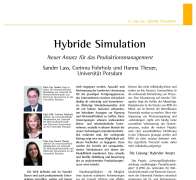
Hybrid Simulator – A New Production Management Approach

Hybrid Simulator - A New Production Management Approach

Neuer Ansatz für das Produktionsmanagement
Sander Lass, Corinna Fohrholz, Hanna Theuer ORCID Icon
In a world of steady change, manufacturing companies face major challenges. They have to react quickly to an increasing competition and more and more individual customer requests. New technologies and organisational structures like RFID or decentralised and real-time based production control can deal with this issue successfully. The specific realization of selection and analysis of each production process of the company often approves to be difficult and cost intensive. Previous simulation approaches are frequently combined with high efforts in order to state credible propositions regarding suitability and economic efficiency. The present paper shows a new opportunity towards managing these disadvantages. Additionally, the advantages are combined with computer-based simulations of the model factory. A fast and flexible illustration of the analysed production processes is achieved.
Industrie Management | Volume 27 | 2011 | Edition 1 | Pages 13-16
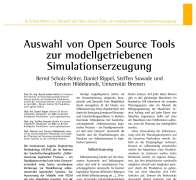
Selecting Open Source Software for the Model Driven Generation of Simulations

Selecting Open Source Software for the Model Driven Generation of Simulations

Bernd Scholz-Reiter ORCID Icon, Daniel Rippel, Steffen Sowade, Torsten Hildebrandt
The Autonomous Logistic Engineering Methodology (ALEM), which is developed within the Collaborative Research Center 637, provides several tools for creating models of autonomously controlled logistic systems. To evaluate such models, the ALEM framework is extended to include a simulation component. As the ALEM Models cannot run directly within simulation software, they are transformed using principles of the Model Driven Architecture. To enable the transformation several open source tools can be applied. This article evaluates a selection of such tools with the aim of integrating them into ALEM.
Industrie Management | Volume 26 | 2010 | Edition 3 | Pages 25-28
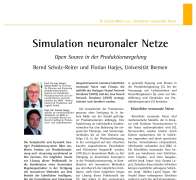
Simulation of Neural Networks – Open Source for Production Control

Simulation of Neural Networks - Open Source for Production Control

Open Source in der Produktionsregelung
Bernd Scholz-Reiter ORCID Icon, Florian Harjes
Dynamics and complexity of today`s production systems bring established approaches for production planning and control to their limits. Accordingly, developing new concepts and methods is a key point for research in this area. The combination of a decentralized control structure and innovative methods from the field of artificial intelligence seems promising here. Open source tools have proven their applicability to implement those methods. They are disposable and can be flexibly adapted to many problems. This contribution introduces an approach for the decentralized control of a shop floor. Here, artificial neuronal networks are used as adaptive control instruments. The simulation of these networks is performed with the open source tool Stuttgart Neural Network Simulator (SNNS) and its successor Java Neural Network Simulator (JNNS).
Industrie Management | Volume 26 | 2010 | Edition 3 | Pages 21-24
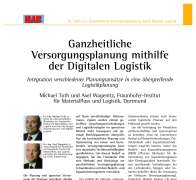
Integrated Supply Plannig – A New Approach of Digital Logistics

Integrated Supply Plannig - A New Approach of Digital Logistics

Integration verschiedener Planungsansätze in eine übergreifende Logistikplanung
Michael Toth, Axel Wagenitz
Considering new challenges in logistics planning and supply processes, companies are forced to plan their supply chains relating to more flexibility, effectiveness and cost reduction. Today, supply processes are planned once and never changed due to new demand or capacity situations. This article will introduce a new approach of integrated logistics planning combining demand and capacity planning (DCP) with supply planning concepts. The result is an Logistic Assistance System (LAS) as a new generation of Digital-Logistics-Software, which allows dynamic supply chain planning by providing DCP-functionalities with a simulation based approach. The developed simulation component is able to handle the complexity of high-value-added branches with efficient algorithms, to forecast the supply chain behaviour (future stock range, dynamic processes and resulting costs) taking different scenarios into account. It has been demonstrated to produce convincing results in different projects.
Industrie Management | Volume 26 | 2010 | Edition 2 | Pages 37-40
1 3 4 5 6