Industrie 4.0

A Recommendation for the Implementation of Innovations

A Recommendation for the Implementation of Innovations

A study on the specific requirements of logistics service provider
Dennis Abel, Hendrik Meyer, Torsten Rudolph
Due to the high requirements of customers, logistics service providers are getting under pressure to improve their processes more efficiently and economically. In this context, the advancing automation and digitalization in all industrial sectors are producing a multitude of innovative solutions which will help solving the problems mentioned before [1]. The resulting sociotechnical systems created this way are often not in the focus due to the new technology. In this study, a project procedure will be presented as a recommendation which will help to introduce an innovation − in this case especially for an automatic guided vehicle− in consideration of the aspects of socio-technical systems.
Industrie 4.0 Management | Volume 37 | 2021 | Edition 3 | Pages 49-52
Maintenance 4.0

Maintenance 4.0

A concept for the representation of maintenance processes and the role of humans in the Industry 4.0
Michael Kelker, Roland Heidel, Lennart Brumby
This article presents a concept for the visualization of maintenance processes in Industry 4.0 using the reference architecture model Industry 4.0, in short RAMI 4.0. The mirroring of maintenance processes is done by transferring relevant maintenance terms from various standards into maintenance assets and the corresponding management shells. Here, the role of the human being has to be considered and the dynamic behaviour of maintenance processes has to be mapped. In this respect, this concept presents different methods of visualizing these issues.
Industrie 4.0 Management | Volume 37 | 2021 | Edition 3 | Pages 63-66
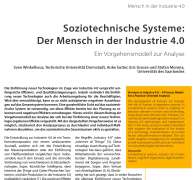
Humans in Industry 4.0

Humans in Industry 4.0

A process model for a practice-oriented analysis
Sven Winkelhaus, Anke Sutter, Eric Grosse ORCID Icon, Stefan Morana
The development of Industry 4.0 changes the role of humans in operations systems. In sociotechnical systems, there is ongoing interaction between humans and technology, impacting human life and work. However, human factors are broadly ignored in research on Industry 4.0 technologies and implementation. In this work, a process model is described that supports the evaluation of the impact of a technology implementation on human factors and performance indicators. This can avoid negative consequences for employees as well as phantom profits and can contribute to a successful digital transformation.
Industrie 4.0 Management | Volume 37 | 2021 | Edition 3 | Pages 45-48 | DOI 10.30844/I40M_21-3_S45-48
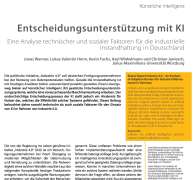
Status Report Industry 4.0

Status Report Industry 4.0

An analysis of adoption barriers for industrial maintenance in Germany
Jonas Wanner, Lukas-Valentin Herm, Kevin Fuchs, Axel Winkelmann, Christian Janiesch
Industry 4.0 is a political concept intended to help German manufacturing companies to exploit data potential. Today, maintenance activities are not proactive by current approaches. Decision support systems based on artificial intelligence allow a change here by even foresighted machine maintenance. However, AI’s opaque decision-making process represents a barrier for users, which endangers its effectiveness. Therefore, this article sheds light on both: the technological as well as social factor for the adoption of AI in Industry 4.0.
Industrie 4.0 Management | Volume 37 | 2021 | Edition 2 | Pages 39-43
Industry 4.0 to Compensate the Shortage of Skilled Workers

Industry 4.0 to Compensate the Shortage of Skilled Workers

Eine Betrachtung für den deutschen Mittelstand
Günther Schuh ORCID Icon, Patrick Scholz, Thomas Scheuer, Tim Latz
German industrial companies are suffering from an increasing shortage of skilled workers. In order to secure Germany’s existing competitive advantages, suitable solutions have to be carried out to counter this shortage. Technologies in the context of “Industry 4.0” offer promising solutions. Using this technologies, significant productivity improvements as well as higher resource utilization rates can be achieved. However, the main challenge is to identify the right technical solutions for the specific business challenges. In the following, a systematic approach is presented to face these challenges.
Industrie 4.0 Management | Volume 37 | 2021 | Edition 1 | Pages 12-16
Industrial Maintenance via Remote Technologies

Industrial Maintenance via Remote Technologies

An Overview of the Current Use of Technologies in Practice
Katrin Wieczorek, Javad Ghofrani, Laura Seiffert, Robert Pampuch, Dirk Reichelt
The level of networking and complexity in intelligent manufacturing is constantly increasing. As a result, the demands on employees are growing, especially due to changing work tasks. In addition, the existing lack of skilled workers leads to bottlenecks. The use of remote technologies opens up new opportunities for collaboration, especially in maintenance. Considering the challenges of industrial maintenance, to what extent can remote technologies be used to efficiently meet these demands? This article provides an overview of the remote technologies currently used and discussed in practice and research. In addition, it shows which prerequisites must be created for an effective application of the technologies.
Industrie 4.0 Management | Volume 36 | 2020 | Edition 6 | Pages 59-64
Working in a Volatile Environment

Working in a Volatile Environment

Skills and working models in the age of the digital transformation
Dominik Augenstein, Eugen Wiebe
Through disruptive changes and an increasing globalization, companies have to rethink their traditional working models. Thereby, the digital transformation seems to provide a solid answer to this challenge and enables a rapid adaption to the new circumstances. Humans are of central importance to respond to these changing demands. A challenge hereby is, that humans have to be embedded in such a flexible working environment considering, that the competence profile is changing rapidly. In order to solve these challenges, a competence profile is provided. Furthermore, it is shown that a working model for the digital transformation enables a company to respond quickly and flexibly to new environmental conditions.
Industrie 4.0 Management | Volume 36 | 2020 | Edition 6 | Pages 51-54
The Potential Model

The Potential Model

Supporting SMEs in selecting suitable Industry 4.0 solutions
Patrick Schumacher, Christian Weckenborg ORCID Icon, Thomas S. Spengler, David Schneider, Tobias Huth, Thomas Vietor
The implementation of Industry 4.0 solutions offers great potential for meeting growing challenges in the context of digitization. Nevertheless, particularly small and medium-sized companies are hesitant to implement Industry 4.0 solutions. Within the framework of the ERDF research project »Synus«, methods and tools were developed to support small and medium-sized companies in the evaluation and selection of Industry 4.0 solutions. This contribution presents the potential model, which enables small and medium-sized enterprises to select suitable Industry 4.0 solutions.
Industrie 4.0 Management | Volume 36 | 2020 | Edition 6 | Pages 25-29 | DOI 10.30844/I40M_20-6_S25-29
Digital Solutions for the Control of Dynamically interconnected Assembly Systems

Digital Solutions for the Control of Dynamically interconnected Assembly Systems

Realisierung von flexiblen Routen im Kontext Industrie 4.0
Jonas Rachner, Simon Hort, Robert Schmitt ORCID Icon
Due to an increased product variety, the need for flexibly configured assembly systems is steadily growing. In contrast to classic assembly lines with predominantly rigid conveyor technology, efficient, individual assembly routes with cycle-independent processing times are implemented in a dynamically interconnected assembly system using intelligent control and AGVs. This article presents the most important factors for the IT-related implementation of a dynamically interconnected assembly system and shows which existing standards from the field of Industry 4.0 can be used for this purpose.
Industrie 4.0 Management | Volume 36 | 2020 | Edition 6 | Pages 43-47
Competencies for Industrial Work 4.0.

Competencies for Industrial Work 4.0.

Requirements and Status Quo of the Competencies of Young Professionals in NRW
Swetlana Franken ORCID Icon
Industry 4.0 is work in progress in Germany, digital technologies such as IoT, KI, Cloud or Big Data Analytics are increasingly being introduced in companies. However, alongside technology, people and organisation are the central success factors of digital transformation. Further training, lifelong learning, agile organisation and corporate culture are becoming increasingly important in companies. Study results on the competence requirements for industrial work 4.0 show that in addition to IT and technical skills, openness, overview knowledge, interdisciplinary cooperation and agility are also required. Young professionals from NRW largely understand the importance of these competences, but show significant deficits in many of them, especially in digital competences, interdisciplinary cooperation and agility. It is necessary to promote these competences in a targeted manner during studies and further education.
Industrie 4.0 Management | Volume 36 | 2020 | Edition 6 | Pages 21-24
1 6 7 8 20