digital twin

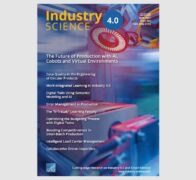
I4S 2/2025: The Future of Production with AI, Cobots and Virtual Worlds

I4S 2/2025: The Future of Production with AI, Cobots and Virtual Worlds

Technology needs innovative, value-adding business models
Artificial intelligence, collaborative robotics, and virtual worlds, such as the metaverse, are fueling visions for new forms of industrial value creation. However, innovation alone is not enough—given that these technologies only develop their full potential through intelligent business models. How can companies efficiently integrate AI-supported automation, cobots and digital twins into their processes?
Assembly in Transition

Assembly in Transition

Empirical results of digitalization
Mathias König ORCID Icon, Herwig Winkler ORCID Icon
Assembly is an important part of industrial production and is also characterized by a high proportion of manual work. Manufacturing companies have an intrinsic interest in increasing personnel productivity and preventing unit labor costs from rising. Many thus hope to gain economic benefits by implementing digitalization projects. The potential of digitalization in assembly must be exploited to achieve these goals.
Industry 4.0 Science | Volume 41 | 2025 | Edition 1 | Pages 42-49
Real-time Reactions for Automated Guided Vehicles (AGV)

Real-time Reactions for Automated Guided Vehicles (AGV)

Monitoring and controlling with long latencies
Dominik Augenstein, Lea Basler
The constant advance of digitalization confronts companies with new challenges and opportunities. Immediate data processing is now ubiquitous and the advantages are obvious. However, broadband coverage in Germany is insufficient, which makes it difficult to improve processes. Mathematical approaches and machine learning enable timely optimization and smooth production.
Industry 4.0 Science | Volume 40 | 2024 | Edition 6 | Pages 56-62
The Key to Successful Digitalization

The Key to Successful Digitalization

Development, implementation and benefits of digital twins in Industry 4.0
Andreas Bayha ORCID Icon, Sönke Knoch ORCID Icon, Dirk Schöttke ORCID Icon
The success of technologies depends not only on their innovative strength and acceptance, but also on their management. Decision-makers evaluate factors like technical framework conditions and organizational requirements, with the demand for flexibility adding to the complexity. Industry 4.0 addresses this with networking, transparency and decentralized decisions. Digital twins, which can be implemented with open source software, play a key role.
Industry 4.0 Science | Volume 40 | Edition 4 | Pages 42-49
Digital Twin and Vertical Integration

Digital Twin and Vertical Integration

Support for sustainability concepts in production processes
Ute Dietrich
Establishing “smart” production processes that are focused on sustainability and based on aggregated data requires a great deal of exchange at various levels. The vertical integration of different production components provides companies with an important basis for achieving their sustainability goals. Digital twins can play a decisive role in driving this process forward.
Industry 4.0 Science | Volume 40 | 2024 | Edition 3 | Pages 67-72
Vom Energiedatenmanagement zum Digitalen Zwilling

Vom Energiedatenmanagement zum Digitalen Zwilling

Vereinfachte Modellierung eines Digitalen Zwillings mithilfe von Energiedaten
Alexander Blinn, Henrik te Heesen, Joachim Brinkmann, Julius Herzog
Bedingt durch globale Entwicklungen hinsichtlich der Preise und Versorgungssicherheit im Energiesektor stehen besonders energieintensive Unternehmen vor großen Herausforderungen. Zusätzlich fordern Kunden mehr Informationen über Energiekennzahlen und CO₂-Emissionen sowie ressourcenschonendere Prozesse. Mit einer energiedatenbasierten Simulationsmethode werden die Ressourceninformationen direkt aus dem Energiedatenmanagementsystem (EDMS) extrahiert und weiterverarbeitet. Hierbei werden sowohl aktuelle als auch stetig aktualisierte historische Daten verwendet, die automatisiert abgeglichen werden. Die digitale Abbildung der vorhandenen Prozesse ist lediglich auf Seiten der Energiedaten notwendig, ohne die technischen Prozesse in ihrer Gänze analysieren zu müssen. Mit dem so erstellten energetischen digitalen Schatten lassen sich Energiebedarfe für bevorstehende Produktionen und Produkte simulieren und können durch automatisierte Vorschläge in der Produktionsplanung positiv ...
Industrie 4.0 Management | Volume 39 | 2023 | Edition 5 | Pages 33-36 | DOI 10.30844/IM_23-5_33-36
Bakery 4.0

Bakery 4.0

Development of an IoT framework for the automatic collection of machine, process data in medium-sized bakery operations
Abderrahim Ait Alla ORCID Icon, Frida Köning, Heiner Alsen, Joshua Coordes, Michael Freitag ORCID Icon
While the digital world has already made its way into many other production areas, the bakery industry has so far benefited little from these technological developments. This is because many baking processes are manually controlled and rely on expert knowledge. In addition, the process data from the machines is still not automatically captured via sensors. This paper describes a procedure for digitizing baking processes by developing an IoT framework consisting of an IoT device including measurement methods, an edge gateway, and a simulation-based solution for process optimization.
Industrie 4.0 Management | Volume 39 | 2023 | Edition 3 | Pages 36-40
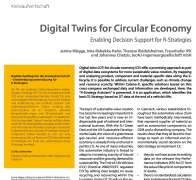
Digital Twins for Circular Economy

Digital Twins for Circular Economy

Enabling Decision Support for R-Strategies
Janine Mügge, Inka Rebekka Hahn, Theresa Riedelsheimer ORCID Icon, Johannes Chatzis
Digital twins (DT) for circular economy (CE) offer a promising approach as part of digital data ecosystems for more sustainable value creation. By mapping and analyzing product, component and material specific data along the li- fecycle, it is possible to address current challenges such as climate change and resource scarcity. Within Catena-X, specific solutions based on this cross-company exchanged data and information are developed. Here, the “R-Strategy Assistant” is presented. It is an application, which identifies the best CE-Strategy based on DT data at the end of a vehicle's life.
Industrie 4.0 Management | Volume 38 | 2022 | Edition 6 | Pages 42-46 | DOI 10.30844/IM_22-6_33-36
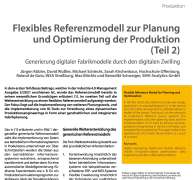
Flexible Reference Model for Planning and Optimization

Flexible Reference Model for Planning and Optimization

Generierung digitaler Fabrikmodelle durch den digitalen Zwilling
Jürgen Köbler, David Wußler, Michael Schlecht, Sarah Kirchenbaur, Roland de Guio, Max Blöchle, Benedikt Schwaiger
In the first article, the reference model was already explained in its essential features [1]. In the second part, the further development to a flexible reference model will be shown. The focus is on the extension to implement different source systems, the implementation of further planning tools, and the implementation of AI tools to achieve dynamic production engineering in the form of holistic and integrated factory planning. This paper explains the development of a holistic demonstrator as a proof of concept.
Industrie 4.0 Management | Volume 38 | 2022 | Edition 5 | Pages 45-48 | DOI 10.30844/IM_22-5_45-48
Multidimensional Maturity Model for Digital Twins

Multidimensional Maturity Model for Digital Twins

Method for Systematic Classification and Assessment
Michael Lütjen ORCID Icon, Eike Broda, Jan-Frederik Uhlenkamp, Jasper Wilhelm, Michael Freitag ORCID Icon, Klaus-Dieter Thoben ORCID Icon
Digital twins are an important part of the Industry 4.0 idea. They mirror physical goods in the digital world and enhance them with additional capabilities and functions for analysis, forecasting and decisionmaking. This paper contributes to the classification and assessment of Digital Twins using a multidimensional maturity model. The presented method "DT-Assess" enables an application-specific assessment of Digital Twins. The developed maturity model consists of seven categories with a total of 31 characteristics to be evaluated. The systematic evaluation in five application scenarios allows, for the first time, a classification of the respective "digital twin" implementation or concept with the aim of identifying further development options and weaknesses.
Industrie 4.0 Management | Volume 38 | 2022 | Edition 5 | Pages 7-11
1 2 3 4