Potenzial: Globalization

Industry 4.0 – The Way to a Digitised Production Company

Industry 4.0 - The Way to a Digitised Production Company

Der Weg zu einem digitalisierten Produktionsunternehmen
Jürgen Köbler, Tobias Fischer, Benjamin Klerch, Michael Schlecht
The age of globalisation is characterised by increased competition. An opportunity to succeed in the face of increasing competition lies in the digitisation of production companies. This article is dedicated to the design of a three-stage model platform of Industry 4.0, which focuses on the consistency of processes from the customer to the supplier at all company levels. The model platform is followed by an overview of the transformation steps for evaluating and shaping progress on the way to become a digitised production company.
Industrie 4.0 Management | Volume 36 | 2020 | Edition 3 | Pages 57-60 | DOI 10.30844/I40M_20-3_S57-60
Digitalization, Globalization and Sustainable Development

Digitalization, Globalization and Sustainable Development

Application to digital manufacturing
Ortwin Renn
In light of the three major global transformations of globalization, digitalization and sustainabilization industrial production faces new challenges and targets. On the one hand industrial modernization in the direction of digital manufacturing (Industry 4.0) has to cope with the new protectionist policies that have started in the United States as a countermovement to globalization. On the other hand, the new vocal demand for climate protection and environmental quality assurance puts pressure on the industry to align its policies with the demand for ecological modernization. It is essential that industrial policy makers include not only efficiency goals as targets for their investment plans but also environmental quality and social compatibility. Keywords:
Industrie 4.0 Management | Volume 35 | 2019 | Edition 6 | Pages 21-23
Departure of Logistics

Departure of Logistics

How the block chain will change networked supply chains in the future
Anja Wilde, Jan-Henner Theißen
A powerful cross-organizational collaboration within the global value chain will continue to be a major competitive advantage in the future. The way supply chains are managed today will no longer be sufficient tomorrow. Blockchain technology makes it possible to technologically map intermediary functions without manifesting the market power of just one central platform (intermediary). On the basis of Blockchain-technology, trusting (data-) networks are created across company boundaries. The technology will not solve all operational problems; however, it may help to secure processes and simplify communication.
Industrie 4.0 Management | Volume 35 | 2019 | Edition 1 | Pages 43-46
Industry 4.0 Business Models

Industry 4.0 Business Models

An analytical framework of Industry 4.0 potentials and necessary adaptations
Patricia Deflorin, Maike Scherrer, Janick Amgarten
Technological changes related to Industry 4.0 generate new potentials. Hence, it is important to understand which dimensions of a business model to adapt. Industry 4.0 technologies enable a company to offer new products, new services or to achieve efficiency improvements. The Industry 4.0 business model decomposition allows visualising which goal the initiative has, what the value offering is and which processes, technologies and capabilities are needed. As connectivity is a key dimension of Industry 4.0, technologies and systems are needed to connect internal and external processes.
Industrie 4.0 Management | Volume 33 | 2017 | Edition 5 | Pages 21-24
Is Predictive Maintenance the Killer App for IIoT?

Is Predictive Maintenance the Killer App for IIoT?

Christoph Papenfuss
Predictive, or condition-based, maintenance is a shining goal for industrial customers and the Industrie 4.0 initiative. Supplementing, or even replacing, inefficient schedule-based maintenance with software promises to reduce equipment failures and unplanned downtime, improve safety and ultimately help the bottom line in an era of unstable prices and uncertain budgets. Predictive maintenance might be taking longer than expected, but in the next five years you might see it move faster than expected.
Industrie 4.0 Management | Volume 33 | 2017 | Edition 2 | Pages 57-60
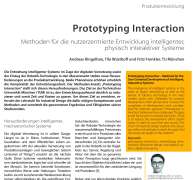
Prototyping Interaction

Prototyping Interaction

Methods for the user centered development of intelligent, interactive systems
Andreas Ringelhan, Tilo Wüsthoff, Fritz Frenkler
The emergence of intelligent systems in the wake of digital networking, as well as the advent of robotics technology in the mass market, poses new challenges for product development. Both phenomena increase the complexity of development work considerably.The methods approach “Prototyping Interaction” addresses these challenges. The goal at the Technische Universität München (TUM) is to reduce the development effort significantly, in order to save time and money. The Chair of Industrial Design explores the necessary skills and methods to reach this goal. And the results are taught to the students.
Industrie 4.0 Management | Volume 32 | 2016 | Edition 1 | Pages 11-14
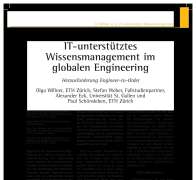
IT-Supported Knowledge Management in Global Engineering

IT-Supported Knowledge Management in Global Engineering

Herausforderung Engineer-to-Order
Olga Willner, Stefan Weber, Alexander Eck, Paul Schönsleben
As a consequence of globalized markets product development and engineering functions increasingly work in globally distributed teams. To overcome challenges of global engineering processes, leading companies employ IT applications for storing knowledge centrally and accessing it locally. Typical IT applications however are not sufficient for engineer-to-order products, i.e. products that are engineered and built to the particular specifications of a customer. This paper explores on the example of a large elevator manufacturer how knowledge-intensive tasks can be coordinated and executed globally, efficiently combining the distinct capabilities of distributed engineering sites.
Industrie Management | Volume 30 | 2014 | Edition 4 | Pages 49-52
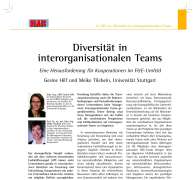
Diversity in Interorganizational Teams

Diversity in Interorganizational Teams

A challenge for cooperation in the R&D environment
Gesine Hilf, Meike Tilebein ORCID Icon
The ongoing demographic change leads to an increasing lack of highly skilled workforce which affects especially R&D driven organizations. In order to counter this effect, organizations tend to cooperate and form alliances and networks. This way they can pool their resources in interorganizational teams and gain access to complementary skills. On a micro level, the success of cooperations thus strongly depends on the success of the respective interorganizational teams. While traditional diversity research focuses on benefits and risks of heterogeneous teams within one organization, interorganizational teams are faced with additional challenges regarding diversity. In order to identify management issues and to gain a comprehensive overview of the relevant diversity dimensions and their complex interactions, we explore different perspectives on interorganizational R&D teams and integrate them into a framework for further research.
Industrie Management | Volume 29 | 2013 | Edition 3 | Pages 25-28
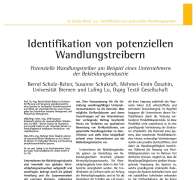
Procedure for the Identification of Change Drivers

Procedure for the Identification of Change Drivers

Potenzielle Wandlungstreiber am Beispiel eines Unternehmens der Bekleidungsindustrie
Bernd Scholz-Reiter ORCID Icon, Susanne Schukraft, Mehmet-Emin Özsahin, Luling Lo
Today, companies operating in the textile industry are integrated within value chain networks. Due to the global distribution and the cooperation with external partners, these companies underlie several influencing factors. In the case that the reaction to these influencing factors is not possible with the use of the existing flexibility, a basic adaption of the company structure is required. The potential to undergo these necessary changes is also named as changeability. To create changeable network structures it is firstly necessary to know about potential influencing factors and their impacts onto the company. The paper on hand therefore describes a procedure for the identification and evaluation of potential change drivers and introduces identified, potential change drivers using the example of a company that is active in the field of the apparel industry.
Industrie Management | Volume 28 | 2012 | Edition 6 | Pages 19-22
Value Chains for Wireless Charging Systems

Value Chains for Wireless Charging Systems

Konsequenzen der kontaktlosen Energieübertragung in Elektrofahrzeuge für automobile Wertschöpfungsketten
Florian Risch, Stefan Günther, Jörg Franke
Due to their considerable advantages, wireless charging systems have the potential of becoming the key market driver for electric vehicles. In addition to their large potentials there are new demands concerning cost reduction of the necessary components and the associated production networks in the automotive industry which must be addressed early on. Therefore, it is the aim of this paper to present the value chains for the new components from suppliers to final assembly lines. The possibilities of allocating the manufacturing processes in the supply chain and the interfaces between the companies are discussed. The consideration of the logistics processes is also done with regards to the appropriate handling and assembly technology.
Industrie Management | Volume 28 | 2012 | Edition 5 | Pages 45-48
1 2 3 5