Potenzial: Globalization

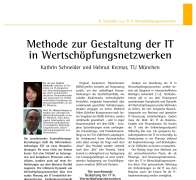
Method for Shaping IT in Value-Added Networks

Method for Shaping IT in Value-Added Networks

Kathrin Schneider, Helmut Krcmar
The increasing demand for collaborative value chains challenges the IT. Both the integration of a heterogeneous and complex process and IT-landscape in a short time and the flexible support of new requirements from the business have to be assured. The dynamism of cooperation makes an exact planning of implementation and IT-costs exceedingly difficult. Therefore, the article shows a method that allows a systematic and structured planning and design of the IT in value-added networks.
Industrie Management | Volume 28 | 2012 | Edition 1 | Pages 37-40
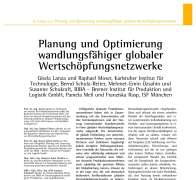
Planning and Optimization of Changeable Global Value Added Networks

Planning and Optimization of Changeable Global Value Added Networks

Gisela Lanza ORCID Icon, Raphael Moser, Bernd Scholz-Reiter ORCID Icon, Mehmet-Emin Özsahin, Susanne Schukraft, Pamela Meil, Franziska Rasp
Due to the concentration of core competences and the utilisation of international location advantages successful German production companies face a situation with globally dispersed sites in global value added networks. The ongoing globalisation, which includes the integration of external sites, suppliers and partners, leads to complex interactions within networks. However, these interactions are not or are simply partially known and not predictable so far. Being able to control dramatic dynamics in the behaviour of global value added networks, German production companies will be positively affected by globalisation in the future. Therefore, changeable global value added networks which can be quickly adjusted to dynamics become crucial. The paper on hand describes an approach for the planning and optimization of adaptable global value added networks. Background is the approach of the research project “planning and optimization of changeable global value added networks” (POWer.net) ...
Industrie Management | Volume 27 | 2011 | Edition 3 | Pages 57-60
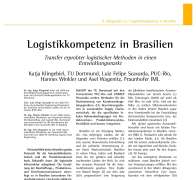
Logistics Competence in Brazil

Logistics Competence in Brazil

Transfer erprobter logistischer Methoden in einen Entwicklungsmarkt
Katja Klingebiel, Luiz Felipe Scavarda, Hannes Winkler, Axel Wagenitz
Brazil offers great potential, e.g. for the automotive industry. However procurement, production and distribution structures often lead to specific challenges. To cope with these challenges tested logistic planning approaches can be transferred. This article describes the cooperation between the Fraunhofer IML, Germany, and various Brazilian partners to initiate such a knowledge transfer and to adopt supply chain planning methods for the Brazilian automotive industry.
Industrie Management | Volume 27 | 2011 | Edition 2 | Pages 33-37
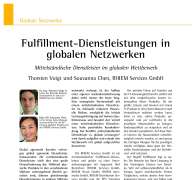
Fulfillment Services in Global Networks

Fulfillment Services in Global Networks

Mittelständische Dienstleister im globalen Wettbewerb
Thorsten Voigt, Souvanna Chen
Global brands require global service providers for supporting their worldwide business. Especially for SME service providers this represents a significant challenge. Whereas physical products more or less look alike in different world markets, peoples’ expectations on services can be of entirely different nature. Therefore a service provider might be forced to re-invent his services when entering a new market. Beyond that, the obvious financial and cultural challenges of founding an organization in a foreign market remain. For those reasons it may not always be the best solution to found an own organization in a foreign market. A strategic partnership with a SME service provider in that other market reduces financial risks, enables high quality services from day one on and preserves a major USP of SME service provider: top managements’ commitment. The conflict “SME service provider” vs. “global services” can be solved and allows SME service providers to compete with global ...
Industrie Management | Volume 26 | 2010 | Edition 5 | Pages 36-38
Requirements for Quality Management Systems in Dynamic Enterprise Networks

Requirements for Quality Management Systems in Dynamic Enterprise Networks

Anforderungen an Qualitätsmanagementsysteme
Patrick Sitek, Marcus Seifert, Klaus-Dieter Thoben ORCID Icon
Demanding customer requirements have led to the situation where products are realised in Dynamic Enterprise Networks by different cooperating companies. In an extreme case such networks exist only for one specific customer order. Such temporary and dynamic organisation forms also make new demands on Quality Management (QM) approaches. Existing QM practices mostly focus on assuring and improving quality of standardised processes inside single companies or long-term relations between business partners in supply chains. This paper discusses in particular the requirements for Quality Management Systems following the DIN EN ISO 9001 in Dynamic Enterprise Networks.
Industrie Management | Volume 26 | 2010 | Edition 4 | Pages 25-28
India’s Global Portals of Engineering and Management Education

India’s Global Portals of Engineering and Management Education

Avrath Chadha, Bhola R. Gurjar
The technical universities which were founded after India’s independence fulfil the dream of the first prime minister Nehru of an advanced and self-sufficient India. Universities such as the IIT Delhi have the ambition to play in the international top league. Multinationals like IBM are attracted by the large number of talented engineers and scientists and have numerous cooperations with Indian universities. American and European universities are trying to integrate Indian students and graduates in their curriculum and research. This article gives an overview on the diverse Indian university and research landscape and shows which advantages western companies and universities have by working together with Indian top-universities.
Industrie Management | Volume 25 | 2009 | Edition 6 | Pages 49-52
Coping with technology driven changes

Coping with technology driven changes

Mediating dynamic organizational structures through gaming
Bernd Scholz-Reiter ORCID Icon, Ernesto Morales Kluge
To prepare employees for structural changes within the organization is crucial for the competitiveness of an enterprise. Pretty often changes in an organization are enabled and driven by technological innovations, e.g. information and communications technologies. The arising information and qualification deficit of the employees has to be faced with respect to the changed organizational environment. In this article we describe how these effects can be faced with the methodology of business simulation games.
Industrie Management | Volume 25 | 2009 | Edition 2 | Pages 9-12
Emerging Chinese Companies

Emerging Chinese Companies

A serious challenge for the competitiveness of German companies
Heiko Gebauer, Thomas Fischer
Chinese industrial companies have evolved into serious competitors for German companies. The success of companies such as Lenovo, Haier, Huawei or CIMC is a clear proof of their competitiveness. What is interesting is that they do not follow the traditional Western management principles. The competitive behaviour of Chinese companies differs from Western companies similar to the Japanese with their revolutionary management concepts such as Lean Management, Total Quality Management or Kaizen. The lack of knowledge on Chinese competitive behaviour often leads Western managers to making the wrong decisions in terms of sustaining or extending their market position as opposed to Chinese competitors. This article gives a detailed description of the competitive behaviour of Chinese companies and offers a guideline for managers on how to deal with emerging Chinese challengers.
Industrie Management | Volume 24 | 2008 | Edition 6 | Pages 15-18
Internationalization of Services

Internationalization of Services

An analysis in the form of system bundling
Michael Schenk, Jörg von Garrel
Although German planning service providers have specialized know-how in the field of factory planning, their size and insufficient resources limit their options to provide their services internationally. The formation of networks represents an outstanding opportunity for SME to bundle their competencies to become active in international markets. In order to support this process, this article identifies opportunities for bundling systems from the perspective of providers and describes potential network configurations. In addition, it introduces measures and actions intended to support planning service providers when they implement their services internationally in a network.
Industrie Management | Volume 24 | 2008 | Edition 5 | Pages 65-68
Strategic Marketing of Industrial Service Networks

Strategic Marketing of Industrial Service Networks

Jörg von Garrel, Daniel Reh
Processes of profound change are taking place in industrial manufacturing and the service sector, both nationally and internationally. If they are to be or remain competitive, enterprises must be able to adapt and evolve. These new demands are creating particular potentials for planning service providers to apply and offer their know-how as a service worldwide. Above all, the opportunity resulting from supplying services for the complete factory life cycle can be used to develop new customers and markets. Strategic marketing also enables a network of SME to carry out projects worldwide.
Industrie Management | Volume 24 | 2008 | Edition 2 | Pages 31-34
1 2 3 4 5