Services

Market Survey: Services in Industry and Logistics

Market Survey: Services in Industry and Logistics

Ann-Katrin Edel, Nele Brenner
The following short market survey presents interfaces between services in industry and logistic of five different providers. Main topics in the survey were the use of IT-Systems, connection with cooperation partners, challenges in the Supply Chain and trends concerning the future of industrial services.
Industrie Management | Volume 24 | 2008 | Edition 5 | Pages 79-81
Product-Service Value Bundles as an Emerging Prospect for Vendors of ERP Systems

Product-Service Value Bundles as an Emerging Prospect for Vendors of ERP Systems

Jörg Becker ORCID Icon, Ralf Knackstedt, Martin Matzner, Tim Kröger
Enterprises increasingly seek to differentiate from competitors by offering complete solutions in form of aligned goods and services. Effectively and efficiently offering such integrated solutions (also referred to as hybrid value bundles) requires an integration of production’s and service unit’s data and processes. Supporting the required data exchanges and providing novel functionality opens up new vistas for vendors of ERP systems.
Industrie Management | Volume 24 | 2008 | Edition 5 | Pages 69-73
Designing Competitive Service Portfolios

Designing Competitive Service Portfolios

Christian Nedeß, Axel Friedewald, Daniel Eggers
industrial enterprises to permanently develop new strategies to differentiate themselves from their competitors. Besides product innovations, services complementing these products are increasingly used for differentiation purposes. But only the right combination of different services forming a service portfolio allows successful service offering. Therefore, a systematic engineering approach is required to compose a service portfolio that fits to a company’s potentials as well as to customer requirements. However, until today this aspect of service engineering is not continuously and systematically supported.
Industrie Management | Volume 24 | 2008 | Edition 2 | Pages 19-22
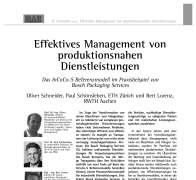
Effective Management of Business Related Services

Effective Management of Business Related Services

Using the InCoCo-S reference model
Oliver Schneider, Paul Schönsleben, Bert Lorenz
In recent years machine and plant manufacturers transformed to providers of complex after-sales services. After that transformation, many companies have problems in managing their activities effectively and efficiently. There is a lack of transparency on the not longer material driven processes. Bosch Packaging Services AG, as a provider of extensive after-sales services for the packaging machines sold by Bosch, realized the needed transparency through the development of two software tools on the basis of the InCoCo-S Reference Model, a process reference model for industrial services. Now Bosch Packaging Services is in the position to offer sustainable service contracts with adequate prices and realistic performance levels.
Industrie Management | Volume 24 | 2008 | Edition 2 | Pages 71-74
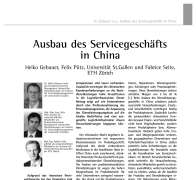
Extending the Service Business in China

Extending the Service Business in China

Heiko Gebauer, Felix Pütz, Fabrice Seite
Confronted with intensive product price competition in China, industrial firms are forced to invest in extending the service business. Extending the service business is far from easy. Chinese competitors offer faked spare parts. Local service skills are very poor and service requirements force industrial firms to invest in logistic infrastructure. This article offers a guideline for managers seeking to professionalize the human resource management in the service organization, to adapt service offerings to the local customer needs, and to set-up a logistic infrastructure.
Industrie Management | Volume 24 | 2008 | Edition 1 | Pages 19-22
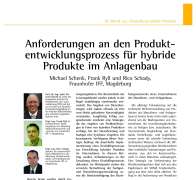
Process of Hybrid Product Development

Process of Hybrid Product Development

Requirements in mechanical and plant engineering
Michael Schenk, Frank Ryll, Rico Schady
Today, mechanical and plant engineering companies are already providing service bundles in the form of product-service combinations. These consist of common ranges of services, e.g. for development, customisation, operator, financing or maintenance. As a rule however, the elements of service bundles are developed separately. Moreover, the services offered are often viewed as a necessity demanded by the market. A strategy appearing to promise long-term success is pursued by offering solutions in the form of hybrid products in which service and material good form a symbiotic relationship. Rigorously pursuing this strategy entails sustainably implementing a business process to develop hybrid products in a company. This paper discusses requirements of organizing this business process. Attention is focused on a networked approach to developing material goods and services as well as the incorporation of a mechanical and plant engineering company’s network of relationships.
Industrie Management | Volume 22 | 2006 | Edition 1 | Pages 55-58
An Approach to the Design of Technical Product Service Systems

An Approach to the Design of Technical Product Service Systems

Jan C. Aurich, Christian Fuchs, Peter Barbian
In today’s competitive environment, product enhancing technical services (service products) are increasingly perceived as success factors in the production industry. Consequentially, there is a need for practically oriented models for systematic service product design. This paper defines service products and describes their functions and corresponding design dimensions. Furthermore, a recently developed phase model for systematic service product design is introduced, based on which an approach for the design of technical product service systems is presented. The approach aims at exploiting the largely unused potentials of the distribution and service network partners with which many production companies work together.
Industrie Management | Volume 20 | 2004 | Edition 5 | Pages 13-16
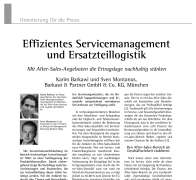
Efficient Service Management and Spare Parts Logistics

Efficient Service Management and Spare Parts Logistics

Mit After-Sales-Angeboten die Ertragslage nachhaltig stärken
Karim Barkawi, Sven Montanus
The stagnation of capital spending in the capital goods market leads to longer product lifecycles. For this reason the demand for support services and spare parts is continuously increasing as those are needed for maintenance and repairs. For suppliers of capital goods this means opportunity and challenge at the same time: While highly profitable after-sales services can compensate declining new product sales the after-sales business requires efficient service organisations which make support services and spare parts available, according to service level agreements.
Industrie Management | Volume 20 | 2004 | Edition 5 | Pages 32-34
Basic Essentials of Strategic Service Management

Basic Essentials of Strategic Service Management

Defining the Breadth of Service Offering
Katharina Hildenbrand, Heiko Gebauer, Elgar Fleisch
Many manufacturing companies want to become solution providers. Unfortunately, they have not extended their service offering systematically. They also have not built up the required capabilities in the company. The article describes how companies can find the right breadth of service offering and the required competences by analysing the customers' processes and needs. The article serves as a guideline for managers to extend and implement the service offering.
Industrie Management | Volume 20 | 2004 | Edition 5 | Pages 17-20
Analysis and Representation of Product-Related Service Processes

Analysis and Representation of Product-Related Service Processes

Gunter Lay, Saskia Tegtmeyer
In many cases producers of investment goods offer their customers product-related services to enhance the problem solving possibilities of the product. As these service offers are gaining importance for industry, an ever-increasing necessity to optimise service processes, as has been done for production processes in the past, emerges. Experiences so far clearly show that many industrial companies have not yet realised this necessity. Service processes are often provided in a rather unorganised way. Against this background this paper presents a tool to assist industrial efforts to analyse and optimise service processes.
Industrie Management | Volume 20 | 2004 | Edition 1 | Pages 40-43
1 3 4 5