Management

Successful Quality Management in Manufacturing Companies

Successful Quality Management in Manufacturing Companies

Insights from an International Industry Study
Robert Schmitt ORCID Icon, Sebastian Schmitt, Alexander Linder, Frank Lesmeister, Daniel Spindelndreier
The view on quality as a critical competitive factor has been established not only in Western countries but is on the rise in emerging markets, too. In the complex of products and rising customer expectations, many companies try to reduce costs and increase the market opportunities for their products by applying broad-based quality initiatives. Normatively distinct quality management offers only few instructions for these approaches, which is constraining the success of the initiatives. Within the framework of an international study on quality management in manufacturing companies, critical success factors and best practices have been identified on the way to the sustainable establishment of effective quality management. On basis of a developed maturity assessment tool, companies are given the ability to identify the status of their own quality management in comparison to best practice.
Industrie Management | Volume 29 | 2013 | Edition 5 | Pages 61-65
Managing Processes of Change Successfully: The Development of Lower

Managing Processes of Change Successfully: The Development of Lower

Die Entwicklung der unteren Führungsebene als Schlüsselfaktor
Rainer Feldbrügge
Demographic trends have direct impact on production and logistics. They affect adversely both the work in the production hall and the company’s profit. To cope with these threats investment in the lower rank of management is necessary. The following article lines out how companies train their technicians and shift managers for the challenges of demographic change, which are in detail staff growing older, decreasing qualifications of new employees and higher staff turnover.
Industrie Management | Volume 29 | 2013 | Edition 3 | Pages 11-14
Time Management – a Long-term and Structured Way of Utilizing Time

Time Management - a Long-term and Structured Way of Utilizing Time

Langfristig strukturiert mit der eigenen Zeit umgehen
Aurelia Drocur
Suggestions, techniques, strategies and ideas for optimizing time management are dime a dozen. But not all of these general methods can really change the long-term and structured way of utilizing time. One fails mostly because the method is not implemented consistently or the technique cannot be transferred to the daily routine. In order to change in the long run, prior knowledge and customization to the individual requirements are essential. This is shown by new findings of scientific research. The bottom line is that there are some really helpful techniques when it comes to time management but that the problem mostly is not starting new strategies but maintaining them.
Industrie Management | Volume 29 | 2013 | Edition 3 | Pages 73.76
Participative Evaluation of Requirements in SME

Participative Evaluation of Requirements in SME

Die Ressource „Mitarbeiter“ nutzen
Dagmar Liebehentze, Franz J. Heeg, Brigitte Schneider-Heeg, Ralf Brüger
The human engineering and business-oriented literature delivers since the 60s of the last century a lot of examples how to involve employees in change processes. A consistent methodology is certainly missing. Eminently in small and medium-sized businesses existing approaches are not used for daily tasks. To reach a systematic and successful participation of employees in change processes it is necessary to have an approach which analyzes the relevant surrounding system and also uses and develops the competences, experiences and attitudes of all participants (both staff and executives).
Industrie Management | Volume 28 | 2012 | Edition 6 | Pages 59-62
Mobile Systems for Collecting Life Data

Mobile Systems for Collecting Life Data

Capabilities, Potentials and Challenges for Use in the Service
Marco Lewandowski, Stephan Oelker
The acquisition of technical data throughout the life of a product is of enormous importance in many industrial areas. For example, the maintenance processes can be designed to be more efficient and derived findings from the operational phase can be used for the development of new generations of products. Mobile systems that support the management of complex technical systems allow greater attention to the operational phases of the lifetime utilizing familiar concepts, such as product lifecycle management (PLM). The requirements and challenges of mobile systems are shown and compared with current trends and concepts.
Industrie Management | Volume 28 | 2012 | Edition 4 | Pages 15-19
Structure vs. Creativity

Structure vs. Creativity

Enabling knowledge work between creativity and strict processes with structured wikis
Stefan Voigt
Within structured wikis we can combine the web 2.0-advantages - flexibility, collective intelligence, self-organization and participation - with process oriented knowledge work. These wikis are able to use process structures to support complex processes. Thus, a structured wiki supports knowledge work in know-ledge intensive processes. Users are not bound to strict processes as the wiki technology enables creativity by definition. This paper shows the differences between traditional and structured wikis by example.
Industrie Management | Volume 28 | 2012 | Edition 3 | Pages 70-74
Corporate Culture—Barrier or Potential for Transformability?

Corporate Culture—Barrier or Potential for Transformability?

An empirical view on the mutability of enterprises
Horst Meier, Julia Velkova, Stefan Schröder, Tobias Wienzek
Challenges of transformability have recently experienced great consideration within the field of scientific research. First empirical research has shown that the German term for transformability „Wandlungsfähigkeit” in many cases is used as a synonym for the term “flexibility”. Today’s scientific considerations on this topic mostly focus the technical aspects. However, further aspects such as human resources and organizational factors have to be implied in the present research on conditions that enable change processes. In the course of considerations about conditions the aspects of corporate culture and informal structures attain more attention. The evaluation is conducted as a business analysis and is complimented with qualitative interviews (informal structures). Through this first results and indicators for empowerers and constraints for change are identified.
Industrie Management | Volume 28 | 2012 | Edition 3 | Pages 56-60
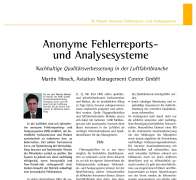
Sustainable Quality Improvement in Aviation

Sustainable Quality Improvement in Aviation

A method involving anonymous incident reporting systems
Martin Hinsch
In aviation anonymous incident reporting systems (IRS) have been set up for decades to reduce or to control operational incidents and risks systematically. The aim of such instruments is to fall back on existing knowledge of the employees in order to optimize operational performance. The system can only be successful in the long run, if anonymity and non-punitivity are guaranteed. Moreover, the company requires a constructive error culture.
Industrie Management | Volume 27 | 2011 | Edition 4 | Pages 69-72
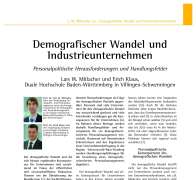
Demographic Change and Industrial Enterprise

Demographic Change and Industrial Enterprise

Personalpolitische Herausforderungen und Handlungsfelder
Lars W. Mitlacher, Erich Klaus
The percentage of employees beyond 50 years of age will grow tremendously over the next 25 years. Fewer younger workers will be available and companies will face the challenge to retain older workers. Companies will be required to introduce an age-differentiated human resource management that deals with the challenges of an older workforce. Based on the results of a survey of companies primarily from the industrial sector, the paper analyses the current situation and develops recommendations for necessary changes in the design of HR instruments of companies.
Industrie Management | Volume 27 | 2011 | Edition 4 | Pages 39-42
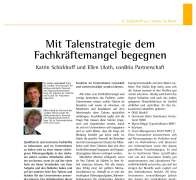
Strategy of Facing a Lack of Skilled Employees

Strategy of Facing a Lack of Skilled Employees

Katrin Schickhoff, Ellen Uloth
Getting qualified and motivated employees and high potentials for companies and keeping them is going to be an important issue in leadership in the years to come. Employees achieve the most if they have a clear understanding of their working tasks and claims by using their talents and resources to their best. Not following these in house policies will lead to a high fluctuation, high status of employee´s illness and burn out. Implementing those resourceful strategies will lead to higher strength and better use of talents in business.
Industrie Management | Volume 27 | 2011 | Edition 4 | Pages 27-30
1 6 7 8 11