Autor: Marcus Seifert

Need for Vocational Training and Intelligent Cargo

Need for Vocational Training and Intelligent Cargo

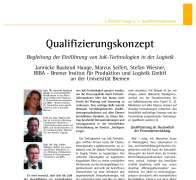
Begleitung der Einführung von IuK-Technologien in der Logistik
Jannicke Baalsrud Hauge, Marcus Seifert, Stefan Wiesner
It is expected that employment will increase in the next 5 years. Furthermore, several surveys examining the training needs state that there is a large need for improving the qualification of employees working at all different positions within the supply chain. The need for qualified persons cannot only be fulfilled by motivating the employees in continuous learning. This article shows an approach used for vocational training in the field of Intelligent Cargo.
Industrie Management | Volume 27 | 2011 | Edition 4 | Pages 77-81
Knowledge Management for Small and Medium Sized Enterprises

Knowledge Management for Small and Medium Sized Enterprises

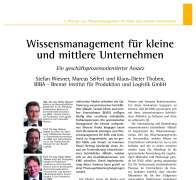
A Business Process Oriented Approach
Stefan Wiesner, Marcus Seifert, Klaus-Dieter Thoben ORCID Icon
The handling of customer-individual requirements, product variants and a worldwide market requires the professionalization of knowledge-intense processes. Small and Medium sized Enterprises (SME) often have excellent individual competencies, but lack a systematic management of the associated knowledge. IT-solutions for Knowledge Management in SMEs provide limited functionalities and are thus rarely used. Therefore, a need exists for the business process oriented approach for Knowledge Management in SMEs, featured in this article. Implemented in a portal for information management, it supports optimization of knowledge-intense processes.
Industrie Management | Volume 27 | 2011 | Edition 4 | Pages 31-34
Requirements for Quality Management Systems in Dynamic Enterprise Networks

Requirements for Quality Management Systems in Dynamic Enterprise Networks

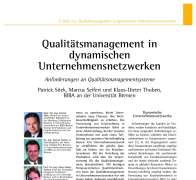
Anforderungen an Qualitätsmanagementsysteme
Patrick Sitek, Marcus Seifert, Klaus-Dieter Thoben ORCID Icon
Demanding customer requirements have led to the situation where products are realised in Dynamic Enterprise Networks by different cooperating companies. In an extreme case such networks exist only for one specific customer order. Such temporary and dynamic organisation forms also make new demands on Quality Management (QM) approaches. Existing QM practices mostly focus on assuring and improving quality of standardised processes inside single companies or long-term relations between business partners in supply chains. This paper discusses in particular the requirements for Quality Management Systems following the DIN EN ISO 9001 in Dynamic Enterprise Networks.
Industrie Management | Volume 26 | 2010 | Edition 4 | Pages 25-28