Management

Climate Neutrality and Digitization

Climate Neutrality and Digitization

A maturity-based approach to identifying measures in production
Stefan Seyfried ORCID Icon, Lukas Martin, Matthias Weigold
Climate neutrality and digitisation are two future-relevant and interlinked topics that are gaining in importance for manufacturing companies. However, especially for small and medium-sized enterprises (SMEs), it is often difficult to get an overview of the concepts and practical measures in these fields. This article presents a maturity model that offers companies practical assistance in combining the goals of climate neutrality and digitisation and in identifying suitable (digitisation) measures for the company to support the transformation towards climate-neutral production. (Only in German)
Industrie 4.0 Management | Volume 39 | 2023 | Edition 2 | Pages 51-55
Multidimensional Maturity Model for Digital Twins

Multidimensional Maturity Model for Digital Twins

Method for Systematic Classification and Assessment
Michael Lütjen ORCID Icon, Eike Broda, Jan-Frederik Uhlenkamp, Jasper Wilhelm, Michael Freitag ORCID Icon, Klaus-Dieter Thoben ORCID Icon
Digital twins are an important part of the Industry 4.0 idea. They mirror physical goods in the digital world and enhance them with additional capabilities and functions for analysis, forecasting and decisionmaking. This paper contributes to the classification and assessment of Digital Twins using a multidimensional maturity model. The presented method "DT-Assess" enables an application-specific assessment of Digital Twins. The developed maturity model consists of seven categories with a total of 31 characteristics to be evaluated. The systematic evaluation in five application scenarios allows, for the first time, a classification of the respective "digital twin" implementation or concept with the aim of identifying further development options and weaknesses.
Industrie 4.0 Management | Volume 38 | 2022 | Edition 5 | Pages 7-11
How Does the Image of the HR Department Influence Recruiting?

How Does the Image of the HR Department Influence Recruiting?

David Padilla
Manufacturing companies are currently facing many hurdles. It is becoming increasingly difficult for them to find qualified workers, so-called blue collar workers. Technology adoption and system usability also pose challenges in the industry, as digital time tracking and shift scheduling are far from the norm in the industrial sector. Human resources software should facilitate the daily tasks of departments in order to achieve business goals. The use of such technologies saves valuable time as processes are automated. The needs of employees are put in the foreground to improve both resource planning and communication of manufacturing companies.
Industrie 4.0 Management | Volume 38 | 2022 | Edition 5 | Pages 64-66
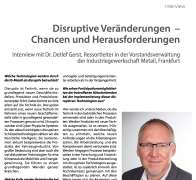
Disruptive Changes – Opportunities and Challenges

Disruptive Changes – Opportunities and Challenges

Interview with Dr. Detlef Gerst, German Metalworkers' Union, Frankfurt
Technology is disruptive when it leads to fundamentally new business models, products and production concepts. It is not just about the technology. Disruption only occurs when new technology is used in the context of a new business model or in fundamentally changed processes. Cyber-physical systems can be used disruptively. (Only in German)
Industrie 4.0 Management | Volume 38 | 2022 | Edition 4 | Pages 7-9
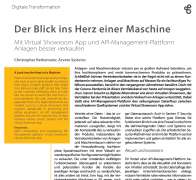
A Look into the Heart of a Machine

A Look into the Heart of a Machine

Mit Virtual Showroom App und API-Management-Plattform Anlagen besser verkaufen
Christopher Berkemeier
Plant construction and engineering companies have to go to great lengths to present their highly complex products that weigh tons. Because sales staff cannot take them to the customer. Exhibiting them at trade fairs has proven its worth. But with the Corona pandemic, this sales channel has disappeared. That’s why digital alternatives are needed, such as a virtual showroom that supports salespeople in presenting and selling equipment. An API management platform ensures the smooth flow of data between various source systems and the virtual showroom app.
Industrie 4.0 Management | Volume 37 | 2021 | Edition 5 | Pages 64-66
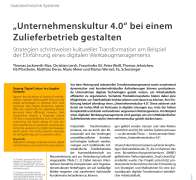
Shaping “Digital Culture” at a Supplier Company

Shaping “Digital Culture” at a Supplier Company

Strategien schrittweiser kultureller Transformation am Beispiel der Einführung eines digitalen Werkzeugmanagements
Thomas Jackwerth-Rice, Christian Lerch, Peter Weiß, Thomas Jehnichen, Matthias Derse, Mario Meier, Marius Wernet
Against the backdrop of industrial transformation, medium-sized supplier firms can use digital technologies to optimize their work processes. New digital production systems offer one opportunity for organizing factory processes more efficiently. However, their introduction requires a “corporate culture 4.0” that is characterized by trust in decisions concerning the future design of such systems, despite the involved high uncertainties. Using the example of a digital tool management system, this article presents measures for strengthening such a corporate culture.
Industrie 4.0 Management | Volume 37 | 2021 | Edition 3 | Pages 16-20
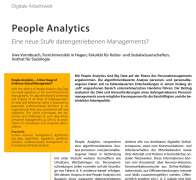
People Analytics − A New Stage of Evidence-based Management?

People Analytics − A New Stage of Evidence-based Management?

Eine neue Stufe datengetriebenen Managements?
Uwe Vormbusch
With the advent of People Analytics Big Data are made operative on the level of personnel management. An algorithm-based screening and analysis of all kinds of employee-related data and behavioral traces is expected to guarantee evidence-based decisions in an organizational field once considered ‘soft’ and subjective. The article summarizes the objectives and challenges of such data-driven personnel management, as well as its implications for employees and corporate labour policies.
Industrie 4.0 Management | Volume 36 | 2020 | Edition 6 | Pages 14-16
Ten Commandments for a Successful Implementation of Digitalization Projects

Ten Commandments for a Successful Implementation of Digitalization Projects

Guidelines for Digital Transformation
Mikko Börkircher, Veit Hartmann, Tim Jeske
In many companies there is still a lack of clarity about the “right” way to implement digitalization projects. Therefore, the article describes guidelines for the successful implementation of digitalization projects. They are derived from the experience of various practical projects and include considerations of economic efficiency as well as resources and staff. Structured as “Ten Commandments for Digitalization Projects”, they are designed to support actors in the practical implementation of digitalization projects
Industrie 4.0 Management | Volume 36 | 2020 | Edition 6 | Pages 55-58
Das HANSEBLOC-Projekt

Das HANSEBLOC-Projekt

Problemstellung und Lösungen
Thomas Twenhöven, Björn Engelmann, Julian Kakarott, Kevin Westphal, Moritz Petersen
Blockchain holds high potential for various applications. In the business context, one of its key features - the availability of data to various parties - is a liability as business secrets shouldn’t be exposed and GDPR compliance has to be ensured. In this paper, we discuss solutions for these privacy problems. Also, we present the HANSEBLOC project, a blockchain-powered platform for data exchange in logistics, and the chosen privacy solutions.
Industrie 4.0 Management | Volume 36 | 2020 | Edition 1 | Pages 45-48 | DOI 10.30844/I40M_20-1_S45-48
Sustainability of Blockchain and Distributed Ledger Technologies

Sustainability of Blockchain and Distributed Ledger Technologies

Volker Skwarek
Blockchain and distributed ledger technologies (BC/DLT) have attracted social and scientific attention at least since the success of Bitcoin and Ethereum as so-called cryptocurrencies. This attention leads to multidisciplinary dynamics whose euphoria often leads to a neglect of scientific thoroughness. As one facet, immutability is a core characteristic and often postulated property of the system. However, it is hardly possible to identify an analysis of the counter side, namely the sustainability of this technology. This article deals with different aspects of the sustainability of BC/DLT and relates them to the requirements of BC/DLT.
Industrie 4.0 Management | Volume 36 | 2020 | Edition 1 | Pages 41-44
1 3 4 5 11