Innovation

Open Innovation – Making Use of the Creativity of External Partners

Open Innovation - Making Use of the Creativity of External Partners

Martin Kaschny, Matthias Nolden
The difference between Open and Closed Innovation is that external partners can get actively involved in all stages of the value added process and are not limited to being mere idea generators. Whilst finding solutions for their own problems and needs, creative individuals or groups of individuals can play an active role in the development of innovative products featuring new functional and design elements. In addition, Open Innovation provides further benefits in the field of image building and innovation marketing.
Industrie 4.0 Management | Volume 32 | 2016 | Edition 1 | Pages 34-37
Open Innovation in Logistics

Open Innovation in Logistics

Successful integration of customers into service development
Katharina Kalogerakis, Birgit von See, Wolfgang Kersten ORCID Icon, Cornelius Herstatt
Compared to other industries the innovative output in logistics is rather low, although innovations provide a promising way to survive in harsh competition. According to the open innovation paradigm, the integration of external resources can improve the innovativeness of a company. This paper analyses requirements logistics services providers as wells as their customers have on joint open innovation initiatives in logistics and shows how open innovation with customers can lead to success.
Industrie 4.0 Management | Volume 32 | 2016 | Edition 1 | Pages 30-33
Open Innovation: Nothing Ventured, Nothing Gained

Open Innovation: Nothing Ventured, Nothing Gained

Wie Industriekonzerne mit Corporate Venture Capital ihr Innovationsmanagement dynamisieren können
Jonas Soluk
For many enterprises, an effective innovation management is an essential part of their sustainable corporate strategy. Without a doubt, creating product, process and business model innovations is necessary to survive the dynamic competition of the 21st century. Opinions differ regarding the question which modality is best to attain this goal. A universally valid model to increase innovation dynamics does not exist. However, the conventional approaches of the last few decades have something in common: They seem to reach its limits in the sense of Industry 4.0 and radical market changes. The use of corporate venture capital can enable corporations to not only react to the change, but also to shape it proactively.
Industrie 4.0 Management | Volume 32 | 2016 | Edition 1 | Pages 38-41
Cybernetic Innovation Management for Knowledge Intensive Organisations

Cybernetic Innovation Management for Knowledge Intensive Organisations

Alan Hansen, Florian Welter, Anja Richert, Frank Hees, Sabina Jeschke
The management of innovation activities is frequently conducted by linear process models, such as stage-gate approaches, that assume planability and controllability. Cybernetic principles offer a useful extension of such approaches by supporting an iterative and systemic management of innovation processes. In this regard, decision makers are increasingly required to broaden their linear perspective on innovation processes by analyzing and designing a working environment that fosters the innovative capability of the employees and the whole company. Thereby the exploitation of all available human, organizational and technical potentials is supported. A practice-approved tool for the diagnosis and design of an innovation fostering working environment is provided with the strategy planner innoBOOST.
Industrie Management | Volume 30 | 2014 | Edition 3 | Pages 30-34
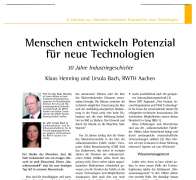
Humans Develop Potential for New Technologies

Humans Develop Potential for New Technologies

30 Years History of Industry
Klaus Henning, Ursula Bach
Which sustainable industrial developments remain to having shaped and changed our work in industry and production? If we look back, experience has shown that it is neither possible to develop fully automated factories nor to conserve all human knowledge by means of huge databases. These formerly trendsetting ideas are now outdated. But what we have learned from the failure of these ideas is a useful concept of the so-called HOT approach: First Human, Second Organization and Third Technology. This way, human knowledge and potential in combination with adequate organization can lead to technical innovation. At present, the challenge is to transfer this concept to recent and future ideas, such as the fully automated car or the change to the use of renewable energy sources. Thus, it should be taken into account that technical innovation must always include human and organizational aspects to be truly sustainable.
Industrie Management | Volume 30 | 2014 | Edition 1 | Pages 19-21
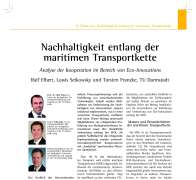
Sustainability Along Maritime Transport Chains

Sustainability Along Maritime Transport Chains

Analysis of Cooperation in Terms of Eco-Innovations
Ralf Elbert, Lowis Seikowsky, Torsten Franzke
The majority of international transport is processed via maritime transport chains, which contribute significantly to global emissions of CO2. As a result, companies attempt to reduce the pollution by optimizing processes and by introducing environmental friendly technologies. However, initiatives are rather pursued on an individual company level than in an inter-actor cooperation. This strategy is ineffective because the key for sustainable operations in a transport chain is the alignment of linking intersections. This paper examines opportunities for the successful implementation of Eco-Innovations along the maritime transport chain as well as its actual adaption. Boundary-spanning cooperation with “landside” actors has been identified as the largest lever for a successful implementation of Eco-Innovations.
Industrie Management | Volume 29 | 2013 | Edition 6 | Pages 53-56
Increasing the Product Attractiveness of Electric Vehicles

Increasing the Product Attractiveness of Electric Vehicles

New product-service combinations
Ingo Westphal, Jasmin Nehls, Stefan Wiesner, Klaus-Dieter Thoben ORCID Icon
Product attractiveness can be substantially increased when offering service extensions alongside. These services may create additional demand for the product by addressing new customer groups. The main challenge however is the development of services which increase customer value of the product to such an extent that leads to a purchase decision. The paper presents a method of idea generation for new product-service combinations following a systematic search approach for possible options. The basic concept of the suggested method as well as its search methodology for identification of promising services will be discussed using the example of the electric car, which so far lacks mass market success due to inadequate business models.
Industrie Management | Volume 29 | 2013 | Edition 5 | Pages 19-24
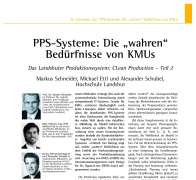
PPC Systems: The “Real” Needs of SMEs

PPC Systems: The “Real” Needs of SMEs

Teil 2
Markus Schneider, Michael Ettl, Alexander Schubel
For a sustained improvement in the logistic goals, such as the punctuality of delivery or cycle time, a consistent, process-oriented design, planning and execution of production systems is required. Besides the development of new methods, support by appropriate IT systems is necessary. Especially for SMEs, there are no solutions in this regard. Thereby first of all the existing MRP systems remain in the old thought patterns, to control and regulate the complexity of the real world through a detailed illustration as a model. For the development of a new ppc system the customer needs were determined apart from solutions of existing systems. The article shows the “real” needs in the environment of the factory structure design and production planning and control of SMEs by using innovation management according to Design for Six Sigma+Lean (DFSS+Lean).
Industrie Management | Volume 29 | 2013 | Edition 2 | Pages 43-48
Innovation Management in Logistics

Innovation Management in Logistics

Analysis and Validation of Innovation Management Methods for Logistic Service Providers
Wolfgang Kersten ORCID Icon, Andrea Victoria Seidel, Nikolaus Wagenstetter
Technological progress, stringent competitive conditions and continually changing customer behaviour force the logistics industry to develop innovative solutions to generate long-term competitive advantage. Compared to the development of physical products, a systematic innovations management has not been established in logistics yet. Grounded in the analysis of interviews with experts from industry, this article puts forward requirements with respect to innovation management implementation and suggests the use of specific methods.
Industrie Management | Volume 28 | 2012 | Edition 6 | Pages 31-34
Knowledge of Older Workers

Knowledge of Older Workers

Preparing for demographic change and unexploited potential
Birgit Verworn, Christiane Hipp
The aging workforce and labour shortage due to lacking young qualified employees are topics which today primarily concern small and medium-sized businesses in unattractive regions. The Federal Statistical Office expects particularly dramatic changes in the age structure of the German workforce in 2017 to 2024. How can companies prepare for these changes? And is it a mere obligatory task or could there have been unexploited potential overlooked so far? Recent German studies provide new insights.
Industrie Management | Volume 28 | 2012 | Edition 3 | Pages 75-78
1 5 6 7 9