Innovation

Artificial Intelligence in ERP Systems

Artificial Intelligence in ERP Systems

Development potential and benchmarking
Marcus Grum ORCID Icon, Nicolas Korjahn
The use of artificial intelligence (AI) is becoming more important for a variety of industries, which is why enterprise resource planning (ERP) systems also offer many possible uses of AI. Due to their newly acquired, AI-based adaptability and learning abilities, modern AI-integrated ERP systems are able to develop competencies, plan processes, make forecasts and interact intelligently with humans. It is not uncommon for such systems to initiate major structural changes for companies and to open up new markets and design areas [1]. In order to measure the progress of an ERP system in terms of AI, the Center for Enterprise Research (CER) has developed an AI maturity model. Building on this model, a tool for evaluating AI integration in an ERP system should be able to showcase potential for development and enable market comparison.
Industry 4.0 Science | Volume 39 | 2023 | Edition 1 | Pages 100-105 | DOI 10.30844/I4SE.23.1.100
Circular Economy – Chance for Innovation

Circular Economy - Chance for Innovation

Tobias Berndt, Claus Lang-Koetz, Silvia Rummel
Circular Economy is considered one of the most promising concepts on the way to a more sustainable economy. Expectations of a responsible corporate orientation are rising: This is shown by a recent ruling of the Federal Constitutional Court, which demands that Germany must be more ambitious in its climate goals [1]. The EU Green Deal envisages climate neutrality by 2050 and the “Circular Economy Action Plan” calls for more effective use of resources and reserves [2]. This article describes a method that companies can use to develop ideas for circular business models.
Industrie 4.0 Management | Volume 38 | 2022 | Edition 1 | Pages 33-36 | DOI 10.30844/I40M_22-1_33-36
Sustainable Innovation – Fields of Action for Sustainable Innovation Management

Sustainable Innovation - Fields of Action for Sustainable Innovation Management

Günther Schuh ORCID Icon, Christian Dölle, Christina Ruschitzka
To ensure competitiveness, it is essential for manufacturing companies to continuously develop innovative products, processes and business models. However, these companies face the challenges of a dynamic and complex business environment. In addition, the relevance of digitalization and sustainability for the manufacturing industry is continuously increasing. This paper describes the newly developed “Sustainable Innovation” approach with relevant fields of action and principles of innovation management, which enables companies to create sustainable value.
Industrie 4.0 Management | Volume 37 | 2021 | Edition 4 | Pages 25-28
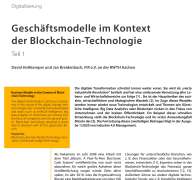
Business Models in the Context of Blockchain Technology

Business Models in the Context of Blockchain Technology

Teil 2
David Holtkemper, Jan Breidenbach
Blockchain technology attracted a great deal of attention with its first application Bitcoin. In addition to the multitude of practical solutions, initiatives and research efforts of the industry, the number of scientific publications on the topic of blockchain is comparatively low. Right now, there is a lack of universal standards and uniform terminology. One way of documenting blockchain technology could be a morphological box. In addition to the advantage of clarity, this type of information structuring offers further advantages that can be considered helpful in creating a comprehensive overview. In order to create such a morphological box, various features of the blockchain technology must be identified and described in detail. One of these features is the “business model”, for which the 4 different characteristics “infrastructure provider”, “platform provider”, “system integrator” and “application provider” have been identified.
Industrie 4.0 Management | Volume 36 | 2020 | Edition 1 | Pages 49-52
Business Models in the Context of Blockchain Technology

Business Models in the Context of Blockchain Technology

Teil 1
David Holtkemper, Jan Breidenbach
The digital transformation continues to progress. In the course of this digital change, new technologies are constantly being developed and topics such as artificial intelligence, big data analytics or blockchain are moving into the focus of companies and the general public. Blockchain technology attracted a great deal of attention with its first application Bitcoin.
Industrie 4.0 Management | Volume 35 | 2019 | Edition 6 | Pages 42-46
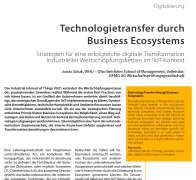
Technology Transfer through Business Ecosystems

Technology Transfer through Business Ecosystems

Strategien für eine erfolgreiche digitale Transformation industrieller Wertschöpfungsketten im IIoT-Kontext
Jonas Soluk
The Industrial Internet of Things (IIoT) radically changes value creation in the manufacturing industry. Dynamic environmental factors, technical complexity, and limited resources cause many companies to be left behind. As a principle borrowed from strategic planning, business ecosystems can provide new ways of interorganizational collaboration and thus dynamize efforts to internalize specific IIoT knowledge. Especially in an early phase of trend scouting and idea generation, ecosystems can be seen as a highly effective venturing concept.
Industrie 4.0 Management | Volume 34 | 2018 | Edition 3 | Pages 63-66
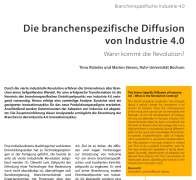
The Sector-Specific Diffusion of Industry 4.0

The Sector-Specific Diffusion of Industry 4.0

When is the Revolution Coming?
Timo Klünder, Marion Steven
The fourth industrial revolution has brought about a radical change for companies in all sectors of industry. Since the consequences of this revolution cannot yet be estimated, the forecasts of the full development of industry 4.0 vary considerably. In the past, industry 4.0’s implementation date has been considered, but the level of detail on the technology side is too high and there is a substantial lack of differentiation on the users side. Knowledge of the industry-specific implementation date of Industry 4.0 is essential for a successful transformation. For this purpose a two-part analysis is carried out: First of all, a suitable innovation cycle for the new production paradigm is being developed. Secondly, determinants of adoption are derived from Industry 4.0. The combination of these parts allows classifying the sectors in the industry 4.0 innovation cycle.
Industrie 4.0 Management | Volume 34 | 2018 | Edition 2 | Pages 33-37
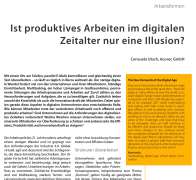
The New Demands of the Digital Age

The New Demands of the Digital Age

Consuela Utsch
One ear on the phone while checking e-mails and revising a text at the same time - that’s life today in many offices all over the world. Constant digital change makes great demands of companies and their staff. People are expected to be available 24/7 while multi-tasking and coping with high noise levels in open-plan offices as well as dealing with constant disruptions in the work process. Together with working on-call or on-demand, these are just some of the challenges and tasks that have to be managed. How can staff continue to be efficient and productive despite all these and more changes to the working world? Are companies prepared for the demands of the digital age? Which adjustments will they have to make to protect staff from excessive demands on the one hand, while boosting efficiency and productivity on the other?
Industrie 4.0 Management | Volume 33 | 2017 | Edition 5 | Pages 53-56
Technology and Innovation Management Enables Efficient Production and Customer Centric Products

Technology and Innovation Management Enables Efficient Production and Customer Centric Products

Ingrid Breitenberger, Toni Drescher, Frank Sygor
Ideas become innovations if the intended product or service creates added value for the customer. Special features, an extraordinary design or tailoring to individual customer needs may represent a unique selling point in the competitive environment. RWTH Aachen in scientific cooperation with Fraunhofer offers advanced training programs on practical methods and best practices how to establish successful technology and innovation management.
Industrie 4.0 Management | Volume 32 | 2016 | Edition 6 | Pages 63-66
Industry 4.0 Begins as a Matter of Attitude

Industry 4.0 Begins as a Matter of Attitude

Mit Business-Simulationen Change-Prozesse unterstützen
Wolfgang Karrlein, Martin Steinleitner
By digital transformation the German SME sector is faced with huge challenges. It also turns existing corporate processes upside down. 82 percent of the managers who were interviewed for a recent survey expect that the internal communication will accelerate significantly. Four out of five are convinced that the transfer of knowledge will play a key role. Three quarters are also convinced that it is necessary that IT and other departments close ranks. Business-simulations effectively support the required transformation process. Topic of this article is to show how they can help changing the attitude and perspective to generate sustainable value from Industry 4.0.
Industrie 4.0 Management | Volume 32 | 2016 | Edition 1 | Pages 48-51
1 4 5 6 9