Business Models

Artificial Intelligence for the Future Economy

Artificial Intelligence for the Future Economy

How to develop competitive business models from data
Johannes Winter
Artificial intelligence (AI) and self-learning systems have immense economic potential and are a driving force for digitalisation. Artificial Intelligence is radically changing value chains, business models, and employment in industry. Data-driven services are added to traditional products in almost all industries. Integrating Artificial Intelligence in products and services as well as using data from the production process provides opportunities for new business models in an increasing competitive international environment.
Industrie 4.0 Management | Volume 36 | 2020 | Edition 2 | Pages 43-46
Blockchain Technology and 5G Networks

Blockchain Technology and 5G Networks

the Power of Decentralized Networks
Katarina Adam
Even though the attention of the mass media has long since turned to other technologies, the significance of blockchain technology is crystallizing more and more clearly. This article briefly describes the technology and uses an application example to show how the use of blockchain technology in the telecommunications industry could be linked to the benefit of all. The fact that our Internet is becoming slower and slower in its existing structure due to the increasing number of accesses via mobile devices can be observed in streaming services, among other things. Progressive digitalisation is producing digital data on an unprecedented scale. The challenge is to secure this data in stable networks at high transmission speeds. Widely diversified networks, which are connected to each other in a decentralized manner, promise a remedy. These structures are very familiar with blockchain technology and it can be assumed whether this technology has the potential to fundamentally change ...
Industrie 4.0 Management | Volume 36 | 2020 | Edition 1 | Pages 15-18
Decentralized IOTA-based Industry Marketplace

Decentralized IOTA-based Industry Marketplace

Industry marketplace based on IOTA, eCl@ss and I4.0 administrative shell
Alexander Belyaev, Christian Diedrich, Holger Köther, Alaettin Dogan
This article presents an IOTA Industry Marketplace. The industry marketplace is a manufacturer- and industry-neutral open-source platform, based on the specifications and guidelines of the platform Industry 4.0 and enables an uncomplicated integration of company information systems into the overall network. The industry marketplace combines distributed ledger technology, unchangeable audit trails, standardized, machine-readable language, an integrated distributed identity system and provides a trusted and secure infrastructure for data and value transfer.
Industrie 4.0 Management | Volume 36 | 2020 | Edition 1 | Pages 36-40 | DOI 10.30844/I40M_20-1_S36-40
Business Models in the Context of Blockchain Technology

Business Models in the Context of Blockchain Technology

Teil 2
David Holtkemper, Jan Breidenbach
Blockchain technology attracted a great deal of attention with its first application Bitcoin. In addition to the multitude of practical solutions, initiatives and research efforts of the industry, the number of scientific publications on the topic of blockchain is comparatively low. Right now, there is a lack of universal standards and uniform terminology. One way of documenting blockchain technology could be a morphological box. In addition to the advantage of clarity, this type of information structuring offers further advantages that can be considered helpful in creating a comprehensive overview. In order to create such a morphological box, various features of the blockchain technology must be identified and described in detail. One of these features is the “business model”, for which the 4 different characteristics “infrastructure provider”, “platform provider”, “system integrator” and “application provider” have been identified.
Industrie 4.0 Management | Volume 36 | 2020 | Edition 1 | Pages 49-52
Business Models in the Context of Blockchain Technology

Business Models in the Context of Blockchain Technology

Teil 1
David Holtkemper, Jan Breidenbach
The digital transformation continues to progress. In the course of this digital change, new technologies are constantly being developed and topics such as artificial intelligence, big data analytics or blockchain are moving into the focus of companies and the general public. Blockchain technology attracted a great deal of attention with its first application Bitcoin.
Industrie 4.0 Management | Volume 35 | 2019 | Edition 6 | Pages 42-46
Product Modularization Along the Supply Chain

Product Modularization Along the Supply Chain

How the Implementation Succeeds
Martin Brylowski, Henning Schöpper ORCID Icon, Marwin Krull
The advancing technological change, the globalization of markets as well as increasing customer requirements have led to a significant increase in complexity in manufacturing companies and their supply chains. Companies and entire value chains are countering this development with product modularization strategies. In this context, however, the investigation of the influences of product modularization on the supply chain receives little attention. This can lead to unused potentials and additional risks, such as the loss of core competencies. Therefore, this article deals with necessary processes and success factors that result from a joint consideration of product modularization along the supply chain. On the basis of a systematic analysis of scientific literature and guideline-supported expert interviews, a process model with different phases and steps was developed and currently necessary success factors were identified.
Industrie 4.0 Management | Volume 35 | 2019 | Edition 5 | Pages 50-54 | DOI 10.30844/I40M_19-5_S50-54
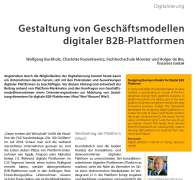
Designing Business Models for Digital B2B Platforms

Designing Business Models for Digital B2B Platforms

Wolfgang Buchholz, Charlotte Kosiorkiewicz, Holger de Bie
In many industries, the transformation of value creation is accelerating as a result of the fundamental change from pipelines business to platform business. For taking part in the new platform business companies need to develop innovative business models. The framework developed for designing digital platforms includes the type of value contribution (what?), the actors involved (who?), the reason for the value contribution (why?) and the way of value creation (how?). The design hints derived from the framework are subsequently used to develop B2B platforms to illustrate their relevance and impact.
Industrie 4.0 Management | Volume 35 | 2019 | Edition 2 | Pages 39-42
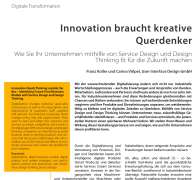
Innovation Needs Thinking outside the Box

Innovation Needs Thinking outside the Box

Identifying Future-Proof Business Models with Service Design and Design Thinking
Franz Koller, Carina Völpel
Digitalization changes industrial value-added processes as well as the expectations and requirements of customers, staff, suppliers and partners. For industrial companies, these changes bring risks and opportunities. They need to react and adapt their products and services to remain competitive and survive in the digital age. With service design and design thinking, companies can identify future-proof business areas to develop products and services that bring users added value. We will introduce you to the nature and effects of such design processes and outline the benefits for your company.
Industrie 4.0 Management | Volume 34 | 2018 | Edition 4 | Pages 62-66
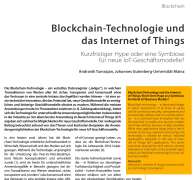
Blockchain Technology and the Internet of Things: Short-Term Hype or a Symbiosis for Novel IoT Business Models?

Blockchain Technology and the Internet of Things: Short-Term Hype or a Symbiosis for Novel IoT Business Models?

Kurzfristiger Hype oder eine Symbiose für neue IoT-Geschäftsmodelle?
Andranik Tumasjan
Blockchain technology - a distributed ledger in which transactions of all kinds of values can be carried out securely, transparently and consensually without trust in a central authority - is a socio-technical innovation that has the potential to enable new business models and make existing business models obsolete. While most applications today exist in the financial sector (e.g., payment processing), the technology is suitable for various industrial applications, especially in the area of Internet of Things (IoT) applications. This article uses three propositions and various concrete examples to shed light on the possible applications of blockchain technology for new IoT business models.
Industrie 4.0 Management | Volume 34 | 2018 | Edition 2 | Pages 29-32
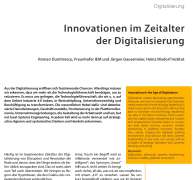
Innovations in the Age of Digitization

Innovations in the Age of Digitization

Roman Dumitrescu ORCID Icon, Jürgen Gausemeier
Digitization creates fascinating opportunities. However, we have to recognize that Germany needs more than the technology leadership in order to succeed in the long term. We must be able to transform the technology leadership we take in the field of industry 4.0 for example into added value, entrepreneurial success and employment. Essential levers to success are data based services, business models, positioning in platform economy, foundation culture, shaping the digitized working environment and, last but not least, Systems Engineering. In any case, our success will be a matter of strategic operation and systemic thinking and acting.
Industrie 4.0 Management | Volume 34 | 2018 | Edition 2 | Pages 7-11
1 2 3 4 9