Business Models

Business Administration Knowledge Laboratory

Business Administration Knowledge Laboratory

Eine Lehr-, Lern- und Kommunikationsumgebung für die universitäre und betriebliche Aus- und Weiterbildung
Axel Braßler, Christoph Grau, Herfried M. Schneider
The internet-based teaching, learning and communication system “Business Administration Knowledge Laboratory” (WiLabBW) is developed and continuously expanded within a cooperation project of Thuringian universities. The paper gives a survey of the basic goals and explains its architecture and business model.
Industrie Management | Volume 21 | 2005 | Edition 1 | Pages 9-12
Peer-to-Peer Architcture for Adaptable E-Business Networks

Peer-to-Peer Architcture for Adaptable E-Business Networks

Alf Benger, Katja Neumann
The adoption of the internet to support electronic business processes is currently done by a transformation of traditional processes. However, the direct transfer does not make use of the network capabilities and of the resulting possibility of direct communication between the business partners. Furthermore, actual systems do not support the dynamics and flexibility required by emerging business models. The article analyses actual interaction patterns and presents a technical concept based on Peer-to-Peer network architecture to support these new types of decentralized economic interactions.
Industrie Management | Volume 20 | 2004 | Edition 2 | Pages 62-65
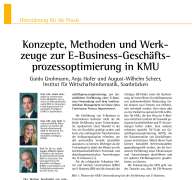
Concepts, Methodology and Tools for E-Business Process Optimisation in SME

Concepts, Methodology and Tools for E-Business Process Optimisation in SME

Guido Grohmann, Anja Hofer, August-Wilhelm Scheer
The article describes an integrated approach for the introduction and continuous management of e-business scenarios and applications in SME. This model enriches existing and publicly available consulting approaches with phases for optimizing business processes, the implementation and introduction of e-business applications and a continous process improvement.
Industrie Management | Volume 20 | 2004 | Edition 1 | Pages 28-31
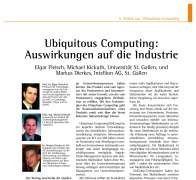
Ubiquitous Computing: Impacts on the Industry

Ubiquitous Computing: Impacts on the Industry

Elgar Fleisch, Michael Kickuth, Markus Dierkes
Using case studies, this article describes the business impact that Ubiquitous Computing could have on future organisations. Not only human beings but also products want to communicate a specific image. The article shows how this will affect future business processes. The product becomes the agent of the producer and communicates with its environment in order to comply with the performance objectives given by the producer. By using Ubiquitous Computing, possible future product functions will outperform the current industrial communication design by far.
Industrie Management | Volume 19 | 2003 | Edition 6 | Pages 29-31
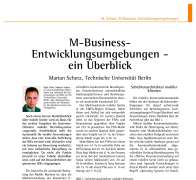
M-Business IDEs – an Overview

M-Business IDEs - an Overview

Marian Scherz
After looking at the current market situation for mobile devices, a system architecture for mobile operation sys-tems is being introduced. The systematic segmentation of Integrated Development Environments (IDEs) and the development of an evaluation scheme enable a detailed and consis-tent market analysis.
Industrie Management | Volume 19 | 2003 | Edition 6 | Pages 53-59
Mobile B2B

Mobile B2B

Stefan Berger, Franz Lehner
This article presents examples of mobile B2B applications. Mobile B2B solutions are often seen as an advancement to their well known stationary counterparts in the internet. Their deployment shall lead to a formidable reduction of costs. Despite this advantage there exist only few examples of successful B2B solutions. Technical restrictions of the mobile clients still prevent their wider diffusion.
Industrie Management | Volume 19 | 2003 | Edition 6 | Pages 45-48
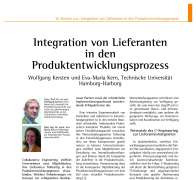
Collaborative Engineering

Collaborative Engineering

An approach for supplier integration into the product development process
Wolfgang Kersten ORCID Icon, Eva-Maria Kern
Collaborative Engineering offers companies new possibilities to involve their suppliers into the product development process. The requirements which a successful approach for internet-supported supplier integration has to fulfil are exemplified for the ship building industry. Flexibility and low implementation effort of the chosen solution turn out to be, together with appropriate functionalities to support the distributed cooperation, decisive success factors.
Industrie Management | Volume 19 | 2003 | Edition 5 | Pages 17-20
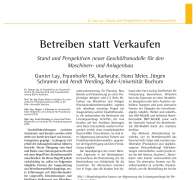
Operate Instead of Sale

Operate Instead of Sale

Perspectives of new, company spanning business models in plant engineering
Gunter Lay, Horst Meier, Jürgen J. Schramm, Arndt Werding
Business relation between customer and supplier is less characterized by purchase of investment goods. In terms of specific use tasks the functional utility of investment goods becomes of higher weight shortly. Within the new business relationship supplier becomes full-service-supplier and cus-tomer becomes user, as flexibility and availability are increasing. The definition contracting model used in plant engineering and construction describes the change from purchasing and property to acquisition by use. Due to the fact that it is a complex term, realizable types and physical forms of contracting models are presented below. Based on this, first experiences with contracting models are presented, future significance of contracting models is calculated, possible short-ages are identified as well as the need to act which hinder an implementation of contracting models yet.
Industrie Management | Volume 19 | 2003 | Edition 4 | Pages 9-13
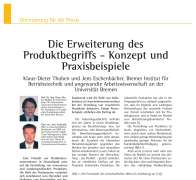
The Extension of the Product Term

The Extension of the Product Term

Concept and Examples
Klaus-Dieter Thoben ORCID Icon, Jens Eschenbächer
The majority of manufacturing enterprises is currently trying to become more competitive in the preparation of customer-centric and innovative products. The focus of manufacturing paradigm is changing from a mainly sales-driven business towards a provider of utility or benefit to the customer. Consequently, the traditional product definition must be extended. Based on the description of the concept of extended products, this paper discusses approaches to extend the classical product definition and the resulting requirements. Additionally, the role of collaboration in enterprise networks will be discussed. Some practical examples are mentioned.
Industrie Management | Volume 19 | 2003 | Edition 4 | Pages 48-51
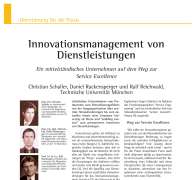
Management of Service Innovations

Management of Service Innovations

A Medium-sized Corporation on the Way to Service Excellence
Christian Schaller, Daniel Rackensperger, Ralf Reichwald
Innovations are significant corporate challenges - and this is particularly the case with companies offering services. This article offers up to date results of an ongoing research project. It describes in detail a case of the way of a medium-sized company from a producer to service leadership, from the ini-tial situation via central challenges up to the current approach of a corporate university as engine and enabling context for permanent innovating of services.
Industrie Management | Volume 19 | 2003 | Edition 4 | Pages 56-59
1 7 8 9