Sustainability

Circular Economy – Chance for Innovation

Circular Economy - Chance for Innovation

Tobias Berndt, Claus Lang-Koetz, Silvia Rummel
Circular Economy is considered one of the most promising concepts on the way to a more sustainable economy. Expectations of a responsible corporate orientation are rising: This is shown by a recent ruling of the Federal Constitutional Court, which demands that Germany must be more ambitious in its climate goals [1]. The EU Green Deal envisages climate neutrality by 2050 and the “Circular Economy Action Plan” calls for more effective use of resources and reserves [2]. This article describes a method that companies can use to develop ideas for circular business models.
Industrie 4.0 Management | Volume 38 | 2022 | Edition 1 | Pages 33-36 | DOI 10.30844/I40M_22-1_33-36
Digital Sustainability Management in Companies

Digital Sustainability Management in Companies

A Service-Oriented Approach to Develop a Platform for Data-Driven Sustainability Management
Justus von Geibler ORCID Icon, Julia Brandt, Lara Waltersmann, Robert Miehe, Ralf Tesch
The digitalization in sustainability management and the creation of a consistent database for sustainability data can significantly support companies in meeting increasing sustainability requirements and transparency regarding the sustainability performance. This paper presents a service-oriented approach for the development of a platform for data-driven sustainability management in manufacturing companies.
Industrie 4.0 Management | Volume 38 | 2022 | Edition 1 | Pages 45-47 | DOI 10.30844/I40M_22-1_45-47
Digitalized Industry and Sustainability

Digitalized Industry and Sustainability

Between Synergy and Dissonance
Frieder Schmelzle, Stefanie Kunkel, Marcel Matthess, Grischa Beier
A considerable part of global greenhouse gas emissions is caused in the industrial sector. Its digitialization is often seen as a means to increase sustainability. At the same time, ecological and social risks emerge. Their exploration is still in its infancy, however, previous findings point out multiple challenges. These must be conceptually taken into account in order to realize a sustainable industry 4.0. Building on a literature analysis, the following contribution presents current developments in research, industry, and policy. We shed light on a number of selected approaches, which aim at a sustainable industry 4.0. Finally, practical design options are outlined.
Industrie 4.0 Management | Volume 38 | 2022 | Edition 1 | Pages 7-11 | DOI 10.30844/I40M_22-1_7-11
Measures and Incentives to Reduce CO2-Emissions

Measures and Incentives to Reduce CO2-Emissions

How Small Carriers and Their Shippers Can Work Towards More Climate-Friendly Road Freight Transport
Moritz Petersen, Ramón van Almsick
Accelerating climate change drives companies to reduce their greenhouse gas emissions. Road freight transport accounts for around 6 % of global CO2 emissions. However, high growth rates, the dependence on fossil fuels, and the high fragmentation of the market make the decarbonization of road freight transport challenging. Based on survey results, this paper elaborates how small road carriers, together with their clients, can contribute to achieving global climate targets by implementing appropriate measures and incentives.
Industrie 4.0 Management | Volume 38 | 2022 | Edition 1 | Pages 41-44 | DOI 10.30844/I40M_22-1_41-44
Electrical and Hydrogen Microgrid

Electrical and Hydrogen Microgrid

Energy Control of a Self-Sufficient Supply System Based on a Combined Electrical and Hydrogen Distribution Grid
David Salomon Stephan, Uwe Werner, Carsten Fichter
The main goal of assembling a self-sufficient microgrid is to integrate all technical equipment into an autonomous energy supply system as a virtual power plant (VPP). The system integration focuses on the power electronic devices and the combination of gas and electrical supply chains. The developed microgrid structure is fed from renewable energy systems (green hydrogen), the electrical grid and the H2 gas grid with a liquid or gaseous energy source. In comparison to an island grid, the microgrid can be operated in parallel mode with the common public grid. The associated challenges of transient energy flows and the holistic view of a regulated microgrid based on an electrical grid and an H2 gas network are part of this article.
Industrie 4.0 Management | Volume 38 | 2022 | Edition 1 | Pages 28-32
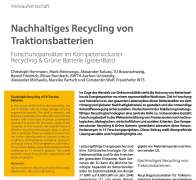
Sustainable Recycling of EV Traction Batteries

Sustainable Recycling of EV Traction Batteries

Christoph Herrmann, Mark Mennenga, Alexander Kaluza, Bernd Friedrich, Elinor Rombach, Alexander Michaelis, Mareike Partsch, Constantin Wolf
In the course of the shift to electromobility, the use of battery cells as energy storage is facing exponential growth. The goal in research and industry is to design the entire life cycle of these battery cells in the light of global sustainability goals and to ensure the necessary supply of raw materials. In this context, the establishment of efficient recycling technologies plays a central role. In particular, there is a need for research into the further development of process routes according to technological, ecological, economic and social criteria. The competence cluster Recycling & Green Battery (greenBatt) addresses these challenges in 15 research projects. This article presents overarching solution approaches and project highlights.
Industrie 4.0 Management | Volume 38 | 2022 | Edition 1 | Pages 12-16 | DOI 10.30844/I40M_22-1_12-16
Off-Peak Delivery: An Opportunity for Climate-Friendly Urban Logistics

Off-Peak Delivery: An Opportunity for Climate-Friendly Urban Logistics

Sebastian Stütz, Daniela Kirsch
Urban logistics has to change to become more silent and eco-friendlier. Off-peak delivery is regarded as an effective measure to cut carbon emissions. Implementing this concept will require the deployment of electric trucks to comply with noise regulations. This article provides an overview of current research themes in this field and uses McKinnon’s “Analytical framework for green logistics”to illustrate off-peak delivery as a concept, its benefits and limitations as well as the key requirements to make this concept work.
Industrie 4.0 Management | Volume 38 | 2022 | Edition 1 | Pages 48-52
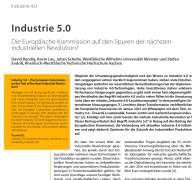
Industry 5.0

Industry 5.0

The European Commission on the trail of the next industrial revolution?
David Bendig, Kevin Lau, Julian Schulte, Stefan Endriß
Managers are still facing significant challenges in implementing Industry 4.0 technologies and many companies have not gone beyond their initial Industry 4.0 lighthouse project to date. In the midst of this ongoing transformation, the European Commission published a white paper in January 2021 dealing with the “Industry 5.0 concept”. This paper investigates the term “Industry 5.0” with regard to the contribution of the European Commission and illustrates the connection with current Industry 4.0 initiatives.
Industrie 4.0 Management | Volume 37 | 2021 | Edition 6 | Pages 20-22 | DOI 10.30844/I40M_21-6_S20-22
Circular Economy through Digital Transformation

Circular Economy through Digital Transformation

The Importance of Digital Transformation for the Circular Economy
Javad Ghofrani, Tassilo Söldner
With a world population of ten billion people by the middle of the 21st century, natural resources must be used sustainably to prevent environmental disasters and wars. Traditional concepts such as recycling alone are no longer sufficient. Instead, we must think in terms of material cycles and transform the traditional production economy into a circular economy. To achieve this, a close link between production and recycling must be established, which is hardly conceivable without digitalization. This article begins with an overview of steps of industrial development towards more sustainability, finally showing how the digital transformation can facilitate the realization of a circular economy.
Industrie 4.0 Management | Volume 37 | 2021 | Edition 5 | Pages 35-38
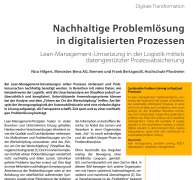
Sustainable Problem Solving in Digitized Processes

Sustainable Problem Solving in Digitized Processes

Lean-Management-Umsetzung in der Logistik mittels datengestützter Prozessabsicherung
Nico Hilgert, Frank Bertagnolli ORCID Icon
In lean management implementations, processes are improved and causes of problems are sustainably eliminated. However, in areas with a lot of data, such as logistics, root cause analysis on the shopfloor becomes confusing and complicated. Supporting application systems can help with analysis and shopfloor management. Using the example of supply logistics in the automotive industry, a simple digital solution is demonstrated that creates transparency, saves time and contributes to sustainable problem solving.
Industrie 4.0 Management | Volume 37 | 2021 | Edition 5 | Pages 31-34 | DOI 10.30844/I40M_21-5_S31-34
1 6 7 8 18