Factory Planning

Boosting Competitiveness in Small Batch Production

Boosting Competitiveness in Small Batch Production

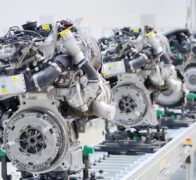
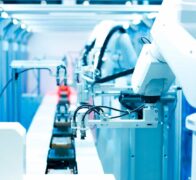
Scalable and flexible body-in-white production line with collaborative mobile robots
Walid Elleuch, Tadele Belay Tuli ORCID Icon, Martin Manns ORCID Icon
Due to the higher customization of products to customer groups and needs, body-in-white manufacturing industries are facing higher variant assembly at the later stages of the production line, thus increasing production costs per unit. Flexible production processes that involve flexible material flows, non-rigid manufacturing sequences, and the automatic reconfiguration of tools are regarded as the pillars of a resilient production system. This article presents a conceptual solution for flexible Body-in-White sheet metal production with autonomous collaborative robotic systems to make product costs affordable for a higher competitive advantage.
Industry 4.0 Science | Volume 41 | Edition 2 | Pages 60-67
The “InTraLab” Learning Factory

The “InTraLab” Learning Factory

Gaining experience and knowledge in digitally transformed work environments
Norbert Gronau ORCID Icon, Malte Rolf Teichmann, Malte Teichmann
Learning factories offer a practical environment for simulating production processes in which learners can acquire skills through the direct application of new technologies. The Industrial Transformation Lab (InTraLab) models hybrid production processes by combining real-world demonstrators and virtual simulations. This enables learners to acquire the skills that are crucial for the digitally transformed world of work.
Industry 4.0 Science | Volume 41 | Edition 2 | Pages 46-51
Work-Integrated Learning in Industry 4.0

Work-Integrated Learning in Industry 4.0

A qualitative analysis of various assistance systems in assembly
Kathleen Warnhoff ORCID Icon
In the era of Industry 4.0, many industrial companies are facing major transformations. In the process of digitalization, factory management is adopting new technologies such as cognitive assistance systems, which has led to changes in work processes. Regarding assembly in the metal and electrical industries, it is unclear to what extent this development has promoted work-integrated learning. Therefore, the topic of this paper is a qualitative analysis that explores employees' perceptions of the learning opportunities and risks presented by cognitive assistance systems. Results: Not all assembly employees benefit equally from these new developments.
Industry 4.0 Science | Volume 41 | Edition 2 | Pages 20-29 | DOI 10.30844/I4SE.25.2.20
Distributed Application Integration in Industry

Distributed Application Integration in Industry

Employing microservices for enterprise application integration (EAI)
Jan-Peer Rudolph ORCID Icon
In line with current digital transformations, the number of software applications in use by companies is continuously increasing. This particularly affects industrial enterprises, which face challenges due to their often complex business processes. A holistic and sustainable integration of these business processes requires a strong link between the different information systems used. In this context, application integration, also known as enterprise application integration (EAI), is becoming more important. Modern approaches such as the use of microservices offer a particularly flexible and efficient solution for seamlessly connecting different applications and thus promoting the agility and scalability of a company’s IT landscape.
Industry 4.0 Science | Volume 41 | 2025 | Edition 1 | Pages 74-80
Digital Factory in Engineering Education

Digital Factory in Engineering Education

A teaching concept from a university of applied sciences
Sven Völker ORCID Icon
The volatility of economic conditions and rapid technological progress require production sites to be constantly adapted and improved. This needs highly qualified factory planners who can use digital planning tools efficiently. The best qualifications emerge from closely interlinking the teaching of planning methods and the application of these methods in a planning project according to the principle of “learning by doing”.
Industry 4.0 Science | Volume 40 | Edition 4 | Pages 8-15
Trends and Challenges in Factory Software

Trends and Challenges in Factory Software

Norbert Gronau ORCID Icon
Any networked information system that is used in the context of manufacturing and logistics in a factory can be referred to as factory software. This article describes six trends that will significantly influence the way software is used in factories in the near future. The trends are described in ascending order in terms of significance of impact.
Industry 4.0 Science | Volume 39 | 2023 | Edition 1 | Pages 114-119 | DOI 10.30844/I4SE.23.1.114
Robotic Process Automation (RPA) in Lieu of a New ERP System

Robotic Process Automation (RPA) in Lieu of a New ERP System

The reality behind the hype
Norbert Gronau ORCID Icon, Benedict Bender, Clementine Bertheau, Hannah Lauppe
Robotic Process Automation (RPA) stands for the software-supported operation of software solutions via their user interface. The primary goal that RPA seeks to achieve is the automated execution of routine tasks that previously required human intervention. However, the potential of RPA to improve processes in the long term is very limited. Automating processes and bridging front-end media disruptions leads to a variety of dependencies and conditions, which are summarized in this article. The path to a sustainable enterprise architecture (and the processes and systems comprised therein) requires open, adaptive systems with modern architecture that are characterized by a high degree of interoperability at various levels.
Industry 4.0 Science | Volume 39 | 2023 | Edition 1 | Pages 120-125 | DOI 10.30844/I4SE.23.1.120
My Colleague Is a Robot

My Colleague Is a Robot

Acceptance of collaborative robotics in warehouses
Frederic Jacob, Eric Grosse ORCID Icon, Stefan Morana, Cornelius J. König
Warehousing is a very labor- and cost-intensive task in many companies. Digitization and automation of manual warehouse processes can increase efficiency, reduce costs and relieve employees. Collaborative robots that share work tasks with employees are increasingly used in warehouses. However, the pure techno-centric use of such robots can negatively influence the acceptance of human-robot collaboration. Various influences such as fear of job loss, higher cognitive stress, expected extra effort, or concerns about injuries can hinder human-robot collaboration and negatively impact economic benefits. This paper presents possible barriers to the acceptance of collaborative robotics in warehouses and discusses recommended actions for human-centered, sustainable human-robot collaboration.
Industrie 4.0 Management | Volume 39 | 2023 | Edition 1 | Pages 23-26
Qualitative Cause-Effect Relationships

Qualitative Cause-Effect Relationships

Planning and implementation of relocation projects in the reorganization of factories
Andreas Nitsche, Malte Stonis ORCID Icon, Peter Nyhuis ORCID Icon
The realization of reorganization projects represents a complex and independent planning task within the framework of factory layout planning. Only little methodical knowledge exists, which considers the temporal, spatial and organizational restrictions in the creation of a schedule. This paper aims to present the interdependencies in the planning and execution of realization projects and thus to provide a basis for discussion for further investigations in the field of scheduling factory relocations for the reorganization of factory objects.
Industrie 4.0 Management | Volume 39 | 2023 | Edition 1 | Pages 53-57
Decentralized Tact Time Control in Assembly

Decentralized Tact Time Control in Assembly

Simplifying robust control of assembly lines via the I4.0 box
Sander Lass, Tim Körppen
In theory, decentralized control approaches in the manufacturing context offer several advantages over monolithic centralized systems where all functions are combined into one or into several authorities. However, practical implementation requires adaptation of the general concept of decentralization to fit individual and specific use cases, especially with regard to their sensible scope. One such use case is the assembly of high-variation products. This article shows the appropriate combination of centralized and decentralized approaches can be leveraged to achieve better planning and increased throughput in manufacturing. With flexible cycle control for work stations and suitable assistance at the assembly workstation, the previous shop-floor oriented organization style can be transformed into a series-like manufacturing process. This is done using a multi-layered infrastructure that follows the Industry 4.0 paradigm of decentralized information processing through autonomous ...
Industry 4.0 Science | Volume 39 | 2023 | Edition 1 | Pages 34-40 | DOI 10.30844/I4SE.23.1.34
1 2 3 7