I4S+ content for subscribers only

Influence of Industry 4.0 on Competence and Role Profiles

Influence of Industry 4.0 on Competence and Role Profiles

Disruption of Job Descriptions Due to the Increased Need for IT Skills in the Manufacturing Sector
Christin Schumacher, Hendrik Lager, Philipp Regelmann, Jan Winkels, Julian Graefenstein
In a previous approach of Lager et al. [1], the development of knowledge, competence and role profiles of employee groups in the course of industry 4.0 was studied. Based on that, the role of the overlapping focus IT is to be examined more closely and the analysis is extended to the tactical level using the example of production planning. In addition, the effects of the need for increased IT competence in all areas of the manufacturing industry on the erosion of current role profile boundaries are presented.
Industrie 4.0 Management | Volume 35 | 2019 | Edition 2 | Pages 31-34
Designing Business Models for Digital B2B Platforms

Designing Business Models for Digital B2B Platforms

Wolfgang Buchholz, Charlotte Kosiorkiewicz, Holger de Bie
In many industries, the transformation of value creation is accelerating as a result of the fundamental change from pipelines business to platform business. For taking part in the new platform business companies need to develop innovative business models. The framework developed for designing digital platforms includes the type of value contribution (what?), the actors involved (who?), the reason for the value contribution (why?) and the way of value creation (how?). The design hints derived from the framework are subsequently used to develop B2B platforms to illustrate their relevance and impact.
Industrie 4.0 Management | Volume 35 | 2019 | Edition 2 | Pages 39-42
Challenges of Age-Appropriate Vocational Training

Challenges of Age-Appropriate Vocational Training

Potential of Mobile IIoT Techno-logies in Work-Related Learning
Malte Teichmann, André Ullrich ORCID Icon, David Kotarski, Norbert Gronau ORCID Icon
An ageing workforce is a central entrepreneurial challenge. One solution is vocational training. For older workers it is associated with problems. The contribution addresses these problems and the increasing amount of mobile industrial Internet of Things Technology (IIoT) within work processes. The aim is to identify solutions for age-appropriate vocational training by work-related learning.
Industrie 4.0 Management | Volume 35 | 2019 | Edition 2 | Pages 23-26
Manufacturing Analytics for Reactive Quality Processes

Manufacturing Analytics for Reactive Quality Processes

Literaturanalyse und Beispiele aus der Praxis
Maximilian Meister, Lukas Hartmann, Markus Wünsch, Joachim Metternich, Amir Cviko, Tobias Böing
Manufacturing Analytics is the evaluation and use of data in the production context. This article shows which potentials can be realised by Manufacturing Analytics in the context of reactive quality management. First, a general definition of the term Manufacturing Analytics is given and then its classification in the context of quality management is carried out. On the basis of a literature analysis and the evaluation of existing use cases, findings regarding the potentials for reactive quality processes are derived. This shows that Manufacturing Analytics is particularly promising and can be used in root cause analysis, defect detection and avoidance. Subsequently, an application example is presented.
Industrie 4.0 Management | Volume 35 | 2019 | Edition 2 | Pages 43-48
Learning by Playing in Virtual Reality

Learning by Playing in Virtual Reality

Weiterbildung durch Gamification
Steve Killian, Nicola Nendel, Tobias Markert, Ralph Riedel ORCID Icon
Many companies face the challenge of training their employees to handle increasingly complex products and to execute complex processes. In the course of globalization, this is no longer just classically interdisciplinary, but also multicultural and multilingual. In addition, the same level of knowledge often needs to be built up and maintained at production sites around the world. In this context, the question arises if traditional training in the form of external human-to-human training will meet the requirements of today’s qualification or whether digitization itself offers opportunities to make training more effective and efficient. An innovative approach, which is presented in the article and is currently being developed by DECURA Consulting GmbH is the combination of virtual reality (VR) and photogrammetry in combination with gamification elements.
Industrie 4.0 Management | Volume 35 | 2019 | Edition 2 | Pages 53-56
Speak the Language of Your Target Group

Speak the Language of Your Target Group

Translate Your Own Knowledge for Others
Anita Hermann-Ruess
It is no surprise that communication is not always easy, even if we speak the same language. Misunderstandings arise or we cannot convince other people of a solution that we consider as the only correct one. In order to inspire our counterpart even better by our idea, we have to translate our request into his own language. Therefore the combination of findings from communication- and neuroscience helps us to create a limbic communication.
Industrie 4.0 Management | Volume 35 | 2019 | Edition 2 | Pages 38-38
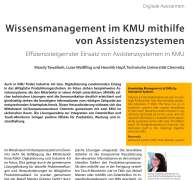
Knowledge Management for Industry 4.0

Knowledge Management for Industry 4.0

Herausforderungen und Lösungsansätze
Klaus North, Ronald Maier
The digital interactions along the value chain pose new challenges for managing information and knowledge. The objectives of this article are to describe the changes in knowledge-based value creation induced by digitalisation and to derive fields of action for knowledge management for Industry 4.0. The “knowledge ladder 4.0” shows how digital technologies can transform strategic and operative knowledge management. Subsequently, we offer a framework for the knowledge-oriented design of dynamic digital organisations that consists of three layers of activities for the operation, reflection and design of knowledge management illustrated with leading questions and case examples in order to promote the productive, responsible and sustainable usage of digital technologies.
Industrie 4.0 Management | Volume 35 | 2019 | Edition 2 | Pages 7-12
Departure of Logistics

Departure of Logistics

How the block chain will change networked supply chains in the future
Anja Wilde, Jan-Henner Theißen
A powerful cross-organizational collaboration within the global value chain will continue to be a major competitive advantage in the future. The way supply chains are managed today will no longer be sufficient tomorrow. Blockchain technology makes it possible to technologically map intermediary functions without manifesting the market power of just one central platform (intermediary). On the basis of Blockchain-technology, trusting (data-) networks are created across company boundaries. The technology will not solve all operational problems; however, it may help to secure processes and simplify communication.
Industrie 4.0 Management | Volume 35 | 2019 | Edition 1 | Pages 43-46
Biointelligent Manufacturing

Biointelligent Manufacturing

A new perspective for sustainable industrial value creation
Robert Miehe, Johannes Full, Thomas Bauernhansl, Alexander Sauer
With digitization, industrial production is already undergoing massive changes. However, the mere introduction of Cyber-Physical systems is not sufficient to address essential challenges of society and companies. This can only be achieved through a systematic application of knowledge about natural processes or nature for the purpose of optimizing industrial manufacturing processes. The result of this biological transformation of industrial value creation is the realization of socalled biointelligent systems.
Industrie 4.0 Management | Volume 35 | 2019 | Edition 1 | Pages 11-14
Cluster Identification of Sensor Data

Cluster Identification of Sensor Data

A Predictive Maintenance Approach for Selective Laser Melting Machines
Eckart Uhlmann ORCID Icon, Sven Pavliček, Rodrigo Pastl-Pontes, Claudio Geisert
Existing selective laser melting (SLM) machine tools are not equipped with analytics tools. This paper describes an approach to analyze offline data, based on machine learning algorithms, to identify clusters. Normal states and error cases can be identified. The results can be used to develop condition monitoring systems that provide predictive maintenance for SLM machine tools.
Industrie 4.0 Management | Volume 35 | 2019 | Edition 1 | Pages 6-10
1 30 31 32 43