I4S+ content for subscribers only

Structural Planning of Future Production Systems

Structural Planning of Future Production Systems

The Required Transformation for Planning and Operating the Smart Factory
Samuel Horler, Egon Müller
The Smart Factory concept describes the extensively networked production of industry 4.0, which affects the entire life cycle of a factory and, in particular, factory planning and factory operation. Both classic and more up-to-date factory planning approaches come to their limits through the new requirements. This paper identifies the requirements that are important for the future structural planning of factories and presents the need for a holistic virtual validation of the factory structure. Furthermore, a methodological approach is addressed for the solution of the challenges.
Industrie 4.0 Management | Volume 33 | 2017 | Edition 3 | Pages 54-58
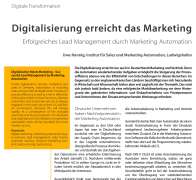
Digitalization Meets Marketing – Successful Lead Management by Marketing Automation

Digitalization Meets Marketing - Successful Lead Management by Marketing Automation

Erfolgreiches Lead Management durch Marketing Automation
Uwe Hannig
Finally digitalization reaches marketing and sales in Germany. Automation of recurring tasks and activities facilitates both increases in process efficiency as well as a rise in effectivity of decisions made in these functions. German researchers and enterprises are not as deeply engaged in this topic yet as their US and British counterparts. However, this will change rapidly. As a consequence of the changed searching and buying behavior of individuals and organizations, the utilization of marketing automation tools will be inevitable for future market success.
Industrie 4.0 Management | Volume 33 | 2017 | Edition 3 | Pages 40-44
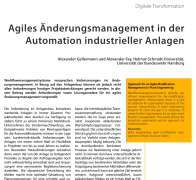
Approach for an Agile Modification Management in Plant Engineering

Approach for an Agile Modification Management in Plant Engineering

Alexander Gellermann, Alexander Fay ORCID Icon
Workflowmanagementsystems promise significant improvements for the modification management. Unfortunately, there is a lack of potential for optimisation because of the process characteristics in plant engineering projects. To close the gap it is necessary to create further requirements for an agile modification management. This article shows the important requirments and an approach for implementation.
Industrie 4.0 Management | Volume 33 | 2017 | Edition 3 | Pages 49-53
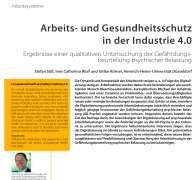
Occupational Health and Safety in Industry 4.0

Occupational Health and Safety in Industry 4.0

Stefan Süß ORCID Icon, Ines Catharina Wulf, Ulrike Körner
As a result of digitalization, the dynamics and complexity of our work environment are continuously expanding, facing employees with increasing man-machine interaction and constantly changing work activities. This technical progress might introduces us to new or altered psychological strains for employees. Results of half-structured interviews show that digitalization leads directly and indirectly to new psychological strains. In order to prevent potential health consequences, it is crucial to consider new dimensions such as flexibility and monitoring in the work place risk assessment.
Industrie 4.0 Management | Volume 33 | 2017 | Edition 3 | Pages 26-30
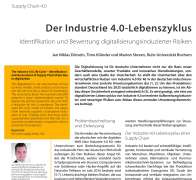
The Industry 4.0 Life Cycle

The Industry 4.0 Life Cycle

Identification and assessment of supply chain risks due to digitization
Jan Niklas Dörseln, Timo Klünder, Marion Steven
The digitalization is not only the basis of new business models, smart products and innovative services but also a source of uncertainty. This uncertainty about the economic benefits presents a major implementation barrier. To digitize the german production site until 2025 a reduction of risks is mandatory. The developed life cycle model of Industry 4.0 supply chain networks supports a transparent evaluation of risks. Findings show that there exists a gap between perceived and real risks. For a successful transformation, companies need to overcome those barriers.
Industrie 4.0 Management | Volume 33 | 2017 | Edition 3 | Pages 68-72
Augmented Reality in a One-of-a-kind Production

Augmented Reality in a One-of-a-kind Production

Potenziale der Informationsversorgung in der Unikatfertigung
Axel Friedewald, Philipp Halata, Nikolaj Meluzov, Hermann Lödding ORCID Icon
The one-of-a-kind production often is characterized by a high share in manual work. Information gathering requires an essential percentage of the workers time. The article shows as Augmented Reality can help to reduce the efforts of information gathering and to increase productivity.
Industrie 4.0 Management | Volume 33 | 2017 | Edition 3 | Pages 7.10
Digitalization of Reporting, Documentation and Certification Processes

Digitalization of Reporting, Documentation and Certification Processes

Ein innovativer Ansatz am Beispiel der Lufthansa Technik AG
Sven Borchert, Wanja Wellbrock
Due to high safety requirements of the aviation industry, the appraisal and documentation of all repair processes, including the final certification of the affected components play a central role. The documentation of all parts of the workflow including materials and machine process parameters as well as the obtained test results leads to inefficient processing times and high costs. To address this problem, Lufthansa Technik AG Hamburg launched the project “Installation of a plenum production” and illustrates how an extensive digitalization and automation of the underlying processes can lead to a reduction in processing time of up to 70%.
Industrie 4.0 Management | Volume 33 | 2017 | Edition 3 | Pages 35-39
Digital Transformation of Business Model

Digital Transformation of Business Model

a Practical Approach for the Successful Design of the Digital Transformation
Daniel Schallmo, Klaus Lang, Manfred Plechaty
The digital transformation of business models plays a special role, because business models contain different elements, which can be digitally transformed. The complexity of production and logistics systems generates the demand for robust and error-resistant control options in the pursuit of corporate objectives. The control of production and logistics systems, especially, is often inadequately managed with methods of exact mathematical specifications alone. The objective of the following contribution is to define introduce a roadmap, including some examples for some instruments.
Industrie 4.0 Management | Volume 33 | 2017 | Edition 3 | Pages 78-82
1 42 43