Autor: Katharina Bunse

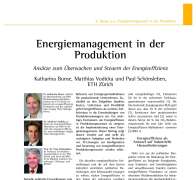
Energy Management in Production

Energy Management in Production

Approaches for Monitoring and Controlling Energy Efficiency
Katharina Bunse, Matthias Vodicka, Paul Schönsleben
Current political developments regarding the withdrawal from nuclear energy will probably result in an additional increase in energy costs over the next few years. This increases the relevance of reducing energy consumption in production for industrial enterprises. Thus, in addition to quality, cost, delivery reliability and flexibility, energy efficiency is integrated as an additional performance criterion in the decisions of production managers. An important instrument to increase energy efficiency in production processes is the implementation of energy management. This paper presents the advantages of an integrated energy management and outlines the main tasks and methods. IT solutions are presented that assist companies in configuring and controlling production processes to become more energy efficient.
Industrie Management | Volume 27 | 2011 | Edition 6 | Pages 53-56
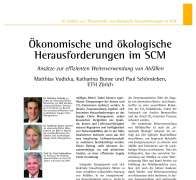
Economic and Ecologic Challenges in SCM

Economic and Ecologic Challenges in SCM

Approaches towards Efficient Recovery of Waste Materials
Matthias Vodicka, Katharina Bunse, Paul Schönsleben
Over the last decades, the cement industries achieved significant efficiency enhancements in their production processes. The so-called “co-processing”, the use of waste as a source of energy and raw material, was found to be both ecologically and economically beneficial. Cement plants can partially replace all fossil fuels by alternative ones and thus achieve significant reduction of cost and carbon footprint. Yet, in this context special challenges regarding supply chain management emerge. While respecting goals like quality, cost and delivery reliability, changing conditions need to be considered. Examples may be new regulations and the question of waste availability at nearby located industries as well as the desire to engage in long-term supply relationships. This article shows the relevant interrelations and presents approaches in order to contribute to a more efficient development of these supply chain relationships.
Industrie Management | Volume 27 | 2011 | Edition 6 | Pages 25-28
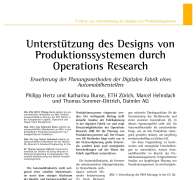
Design of Production Systems Supported by Operations Research

Design of Production Systems Supported by Operations Research

Enhanced Planning Approaches on the Factory Level in the Automotive Sector
Philipp Hertz, Katharina Bunse, Marcel Helmdach, Thomas Sommer-Dittrich
Due to a difficult market situation represented by the world economic and related market crisis and a steady growth of model-variety the automotive industry is facing major challenges: short innovation cycles, increased complexity of production and cost pressures. To respond to these challenges advanced approaches for long-term planning of production systems have to be implemented. This paper presents approaches of plant design utilizing digital factory and shows applications of operations research (OR) for the planning of production systems. The application of OR methods holds significant potential not only for the network planning level but also for supporting strategic decisions on the production system level.
Industrie Management | Volume 27 | 2011 | Edition 3 | Pages 21-24
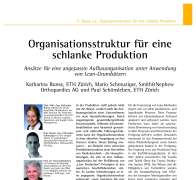
Concept for an Organizational Structure for Lean Production

Concept for an Organizational Structure for Lean Production

Ansätze für eine angepasste Aufbauorganisation unter Anwendung von Lean-Grundsätzen
Katharina Bunse, Mario Schmuziger, Paul Schönsleben
„Lean Production“ is a known as successful production concept increasing productivity of a company in the long-term. Implementing lean principles in production can be challenging for the organizational structure of a company. Insufficient holistic process models, missing interface definitions and inflexible management structures can be major limitations. This article analyses - with the example of a Swiss production site of a company in the medical engineering sector - the challenges for the organization associated with the implementation of lean principles in operations. Requirements for an adapted organizational structure are highlighted and alternative organizational structures outlined. Advantages and disadvantages of these alternatives are presented and a solution for the case-study example developed. Companies in a similar environment can get suggestions for the adaption of their own organizational structure when implementing lean management principles in their production.
Industrie Management | Volume 26 | 2010 | Edition 2 | Pages 53-56
Modularization in the Car Production

Modularization in the Car Production

Production Concepts for Modular Products Using the Example Car
Christian Schneider, Katharina Bunse, Philipp Gneiting, Thomas Sommer-Dittrich
The automotive industry faces substantial challenges: a difficult market environment, increasingly complex technologies and shorter product life cycles characterize the industry. Modularization has been considered a promising remedy to help solving some of these demanding problems. Rewards of the application of modular systems are expected from various different sides. So far, however, its implications for production have rarely been discussed. This paper presents three production concepts for modular pro-ducts and their respective advantages and disadvantages. The integration of the production perspective allows more prudent strategic decisions regarding modularization.
Industrie Management | Volume 26 | 2010 | Edition 1 | Pages 57-60