Autor: Dieter Kreimeier

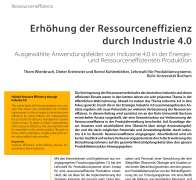
Holistic Resource Efficiency through Industry 4.0

Holistic Resource Efficiency through Industry 4.0

Thom Wienbruch, Dieter Kreimeier, Bernd Kuhlenkötter ORCID Icon
This article deals with the presentation of a concept that shows new possibilities for a holistic improvement in the company’s internal resource efficiency by using Industry 4.0. Subsequently, the structure of a resource management system will be shown. To attain a holistic improvement of the resource efficiency, the viewing frame will be extended to the whole product lifecycle to show which potentials a coupling along the entire value-added chain provides.
Industrie 4.0 Management | Volume 33 | 2017 | Edition 1 | Pages 62-66
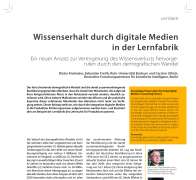
Knowledge Preservation by Using Digital Media in a Learning Factory

Knowledge Preservation by Using Digital Media in a Learning Factory

Ein neuer Ansatz zur Verringerung des Wissensverlusts hervorgerufen durch den demografischen Wandel
Dieter Kreimeier, Sebastian Freith, Carsten Ullrich
A closer look at the population pyramid shows the ongoing demographic change. The number of employees that are due to retire on account of their advanced age will increase significantly in the next years. Without further actions the knowledge and practical expertise of these experienced employees will no longer be available in the company. The preservation of the practical knowledge by the integration of digital media in an industrial production environment is subject of the article and is verified by the learning factory of the chair of production systems.
Industrie Management | Volume 31 | 2015 | Edition 3 | Pages 69-72
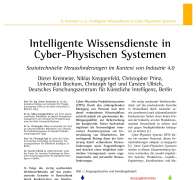
Intelligent Knowledge Services within Cyber-Physical Systems

Intelligent Knowledge Services within Cyber-Physical Systems

Soziotechnische Herausforderungen im Kontext von Industrie 4.0
Dieter Kreimeier, Niklas Kreggenfeld, Christopher Prinz ORCID Icon, Christoph Igel, Carsten Ullrich
As a result of continuously increasing economic constraints for the producing sector in Germany due to competitors from low-wage countries, production paradigms are changing substantially. This paradigm shift is characterized by rapidly advancing automation processes. Hence, highly complex Cyber-Physical Production Systems (CPPS) are developed and put into practice. In combination with decreasing numbers of staff and the resulting loss of knowledge, this leads to a deficit of competence required to handle the increasing complexity of CPPS. As a result, a need for innovative assistance systems arises for the support of the remaining employees. The given article describes the challenges and problems and drafts a potential technical solution as well as challenges concerning organization and staff.
Industrie Management | Volume 30 | 2014 | Edition 6 | Pages 25-29
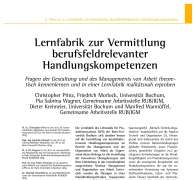
Learning Factory for Imparting Different Competences

Learning Factory for Imparting Different Competences

Experience work design and management in a training factory
Christopher Prinz ORCID Icon, Friedrich Morlock, Pia Sabrina Wagner, Dieter Kreimeier, Manfred Wannöffel ORCID Icon
Learning factories in Germany concentrate on the two classic aspects of production: Optimization of production processes (lean management) as well as the efficient use of resources. The learning factory of the chair of production systems at Ruhr-University Bochum considers also the topic management and organization of labour to convey competences in the field of co-determination. In cooperation between the faculty of mechanical engineering and social sciences as well as the office of cooperation RUB/IMU different learning factory exercises have been developed, which impart this learning factory a special significance.
Industrie Management | Volume 30 | 2014 | Edition 3 | Pages 39-42
Configuration of Modular Production Systems

Configuration of Modular Production Systems

Designing of planning alternatives
Dieter Kreimeier, Stefan Schröder, Niklas Kreggenfeld
The steadily alternating requirements for industrial companies implicate the challenge to enhance production systems. In such a turbulent as well as dynamic environment, companies must be enabled to act and react quickly. Therefore they have to be equipped with appropriate technologically and organizationally realizable as well as economically rentable options. Within this paper, a methodical approach for a systematic and individual configuration of production systems is presented in order to solve the depicted problems.
Industrie Management | Volume 29 | 2013 | Edition 4 | Pages 18-22
Designing Changeable Production Systems

Designing Changeable Production Systems

Holistic Identification and Analysis of Change Factors
Horst Meier, Dieter Kreimeier, Julia Velkova, Stefan Schröder
Internal and external influences of change plus the steady examination with continuous as well as discontinuous change constitute a great challenge for industrial companies to be mastered. The improvement of production systems towards variable and unpredictable requirements caused by a variety of company-specific impacts will be increasingly focused. In this article a concept will be introduced which helps to identify and analyze company-specific change factors systematically.
Industrie Management | Volume 28 | 2012 | Edition 2 | Pages 55-58