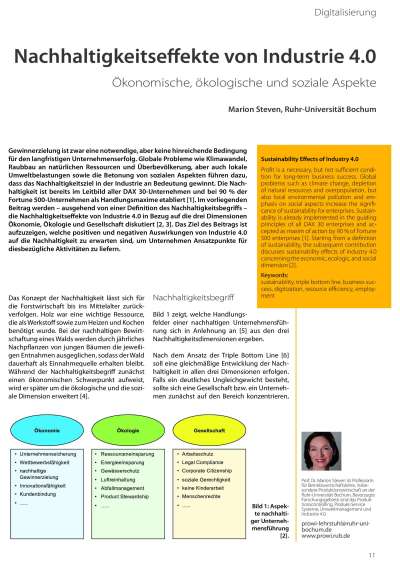
Sustainability Effects of Industry 4.0

Ökonomische, ökologische und soziale Aspekte

JournalIndustrie 4.0 Management
Issue Volume 35, 2019, Edition 6, Pages 11-15
Share Cite Download

Abstract

Profit is a necessary, but not sufficient condition for long-term business success. Global problems such as climate change, depletion of natural resources and overpopulation, but also local environmental pollution and emphasis on social aspects increase the significance of sustainability for enterprises. Sustainability is already implemented in the guiding principles of all DAX 30 enterprises and accepted as maxim of action by 90 % of Fortune 500 enterprises [1]. Starting from a definition of sustainability, the subsequent contribution discusses sustainability effects of industry 4.0 concerning the economic, ecologic, and social dimension [2].

Keywords

Access limited

You are currently not logged in / not yet registered.

In order to download the desired file(s), you must be logged in and have an appropriate inclusive subscription. Alternatively, you can also obtain access by paying a one-off fee.

Subscription included Purchase
without 29,00 €
Digital 27,55 €
Expert 26,10 €
Professional 0,00 €

Download for one time 29,00 €

All prices include 7% VAT

After purchasing access rights, you will automatically be redirected back to this page.


Potentials: Resource Efficiency

You might also be interested in

Industry 4.0—Progress and Digitalization in Limbo

Industry 4.0—Progress and Digitalization in Limbo

Status of sustainable transformation and digitalization in production engineering
Christian Donhauser ORCID Icon, Daniel Riepl
Digitalization projects help users represent complex processes more simply and efficiently. However, there are many obstacles to implementation. Reluctance to implement these projects is palpable. This affects, among others, employers and employees, who may fall behind economically by waiting or avoiding change. These observations can be traced back to an overarching research question: What barriers and systemic challenges hinder sustainable transformation within the context of Industry 4.0, particularly when considering human labor in production engineering? What questions are the affected stakeholders asking? The primary goal of this long-term research project is to define these questions decisively and in detail in order to develop a conceptual foundation that integrates research, teaching, and technological development and thus combines the potential of digital technologies with the experiential and practical knowledge of production workers.
Industry 4.0 Science | Volume 42 | 2026 | Edition 3 | Pages 56-60
Application Potentials of Chinese Knowledge Platforms

Application Potentials of Chinese Knowledge Platforms

Digital platforms for knowledge transfer in research and education
Yunhao Su, Martin Braun ORCID Icon
Knowledge drives innovation, which is why digital platforms are increasingly used for knowledge transfer. The People’s Republic of China (PRC) is a global leader in digitalization and digital platforms are central to Chinese knowledge transfer and innovation systems. This study supplements theoretical concepts of knowledge transfer with empirical findings on the (further) development of relevant knowledge platforms. It examines the influence of specific design features on the functionality and quality of digital knowledge platforms. A literature review identifies seven condensed success criteria. Nine leading Chinese knowledge platforms are categorized based on their transfer logic and functional scope. Online survey participants assess the platform-specific manifestations of the identified criteria and highlight potential and areas for improvement in platform-based knowledge transfer.
Industry 4.0 Science | Volume 42 | 2026 | Edition 3 | Pages 84-93
VR Training for Multimodal Cobot Interaction

VR Training for Multimodal Cobot Interaction

Virtual learning environments for collaborative robots
Christoph S. Zoller, Justus Langer, Kristoffer Waldow ORCID Icon, Merle Meyer, Arnulph Fuhrmann ORCID Icon
The VIRAMM research project is developing and prototyping a VR-based training concept for the integration of collaborative robots (cobots) in assembly-oriented U-cells. Since the benefits of cobots depend heavily on process, layout, and role integration, VIRAMM addresses the previously lacking consistent scenario design for variant comparisons with Key Performance Indicator (KPI)-based evaluation.
Industry 4.0 Science | Volume 42 | 2026 | Edition 3 | Pages 106-112
Decentralized Coordination of AMRs

Decentralized Coordination of AMRs

Regulations for Autonomous Mobile Robots
Manuel Savadogo, Malte Stonis ORCID Icon, Peter Nyhuis ORCID Icon, Jürgen Hupp
The increasing automation of intralogistics requires flexible and resilient control concepts for Autonomous Mobile Robots (AMR). While centralized coordination approaches enable stringent control, they quickly reach their limits in terms of scalability and robustness. This paper therefore presents regulations for the decentralized coordination of AMR within the framework of the ORPHEUS project. The focus is on translating known decentralized decision-making principles into a rule framework tailored to industrial material flow scenarios, addressing both operational task assignment and safety-related conflict situations. ORPHEUS thus makes a significant contribution to the methodological structuring, parameterization, and practical transferability of decentralized coordination logics.
Industry 4.0 Science | Volume 42 | 2026 | Edition 3 | Pages 96-105
Immersive Human Digital Twins for Industry 4.0

Immersive Human Digital Twins for Industry 4.0

Supporting adaptive human-centric production by integrating cognitive and physical states
Tajbeed A. Chowdhury ORCID Icon, Eric Wagner ORCID Icon, Paul Motzki ORCID Icon, Martina Lehser ORCID Icon
The rapid advancement of immersive technologies has created new opportunities to transform human-machine collaboration in industry. This paper presents an immersive platform with a digital twin that combines both physical and cognitive characteristics of human dynamics. By integrating multimodal sensing, human biomechanics, and cognitive state into digital twin technology, the proposed system enhances operational safety and ensures better ergonomics. The main argument is that human digital twins are not only desirable but essential for next-generation industrial systems. We discuss the limitations of existing human modeling approaches, outline the conceptual foundations of human digital twins, and demonstrate their industrial relevance across safety, productivity, ergonomics and sustainability.
Industry 4.0 Science | Volume 42 | 2026 | Edition 3 | Pages 6-13 | DOI 10.30844/I4SE.26.3.1
Digital Twins for Emission Reduction

Digital Twins for Emission Reduction

Ex-ante case study on a pump test bench in industrial production
Felix Bischoff, Ingela Tietze ORCID Icon, Peter Hertweck, Nina van Hasz
Digital twins are frequently referred to as a promising approach for reducing greenhouse gas (GHG) emissions in industrial production; however, robust empirical evidence of their benefits under real-world conditions is largely lacking. In this case study, the emission reduction potential of a digital twin—as a conceptually described target system—is quantified ex-ante via the example of a test bench for hydraulic pumps. To this end, the GHG emissions of the original test plan for the year 2025 are determined based on actual measured energy consumption of the tested pumps and time-resolved grid electricity emission intensities. This is followed by a rule-based rescheduling, in which energy-intensive test processes are shifted to time intervals with lower emissions. The rescheduling takes operational constraints into account so that processes and equipment remain unchanged. The savings potential is determined by comparing the GHG emissions of the reference and the optimized case.
Industry 4.0 Science | Volume 42 | 2026 | Edition 3 | Pages 16-24 | DOI 10.30844/I4SE.26.3.2