Social Networks in Logistics and Industry 4.0

The Usage of Social Networks for Communication Enhances Production and Logistics

JournalIndustrie 4.0 Management
Issue Volume 34, 2018, Edition 5, Pages 51-54
Open Accesshttps://doi.org/10.30844/I40M18-5_51-54
Bibliography Share Cite Download

Abstract

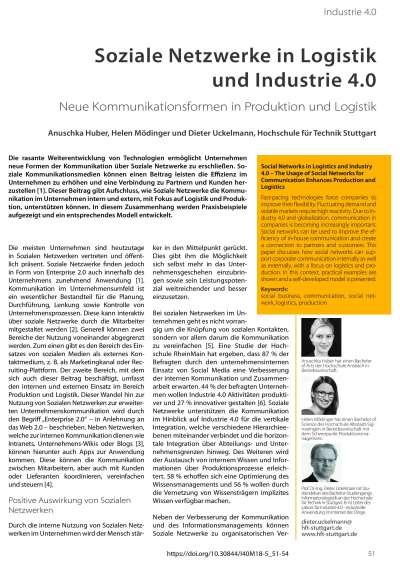
Fast-pacing technologies force companies to improve their flexibility. Fluctuating demand and volatile markets require high reactivity. Due to Industry 4.0 and globalization, communication in companies is becoming increasingly important. Social networks can be used to improve the efficiency of in-house communication and create a connection to partners and customers. This paper discusses how social networks can support corporate communication internally as well as externally, with a focus on logistics and production. In this context, practical examples are shown and a self-developed model is presented.

Keywords


Bibliography

[1] MTSLogistics: How can logistics and supply chain benefit from social media?. URL: https://www.morethanshipping.com/can-logistics-supply-chain-benefit-social-media/, Abrufdatum 13.04.2018.
[2] Gabriel R.; Röhrs, H.-P.: Social Media – Potentiale, Trends, Chancen und Risiken, 1. Auflage. Bochum Kaarst 2017.
[3] Abts, D.; Mülder, W.:Grundkurs Wirtschaftsinformatik – Eine kompakte und praxisorientierte Einführung, 9. Auflage. Wiesbaden 2017.
[4] NextCargo: Stau- und Laderaum Programm mit 3D-Visualisierung. URL: http://www.nextcargo.com/#carousel-ex- ample-generic, Abrufdatum 15.04.2018.
[5] Saunders, K: Logistics Companies are Lacking the “Social” in Social Networking. URL: https://www.eft.com/technology/logistics-companies-are-lacking-social-social-networking, Abrufdatum 16.04.2018.
[6] Petry, T.; Schreckenbach, F.: Enterprise 2.0. In: OrganisationsEntwicklung (2015) 4, S. 102-104.
[7] Kagermann, H.: Chancen von Industrie 4.0 nutzen. In: Vogel-Heuser, B.; Bauernhansl, T.; ten Hompel, M. (Hrsg): Handbuch Industrie 4.0 Bd.4 – Allgemeine Grundlagen, 2. Auflage. München Dortmund Stuttgart 2017.
[8] EON Reality Inc.: Exxon Mobil – Immersive 3D Training Environment. URL: https://www.eonreality.com/portfolio-items/immersive-3d-training-environment/, Abrufdatum 16.04.2018.
[9] Axon Gesellschaft für Informationssysteme mbH: Die Zukunft von SharePoint: Der „Enterprise Workplace“. URL: http://www.axongmbh.de/kompetenzen/sharepoint/social-intranet, Abrufdatum 20.04.2018.
[10] Rouse, M.: Ariba (Ariba Network). URL: https://www.searchenterprisesoftware.de/definition/Ariba-Ariba-Network, Abrufdatum 15.04.2018.
[11] Hommel, E.-M.: Das Internet der Menschen. In: Handelsblatt print (2016) 79, S. 28.
[12] Hernse-Ferch, S.: Ohne die Bereitschaft der Belegschaft stockt die Vernetzung. In: VDI nachrichten (2017) 20, S. 29.
[13] Ulbricht, C.: Social Media und Recht – Praxiswissen für Unternehmen, 3. Auflage. Freiburg 2016.
[14] Süddeutsche Zeitung: Mobile Website oder App: Vor- und Nachteile für Nutzer. URL: http://www.sueddeutsche.de/news/ wissen/technik-mobile-webseite-oder-app-vor-und-nachteile-fuer-nutzer-dpa.urn-newsml-dpacom-20090101-150813-99-03195, Abrufdatum 13.07.2018.
[15] Liegel, P.: Elektronischer Datenaustausch über das Ariba-Netzwerk. URL: https://ecosio.com/ de/blog/2015/04/28/Elektronischer-Datenaustausch-ueber-das-Ariba-Netzwerk/, Abrufdatum 13.07.2018.
[16] Rixecker, K.: Mobiles Arbeiten: Deutsche Unternehmen bei der App-Nutzung ganz weit vorne. URL: https://t3n.de/news/mobile-enterprise-apps-studie-754382/, Abruf- datum 13.07.2018.
[17] Gerlach, S.: Selbstorganisierte Kapazitätsflexibilität in Cy- ber-Physical-Systems. URL: https://www.kapaflexcy.de/ content/dam/kapaflecy/documents/KapaflexCy_Info- blatt01_130129.pdf, Abrufdatum 20.04.2018.
[18] Gerlach, S.: Die Stechuhr schlägt zurück. URL: https://blog.iao.fraunhofer.de/die-stechuhr-schlaegt-zurueck/, Ab- rufdatum 15.04.2018.
[19] Schröder, S.: Virtuelles Training mit 3D-Visualisierung. URL: https://www.siemens.com/innovation/de/home/pictures-of-the-future/digitalisierung-und-software/simulation-and-virtual-reality-immersives-training-in-virtuellen-welten.html, Abrufdatum 15.04.2018.
[20] Schonschek, O.: Datenschutz: Social Intranet und die Gren- zen für Analysen. URL: https://www.searchenterprisesoft- ware.de/sonderbeitrag/Datenschutz-Social-Intranet-und-die-Grenzen-fuer-Analysen, Abrufdatum 18.07.2018.
[21] Rübsamen, M.: SAP-Procurement – jetzt die Weichen richtig stellen. URL: https://www.computerwoche.de/a/sap-procurement-jetzt-die-weichen-richtig-stellen%2C3329991, Abrufdatum 18.07.2018.
[22] Sieglerschmidt, G.: Digitale Spedition, klassische Spedition oder Frachtenbörse? Ein Vergleich. URL: https://www.frachtraum.com/de/blog/digitale-spedition/, Abrufdatum 16.04.2018.
[23]Simmet, H.: Sharing – Megatrend auch in der Logistik. URL: https://www.dvz.de/rubriken/management-recht/ speditionsmanagement/ detail/news/sharing-megatrend-auch-in-der-logistik.html, Abrufdatum 18.07.2018.
[24] Kratzer Automation: Kratzer Automation präsentiert neues App-Trio auf der transport logistic 2017. URL: https:// www.kratzer-automation.com/de/aktuelles0/pres- semitteilungen/pressemitteilung/news/kratzer-automation-praesentiert-neues-app-trio-auf-der-transport-logistic-2017/, Abrufdatum 15.04.2018.

Your downloads


Potentials: Leadership

You might also be interested in
Serious Games as a Training Tool

Serious Games as a Training Tool

Game mechanics design to promote resilience
Annika Lange ORCID Icon, Thomas Knothe ORCID Icon
Unforeseen events are increasingly challenging manufacturing companies. Being resilient during crises is becoming a key competence. Serious games (SG) can help make resilience-building processes more transparent. This article derives specific requirements for SG from different phases of resilience and shows how these can be implemented in game mechanics in order to effectively support the training of resilience.
Industry 4.0 Science | Volume 42 | 2026 | Edition 2 | Pages 98-104
Learning Factories for the Future of Manufacturing in Brazil

Learning Factories for the Future of Manufacturing in Brazil

Advancing manufacturing through technology and skills development
Manufacturing firms in developing countries face challenges in closing productivity gaps while adopting Industry 4.0 technologies. Learning factories are one helpful approach to countering these challenges. One such example is the learning factory Fábrica do Futuroin São Paulo, Brazil, which has engaged students, supported competence development, and collaborated with industry in applied research, functioning as a hub for advanced manufacturing initiatives.
Serious Gaming and the Energy Transition

Serious Gaming and the Energy Transition

Collaborative knowledge generation and interactive understanding of complex interrelationships
Janine Gondolf ORCID Icon, Gert Mehlmann, Jörn Hartung, Bernd Schweinshaut, Anne Bauer
Conveying the complexity and multifaceted nature of the energy transition to a broad audience is a challenge. This article demonstrates how interactive serious games on a multitouch table can help make connections tangible and comprehensible. The games and the table were used in various conversational contexts. These are presented here in three case vignettes based on participant observation of the different applications, as well as situated and shared reflection. The vignettes demonstrate how interaction can trigger epistemic processes, enable shifts in perspective, and foster collective thinking, all of which are necessary for shaping the future of society as a whole.
Industry 4.0 Science | Volume 42 | 2026 | Edition 2 | Pages 62-69
Industrial Transformation via a Machining Learning Factory

Industrial Transformation via a Machining Learning Factory

A learning module to foster competencies for a sustainability-driven transformation
Oskay Ozen ORCID Icon, Victoria Breidling ORCID Icon, Stefan Seyfried ORCID Icon, Matthias Weigold
Sustainability-enhancing transformation processes are necessary in all sectors if we are to remain within planetary boundaries. This also applies to the industrial sector as a significant emitter of greenhouse gases. Employees need new competencies to master this complex task of industrial transformation. These range from CO2 equivalents accounting to the development and evaluation of transformation scenarios, including technical measures. The learning module developed here addresses these competency requirements and uses the example of the ETA factory to show how a competency-oriented learning module for industrial transformation can be structured. It essentially comprises four phases: data collection and CO2 equivalents accounting, cause analysis, development of measures and evaluation of measures.
Industry 4.0 Science | Volume 42 | Edition 2 | Pages 38-47 | DOI 10.30844/I4SE.26.2.38
Experiencing Digital Twins in Production and Logistics

Experiencing Digital Twins in Production and Logistics

The fischertechnik® Learning Factory 4.0 as a development platform for possible expansion stages
Deike Gliem ORCID Icon, Sigrid Wenzel ORCID Icon, Jan Schickram, Tareq Albeesh
The fischertechnik® Learning Factory 4.0 has proven to be a suitable experimental environment for testing digital twins. Depending on the targeted maturity stage, the functions of a digital twin range from status monitoring and forecasting to the operational control of production and logistics systems. To systematically classify these functions, this article presents a maturity model that serves as a framework for the development of a digital twin. Building on this, selected use cases are implemented in a test and development environment based on a system architecture with multi-layered logic structure. These initial implementations serve to highlight application purposes, relevant methods, and typical challenges and potentials in the transfer to real factory environments.
Industry 4.0 Science | Volume 42 | Edition 2 | Pages 30-37 | DOI 10.30844/I4SE.26.2.30
From Brownfield to Industry 4.0

From Brownfield to Industry 4.0

Learning factories as training and testing environment for digital transformation
Jakob Weber, Sven Völker ORCID Icon
To succeed in their digital transformation, manufacturing companies need engineers with in-depth knowledge of key technologies and concepts, and a profound understanding of the transition from Industry 3.0 to Industry 4.0. This article describes the concept of a learning factory that is continuously subjected to a digital transformation, thereby creating an environment for the development of transformation competencies. The concept of digital transformation is based on digital worker assistance systems and multi-agent systems for production control. These enable the incremental integration of existing resources into the digitalized factory. The learning factory is not presented to students as a completed solution. Instead, it is continuously developed further as part of student projects. This way, it contributes directly to the qualification of personnel for the implementation of Industry 4.0.
Industry 4.0 Science | Volume 42 | 2026 | Edition 2 | Pages 88-96