communication

Digital Trust Management

Digital Trust Management

Olaf Resch ORCID Icon
Digital Trust is an important prerequisite to conduct business in the digital age. However, digital trust has to be earned and cannot be taken for granted. This article discusses different aspects of digital trust and proposes a management-oriented approach to improve an organization’s trustworthiness as well as its systematic trust in others.
Industrie 4.0 Management | Volume 39 | 2023 | Edition 3 | Pages 20-23
The Loop of Cognition

The Loop of Cognition

How “intelligence” is constellated on a silicon basis
Claus Riehle, Thorsten Pötter, Thomas Steckenreiter
In process engineering, one thinks of production operations that are controlled or regulated by sensors and actuators. And any realization of matter transformation is based on a physical substratum, which holds equally for living systems and their behaviour. The article distinguishes between three system levels: the functional level, the interface to the environment and the cognitive level of. Using these three levels, the learning cycle or the previous Cognitive Loop can be very well illustrated. If one compares with this way of distinction the Bio-Informatization of human intelligence with the technical development stages of mechanization, automation, regulation and deep learning, then the cybernetic-sociological term “operational closure” becomes understandable. It becomes obvious that in the context of a digitized culture of production and organization, we should be prepared for a new kind of cognitive loop based on silicon (SI), an intelligent system behavior via ...
Industrie 4.0 Management | Volume 36 | 2020 | Edition 2 | Pages 52-56 | DOI 10.30844/I40M_20-2_S52-56
Social Networks in Logistics and Industry 4.0

Social Networks in Logistics and Industry 4.0

The Usage of Social Networks for Communication Enhances Production and Logistics
Anuschka Huber, Helen Mödinger, Dieter Uckelmann ORCID Icon
Fast-pacing technologies force companies to improve their flexibility. Fluctuating demand and volatile markets require high reactivity. Due to Industry 4.0 and globalization, communication in companies is becoming increasingly important. Social networks can be used to improve the efficiency of in-house communication and create a connection to partners and customers. This paper discusses how social networks can support corporate communication internally as well as externally, with a focus on logistics and production. In this context, practical examples are shown and a self-developed model is presented.
Industrie 4.0 Management | Volume 34 | 2018 | Edition 5 | Pages 51-54 | DOI 10.30844/I40M18-5_51-54
Make Successful Lean an Everyday Practice

Make Successful Lean an Everyday Practice

Lean-Management setzt Kulturwandel voraus
Daniela Best, Albert Hurtz
Achieving lean structures and principles in a company means taking care that a cultural change takes place through all the parties everyone, including the leaders and employees, should be convinced that it is sensible, necessary and the correct thing to establish Lean. Lean should not be considered to be a foreign object in an environment where old habits persist. Cultural changes can be brought when thoughts about Lean are internalized by the people in the company, which become a part of the corporate philosophy. This article shows which measures the decision makers in management can take to develop Lean and make it an everyday practice.
Industrie Management | Volume 31 | 2015 | Edition 1 | Pages 53-56
Innovative Working Environments

Innovative Working Environments

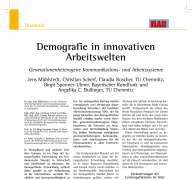
Age-Mixed Communication and Demographic Work Systems
Jens Mühlstedt, Christian Scherf, Claudia Roscher, Birgit Spanner-Ulmer, Angelika C. Bullinger-Hoffmann
Due to demographic change, fundamental transformations in economy and society can be identified in Germany and other European countries. The requirements on companies regarding increasing flexibility and innovation skills proceed parallel to demographic change. Hence, research on demographics in innovative working environments can deal with these changes in positive ways. The article describes two design tools: first the modular age explorer MAX which makes demographic change perceptible for young people and second flexible, generation-heterogeneous organizations which provide both innovation and value potential. These tools enable generation-heterogeneous communication and work systems for the researchers and all departments.
Industrie Management | Volume 29 | 2013 | Edition 3 | Pages 34-38
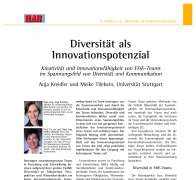
Diversity as a Potential for Innovation

Diversity as a Potential for Innovation

Creativity and innovativeness of new product development teams between diversity and communication
Anja Kreidler, Meike Tilebein ORCID Icon
Through their diversity of competences and knowledge, heterogeneous new product development teams have a high potential for innovativeness. On the one hand, team diversity helps to deal with complex tasks and to improve the development of new products. On the other hand, a high level of diversity can lead to communication and cooperation barriers within the team, obstructing teamwork and hence hindering creativity and innovativeness. Therefore, finding the right constellation in this conflict between diversity and communication - exploiting the benefits whilst avoiding the hindrances - contributes to helping develop the full potential for innovation. This paper describes the different influences of diversity on the innovativeness of NPD teams and gives practical implications for managing heterogeneous teams.
Industrie Management | Volume 28 | 2012 | Edition 3 | Pages 47-50
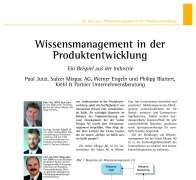
Knowledge Management of Product Development

Knowledge Management of Product Development

an Industry Example
Paul Jutzi, Werner Engeln, Philipp Blattert
Today knowledge is the company’s main resource. To be competitive, companies need qualified employees who are able to use their knowledge for solving problems. Especially in the field of product development it is essential that relevant knowledge is available. Knowledge Management is one important module of the concept of Lean Development. The Sulzer Mixpac AG has established Lean Development in its structure, while knowledge management has been introduced to the organization. This article provides background information. Sulzer Mixpac has followed the Toyota principle: “Before we build cars, we build people!”
Industrie Management | Volume 27 | 2011 | Edition 4 | Pages 43-46
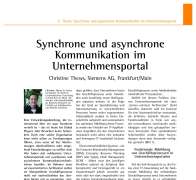
Synchronous and Asynchronous Communication in Corporate Portals

Synchronous and Asynchronous Communication in Corporate Portals

Christine Thews
Nowadays it is not unusual that the R & D departments of global players might be spread over several locations worldwide. Whenever fast decisions are to be made in many times such an organization can lead to delays. Web based corporate portals with synchronous and asynchronous features of communication have been approved as a practical solution. Within a service oriented architecture it not only illustrates comprehensibly overlapping business processes, it also offers staff members so-called „Collaboration Services“ which substantially simplify teamwork.
Industrie Management | Volume 22 | 2006 | Edition 5 | Pages 55-58
Autonomous Control in Transport Logistics: Modelling Communication

Autonomous Control in Transport Logistics: Modelling Communication

Modellierung der mobilen Kommunikation
Markus Becker, Andreas Timm-Giel
High dynamics and structural complexity in current and future logistic systems are complicating central planning and control. For enabling a more decentralised and autonomous control, communication between the elements of the logistical network are necessary for the provisioning of the information needed. This article details the modelling of the communication between the components. This modelling contains source and sink of the information as well as the amount of data, frequency of transmission, quality of service and the moment of transmission for a reasonable usage of the information. The technical feasibility with current and upcoming communication systems is evaluated under consideration of the model.
Industrie Management | Volume 21 | 2005 | Edition 5 | Pages 71-74
Process-Orientated Information Retrieval On-Demand in Producing Enterprises

Process-Orientated Information Retrieval On-Demand in Producing Enterprises

Jürgen Fleischer, Markus Herm, Karl-Heinz Sternemann
Due to increasing pressure of competition accompanied with the developments in information technology many companies consider speeding up and improving their business processes with regard to major orientation towards their customers. Employees which are involved in these business processes have to be supported by an improved and tailored information supply. One possibility for this support by new Information Compative Technologies (ITC) will be shown in this article on the basis of an example for a customer complaint process.
Industrie Management | Volume 21 | 2005 | Edition 1 | Pages 17-20