
Comparing Industry 4.0 Maturity Models |

| Journal | Industry 4.0 Science |
| Issue | Volume 39, 2023, Edition 1, Pages 16-33 |
| Open Access | https://doi.org/10.30844/I4SE.23.1.16 |
| Bibliography | Share | Cite | Download |
Abstract
Keywords
Article
For the German version of this article see here
Which maturity models were included?
By conducting a literature review of the terms “Industry 4.0 Maturity Model” and “Industry 4.0 Maturity Index” in German and English, the authors were able to identify 28 maturity models and seven overviews of maturity models (Schumacher, et al., 2016) (Kese & Terstegen, 2017) (Müller, et al., 2018) (Matt, et al., 2018) (Angreani, et al., 2020) (Mrugalska & Stasiuk-Piekarska, 2020) (Dommermuth, 2021). After deleting duplicate entries, the maturity models were further reviewed according to the following criteria:
- Is the model still available?
- Does the model have publicly available documentation?
- Does the model cover a broad area of action? The authors deemed models that only focused on logistics, supply chain management, smart factory, IT landscape or organizational topics, for example, to be too narrow in scope.
- Does the model indicate not only the status quo, but also a gradual development path to a higher level of maturity?
- Was the model not developed by management consultancies or providers of Industry 4.0 technologies? This criterion is intended to exclude any bias due to prior involvement or due to a desire to achieve better marketability of one’s own services.
- Can the model be carried out independently by the company using it?
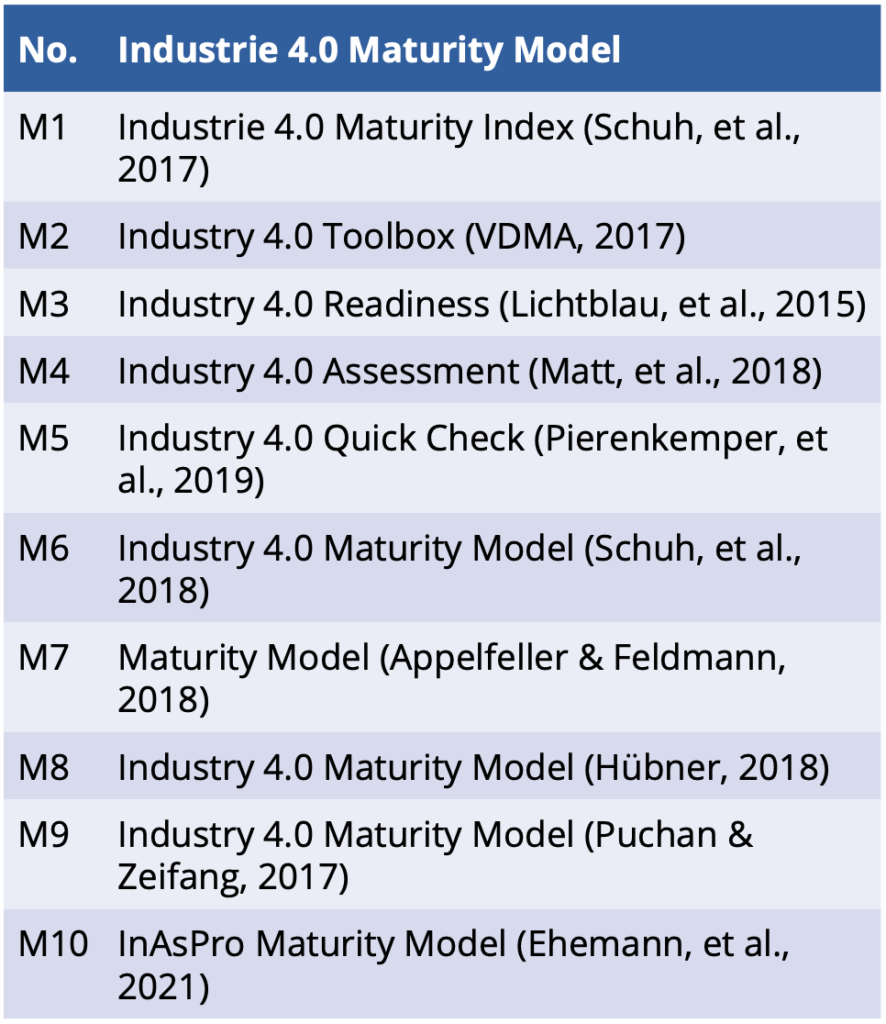
All models that met these selection criteria were included in the comparative evaluation (See Fig. 1).
Assessment methodology
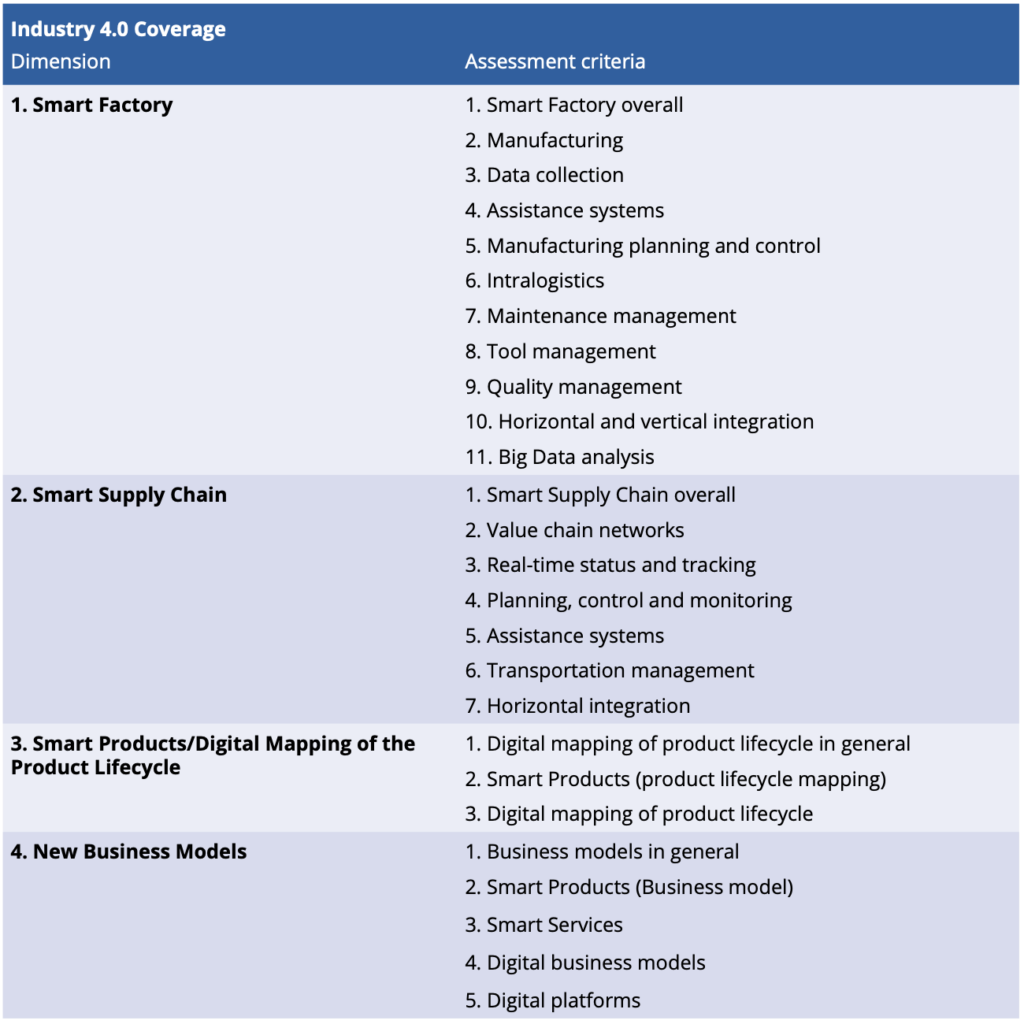
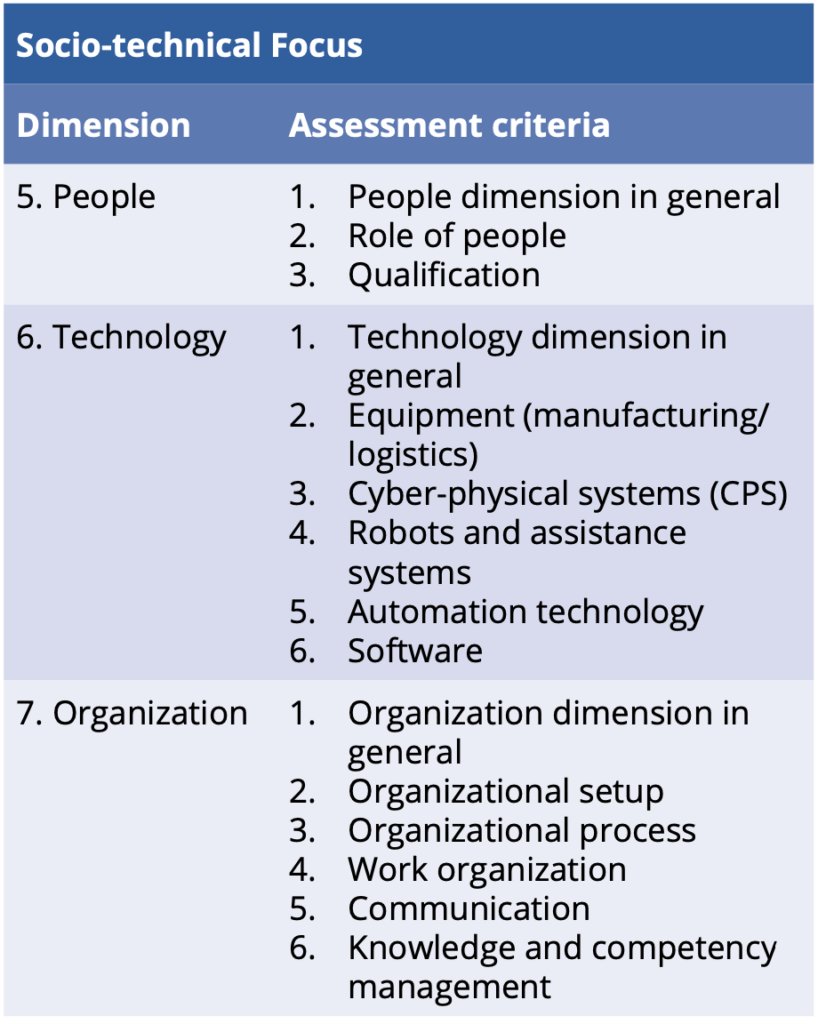
Based on the necessary technologies, areas of action and success factors of digital transformation, several essential criteria for evaluating the maturity models were developed. These can be divided into three main areas: Industry 4.0 coverage, focus on the three-part intersection of people-organization-technology, and practical applicability of the maturity model.
Maturity models: Industry 4.0 coverage
During evaluation, the authors assessed the extent to which the respective evaluation criterion is mentioned and described in the maturity level of the model being tested. A four-level evaluation scheme is used for this purpose:
3: The criterion is mentioned and fully taken into account by the maturity model
2: The criterion is mentioned and partially taken into account by the maturity level
1: The criterion is mentioned indirectly and is partially taken into account by the maturity level
0: The criterion is not taken into account by the maturity model.
Maturity models: Applicability
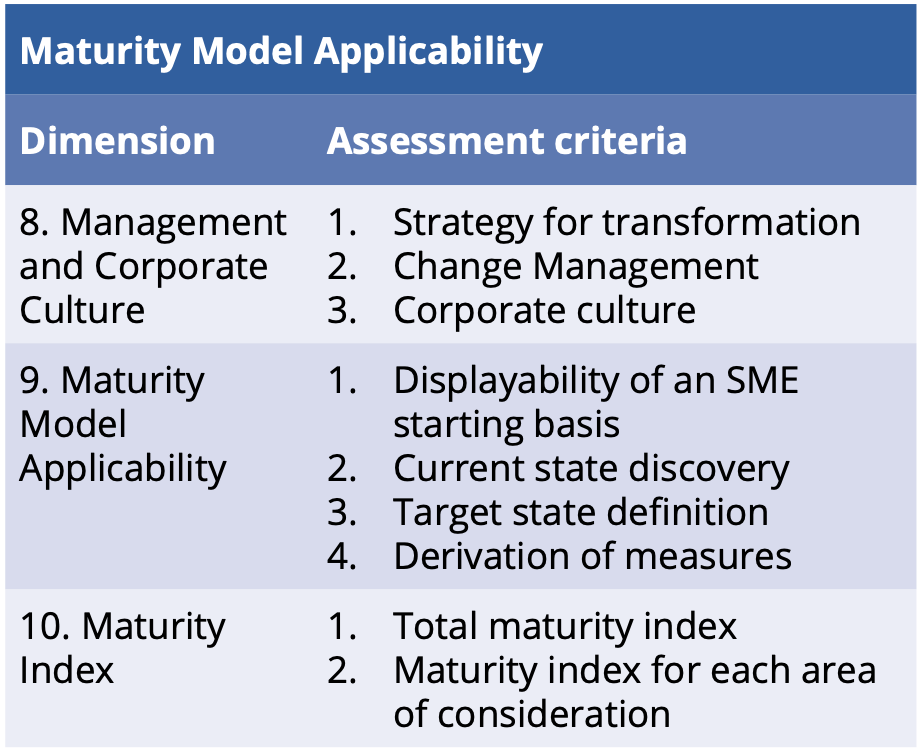
With the help of maturity models, it must be possible to evaluate the current state of the company and lay bare a gradual development path to a higher level of maturity (Knackstedt, et al., 2009, p. 535). When evaluating the maturity models, consideration is given to whether they can be used to determine the current state, whether a target state can be defined based on said current state, and whether measures for the transformation from the current state to the target state can be derived. The authors also assessed whether the typical initial situation of SMEs and medium-sized companies could be represented in the maturity model.
Questions regarding the consideration of corporate culture and the numerical recording of maturity levels are also summarized here. Overall, the criteria shown in Figure 4 were used.
Evaluation of the models
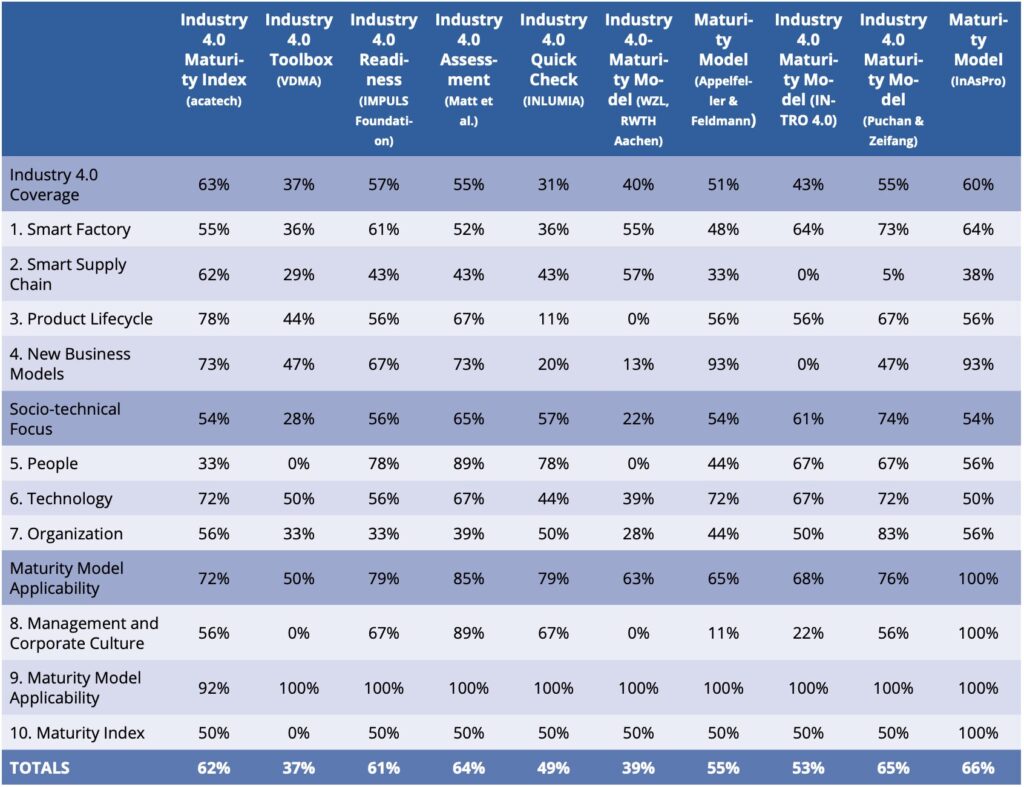
The overall results of the assessment of existing Industry 4.0 maturity models are presented in an overview in Figure 5. Overall, all maturity models were deemed suitable for recording the actual state, defining a target state and deriving measures. Due to its structure, which requires a great deal of explanation, especially for SMEs, the applicability of the Industry 4.0 Maturity Index (acatech) has been somewhat downgraded compared to the other models. All models calculate a corresponding maturity index for each area of consideration, while the InAsPro maturity model is the only model that also calculates an overall maturity index.
Major differences were found with regard to Industry 4.0 coverage, socio-technical focus as well as in the area of management and corporate culture.
Industry 4.0 coverage
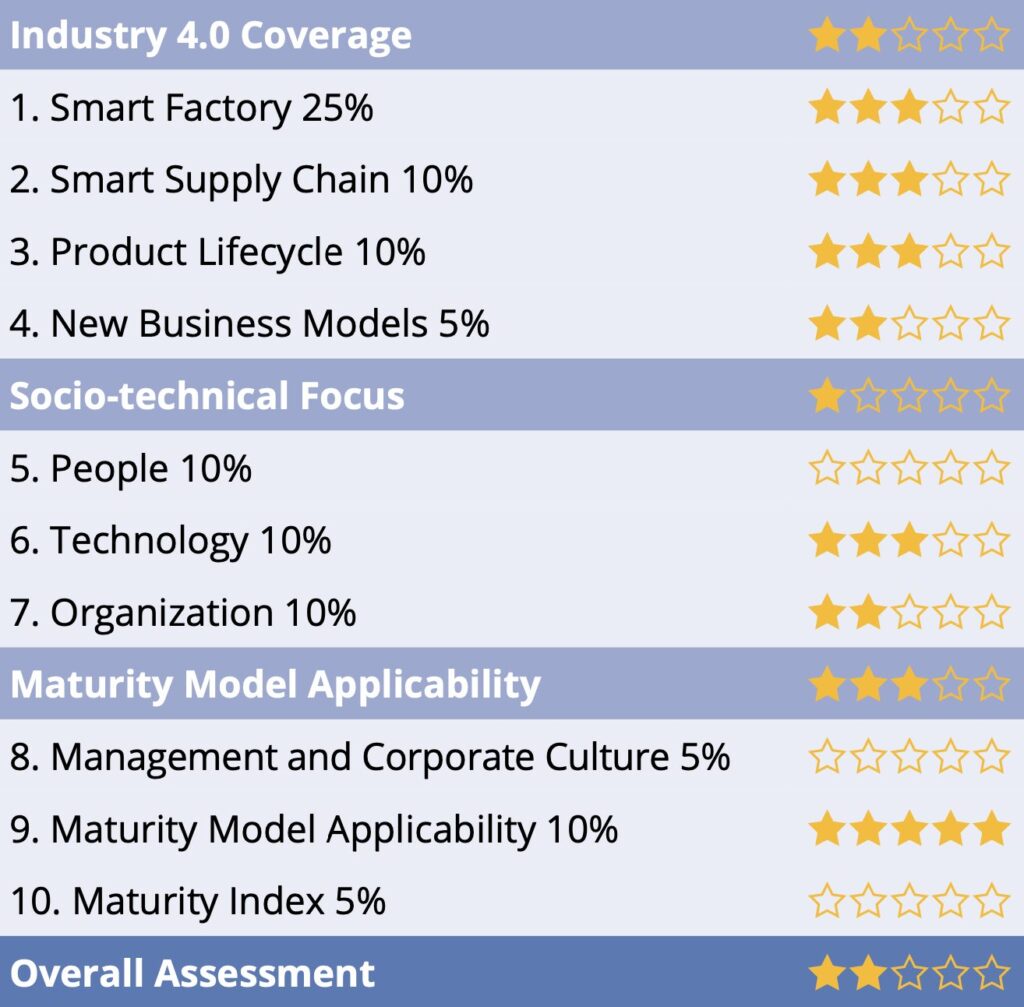
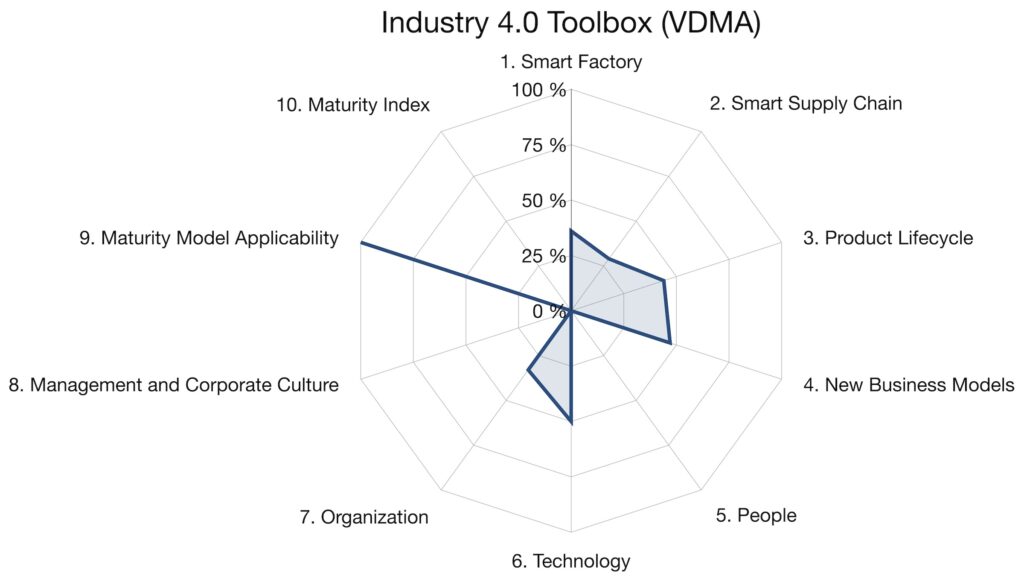
At 63 percent, the Industry 4.0 Maturity Index (acatech) offers the best overall coverage of Industry 4.0, followed by Maturity Model (InAsPro) at 60 percent. Using an Industry 4.0 maturity model with a core that only partially covers Industry 4.0 topics does not seem sensible. This affects the VDMA’s Industry 4.0 Toolbox, which only attained 37 percent, the Industry 4.0 Quick Check from INLUMIA, and the Industry 4.0 maturity models from the WZL at RWTH Aachen and from INTRO 4.0.
The Industry 4.0 Maturity Index (acatech) also offers the best coverage in the “Smart Supply Chain” and “Smart Products/Digital mapping of the product life cycle” dimensions, while the InAsPro and Appelfeller and Feldmann maturity models provide the best coverage in the “New business models” dimension. The “Smart Factory” dimension is best represented by the Industry 4.0 maturity model from Puchan and Zeifang. Overall, it seems that there is still room for improvement in all models and that in some cases essential perspectives of Industry 4.0, such as the supply chain or new business models, are hardly or not at all covered.
Socio-technical focus
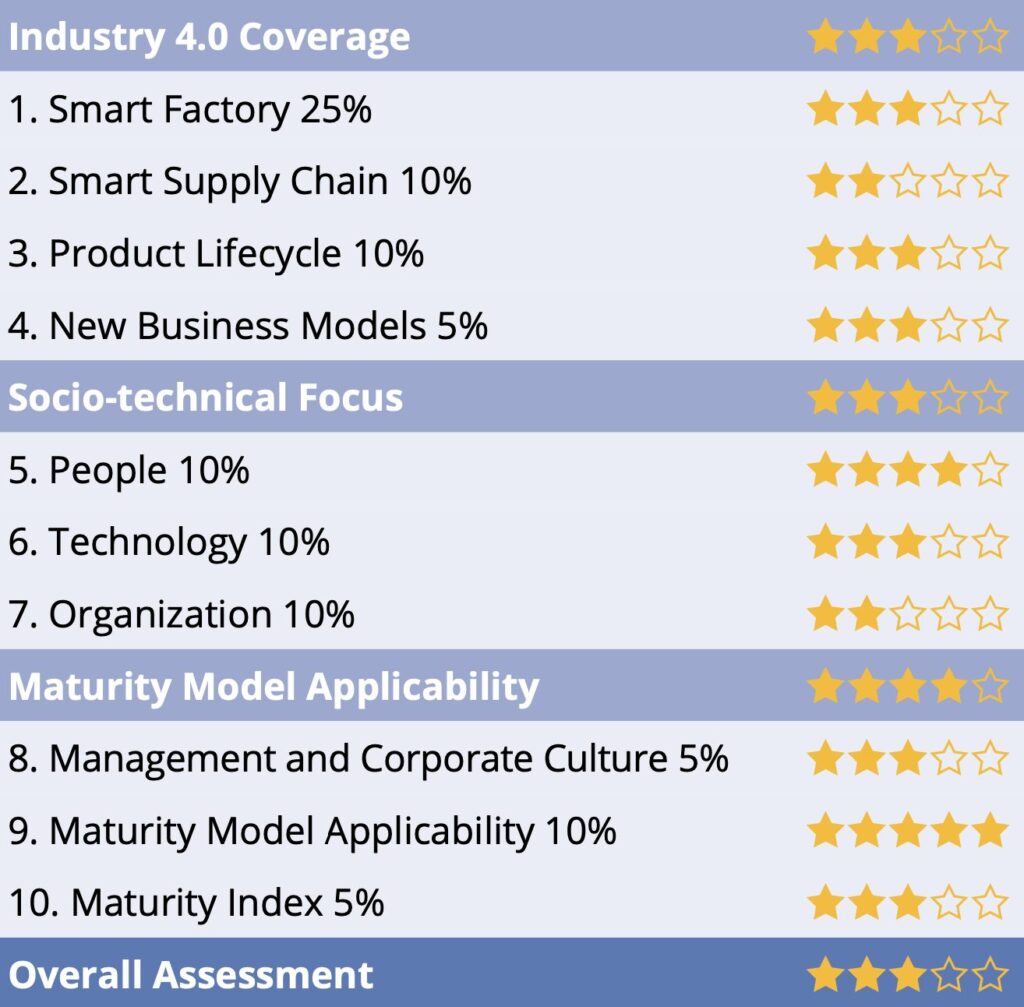
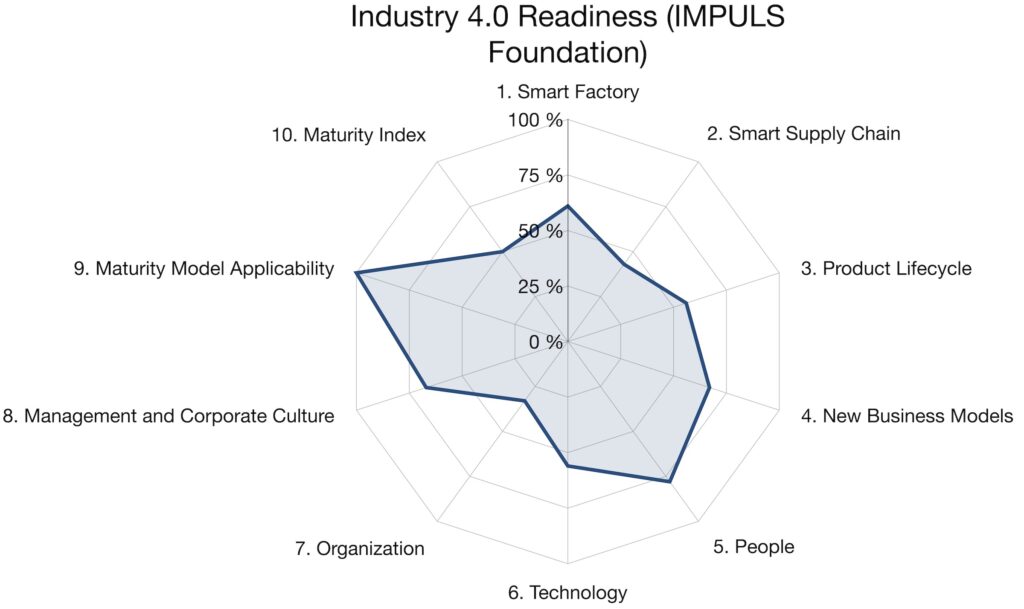
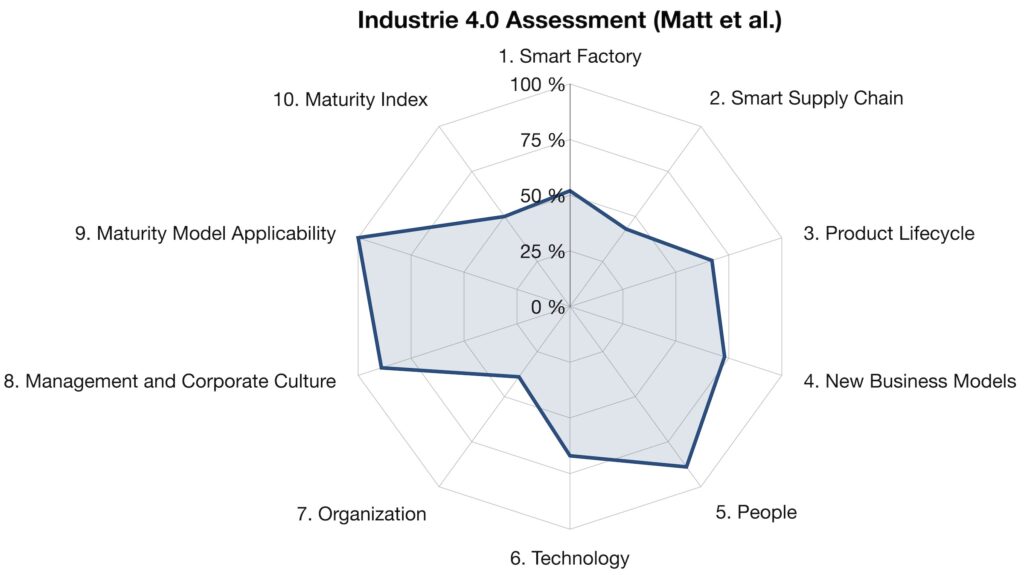
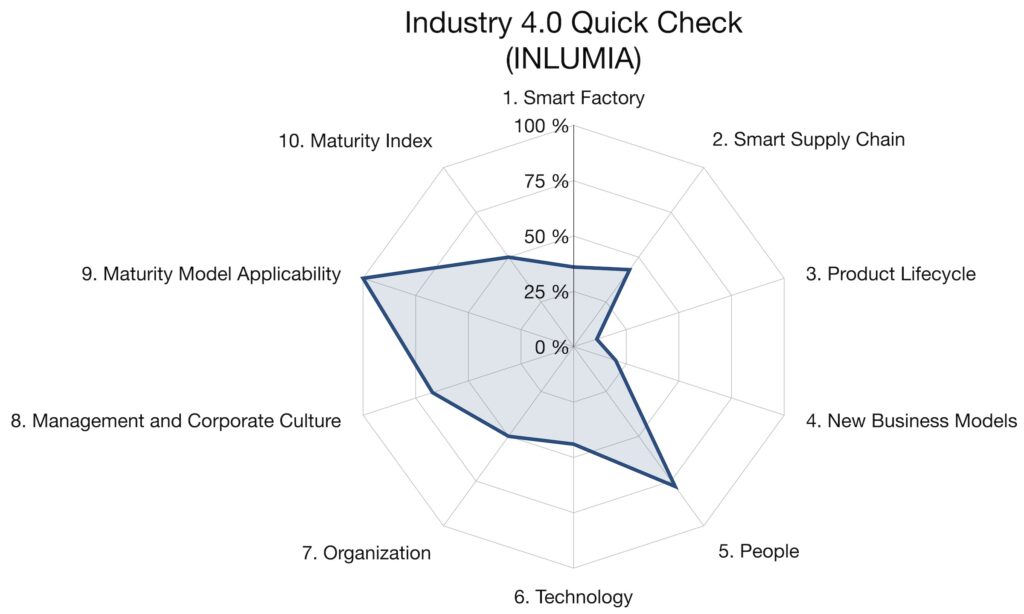
The Industry 4.0 maturity model from Puchan and Zeifang has the best overall socio-technical focus at 74 percent. At 83 percent, it by far provides the best coverage in the “Organization” dimension. All other maturity models have significant deficits here. The “People” dimension is best represented by Industry 4.0 Assessment (Matt et al.) with 89 percent, followed by the Industry 4.0 Readiness (IMPULS Foundation) and Industry 4.0 Quick Check (INLUMIA) models, each with 78 percent.
The best coverage of the “Technology” dimension is jointly provided by the Industry 4.0 Maturity Index (acatech), Maturity Model (Appelfeller & Feldmann) and the Industry 4.0 Maturity Model (Puchan & Zeifang), which are tied at 72 percent each. Overall, it can be stated that all models provide coverage of the “Technology” dimension, with a range from 39 to 72 percent, coverage of the “Organization” dimension with a range from 28 to 83 percent, and coverage of the “People” dimension with a range from 0 to 89 percent. Models that do not adequately take people and organizations into account in the maturity level of Industry 4.0 should not be used in practice.
Applicability of the maturity model
This criterion summarizes the three aspects of management and corporate culture, applicability and level of detail of the maturity index.
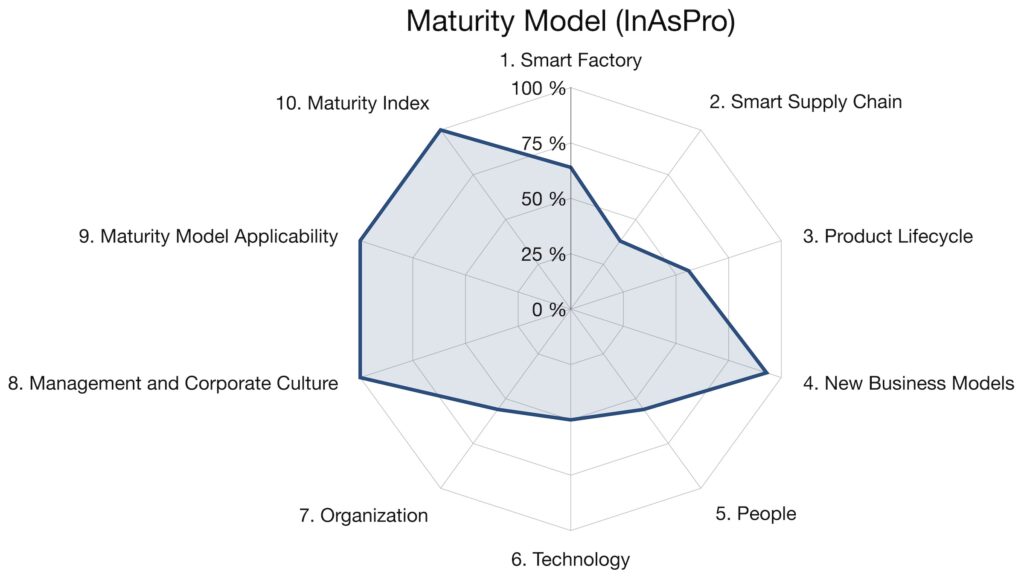
The InAsPro maturity model provides the best consideration of these three topics with a score of 100 percent. Industry 4.0 Assessment by Matt et al. is also a frontrunner with 85 percent. None of the models have completely failed the applicability assessment, though the VDMA Industry 4.0 Toolbox and the WZL Maturity Model from the WZL at RWTH Aachen do completely ignore the areas of management and corporate culture.
Overall view
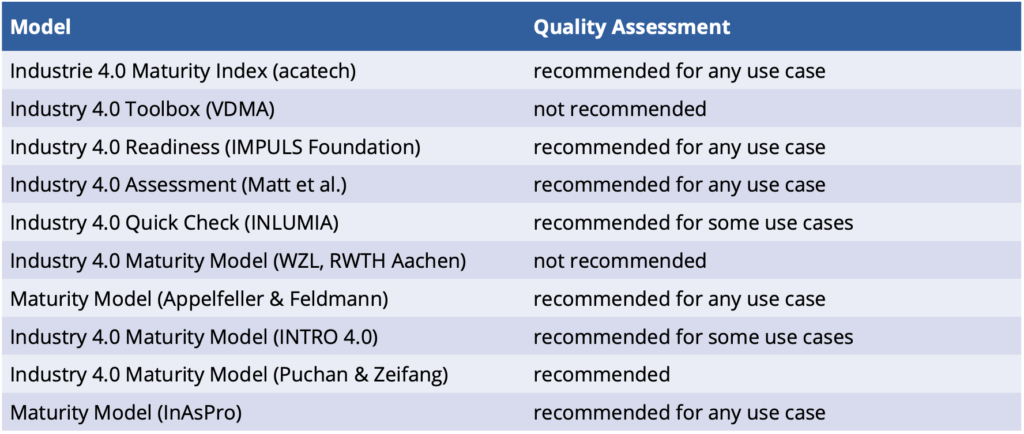
Five of the models that were compared in terms of their ability to measure the maturity of a company with regard to Industry 4.0 can be recommended without restriction and for any use case. They do not have any significant deficits and cover the entire range of Industry 4.0. topics and are also easy to handle. There is a sixth model that can compete very well in the top group and even has the second-best overall rating in the comparison, only showing clear weaknesses in the “Smart Supply Chain” dimension.
There are two other models which generally cover all assessment criteria, but show deficits in the Smart Factory area. These deficits would have to be compensated for individually, which means that these models receive a limited recommendation for use in some cases.
Application of these comparative criteria led to the classification of two models as unusable. These models ignore aspects which are essential to the development or implementation of Industry 4.0. Figure 6 shows the quality assessments which were awarded.
Conclusion
Evaluation of these maturity models has led to important insights into the suitability of existing maturity models as a tool for the digital transformation of SMEs and medium-sized businesses. The results show that there are still deficits in the content of existing maturity models with regard to Industry 4.0 coverage, socio-technical focus and management and corporate culture. However, due to their limited resources, it is important that SMEs and medium-sized companies are able to receive concrete, complete and detailed recommendations for action. In order to render themselves usable for SMEs and medium-sized companies, future maturity models must therefore aim to provide more concrete coverage of the following topics in particular:
- Organizational topics in manufacturing (e.g. lean manufacturing, modularization)
- Knowledge and competence management
- Data collection and production planning and control
- Supporting processes such as intralogistics, maintenance management, tool management and quality management
- Decentralization of organizational units
- The changing role of people
- Cognitive and physical assistance functions for people
- Horizontal and vertical integration
- Networking in the supply chain
- Digital mapping of the product life cycle
- New, data-based business models
Models
Model 1 – Industry 4.0 Maturity Index (acatech)
The Industry 4.0 Maturity Index from acatech (Schuh, et al., 2017) aims to show companies a digital roadmap to mastering Industry 4.0. To this end, the model assess existing skills and those that need to be further developed based on four design fields, five function areas and six maturity levels. The function areas, which consist of development, logistics, services and marketing/sales, each encompass the design fields of resources, information systems, organizational structure and culture.
The maturity is determined in six maturity levels (computerization, connectivity, visibility, transparency, forecasting ability and adaptability) by answering a questionnaire about the business processes carried out within the five functional areas. The answer options correspond to the respective maturity levels.
Evaluation
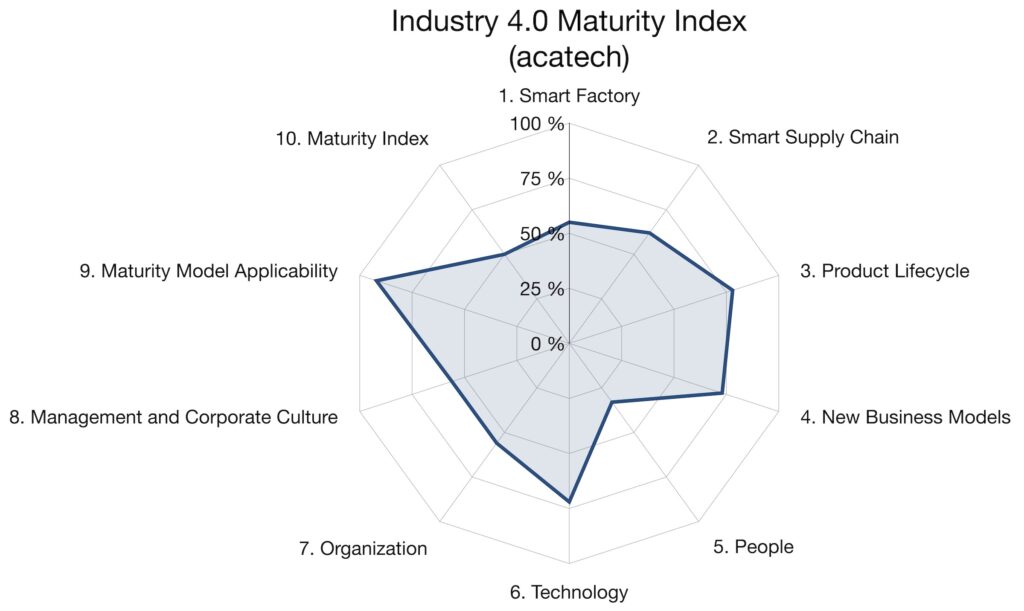
The areas of Smart Products/Digital mapping of the product life cycle and New Business Models have quite good Industry 4.0 coverage at 78 percent and 73 percent respectively. In the area of Smart Factory, several aspects important for manufacturing companies, such as production, intralogistics, maintenance management and tool management, are only superficially described;, while quality management is not mentioned at all. The area of Smart Supply Chain is well covered, but there is a lack of detail in the areas of planning, control and monitoring as well as assistance systems in the supply chain.
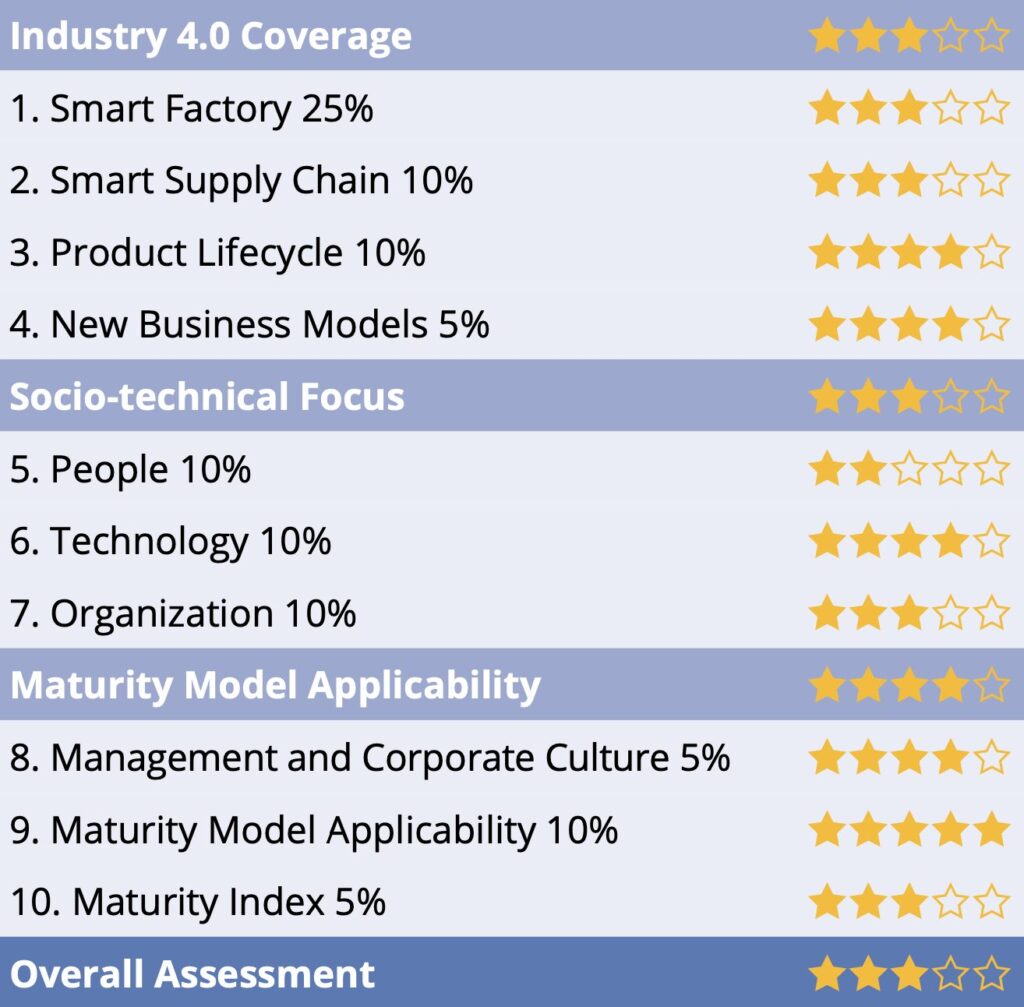
Conclusion: Recommended without restriction/for any use case.
A socio-technical approach was taken, yet organizational aspects and the changing role of people therein were not at all or only superficially described by the model. Corporate culture and aspects of change management were described. The transformation strategy was not discussed within the maturity level itself because the authors see the strategy as an input which is to be entered before the analysis begins. The maturity model can be applied in all required areas. However, due to its multidimensional structure, it requires explanation and could appear (too) complex to some SMEs/medium-sized companies.
Model 2
Industry 4.0 Toolbox (VDMA)
The VDMA Industry 4.0 Toolbox (VDMA, 2017) was developed particularly for medium-sized mechanical and plant engineering companies in order to give them orientation on their way to leveraging the full benefits of Industry 4.0 and to show them potential for improvement in the area of their products and manufacturing processes. For this purpose, the maturity levels of products and manufacturing processes are presented in a table that is comprised of six observation areas and five maturity levels (from 1 to 5, without naming the content), allowing the company to classify itself based on the results.
1. Products
1.1 Integration of sensors/actuators
1.2 Communication/connectivity
1.3 Functionalities for data storage and information exchange
1.4 Monitoring
1.5 Product-related IT services
1.6 Product-related business models
2. Manufacturing
2.1 Data processing for manufacturing
2.2 Machine-to-machine communication (M2M)
2.3 Corporate networking with manufacturing
2.4 ICT infrastructure for manufacturing
2.5 Human-machine interfaces
2.6 Efficiency with small batch sizes
Evaluation
Conclusion: Not recommended.
The Industry 4.0 Toolbox focuses primarily on the areas of Smart Products, Smart Services and technical aspects such as data acquisition, machine-to-machine communication (M2M) and communication/connectivity. Important topics of Smart Factory – such as intralogistics, maintenance management, tool management and quality management – are not considered. The human factor, organizational issues as well as Management and Corporate Culture are not addressed or are only addressed to a limited extent. The maturity model can be applied in all required areas. A maturity index is not calculated.
Model 3
Industry 4.0 Readiness (IMPULS Foundation of the VDMA)
The Industry 4.0 Readiness model from the IMPULS Foundation of the VDMA (Lichtblau, et al., 2015) was developed to show companies where they currently stand and whether they are already taking advantage of the potential of industry. Maturity is determined by answering a questionnaire with questions spanning six areas of consideration and a total of 18 sub-areas:
1. Strategy and organization
1.1 Strategy
1.2 Investments
1.3 Innovation management
2. Smart factory
2.1 Digital image
2.2 Machine park
2.3 Data usage
2.4 IT systems
3. Smart operations
3.1 Cloud usage
3.2 IT security
3.3 Autonomous processes
3.4 Information exchange
4. Smart products
4.1 Data analysis in usage phase
4.2 ICT additional functionalities
5. Data-driven services
5.1 Share of data usage
5.2 Share of revenue
5.3 Data-based services
6. Employees
6.1 Skill-building
6.2 Employee competencies
The answer options each correspond to one of six maturity levels, ranging from level 0 (outsider) to level 6 (excellence).
Evaluation
The Industry 4.0 Readiness model focuses on a fairly broad coverage of Industry 4.0 topics. The areas of Smart Products and Smart Services are well covered. In the area of Smart Factory, almost all criteria were taken into account directly in the level of maturity. However, tool management is missing and topics such as manufacturing and assistance systems for people were only indirectly and superficially mentioned.
Conclusion: Recommended without restriction/for any use case!
The area of Smart Supply Chain is generally only addressed indirectly. In terms of socio-technical focus, the People area is well covered. In the area of technology, there is a lack of detail on cyber- physical manufacturing systems, robots and assistance systems, as well as on aspects of automation. With the exception of the criterion of knowledge and competence management, organizational topics were only briefly touched upon. In the area of Management and Corporate Culture, the aspects of transformation strategy and change management were described, though corporate culture was only discussed indirectly. The maturity model can be applied in all required areas. A maturity index is determined for each area of consideration.
Model 4
Industry 4.0 Assessment (Matt et al.)
The Industry 4.0 Assessment model by Matt et al. (2018) is part of a five-stage method for introducing Industry 4.0 to SMEs. It serves as a company’s self-assessment and is designed to precede analysis of potential and an implementation plan. Maturity is determined by answering a questionnaire with questions spanning four areas of consideration with a total of 22 sub-areas:
1. Operation
1.1 Agile Manufacturing Systems
1.2 Monitoring & Decision Systems
1.3 Big Data for Manufacturing
1.4 Manufacturing Planning and Control
2. Organization
2.1 Business Models 4.0
2.2 Innovation Strategy
2.3 Strategy 4.0
2.4 Supply Chain Management 4.0
3. Socio-culture
3.1 Human Ressource 4.0
3.2 Work 4.0
3.3 Culture 4.0
4. Technology
4.1 Big Data
4.2 Communication & Connectivity
4.3 Cyber Security
4.4 Deep Learning, Machine Learning, Artificial Intelligence
4.5 Additive Manufacturing
4.6 Maintenance
4.7 Robotics & Automation
4.8 Product Design and Development
4.9 Standards 4.0
4.10 Virtual Reality, Augmented Reality and Simulation
Evaluation
The Industry 4.0 Assessment model focuses on providing fairly broad coverage of Industry 4.0 topics. New business models are best covered within the area of Smart Products, Smart Services as well as in the area of Smart Products/Digital mapping of the product life cycle. Coverage of the Smart Factory area is average in quality. The aspects of tool management and quality management are missing, while data collection is only addressed indirectly. In the socio-technical area, the model has very good coverage of the People dimension:
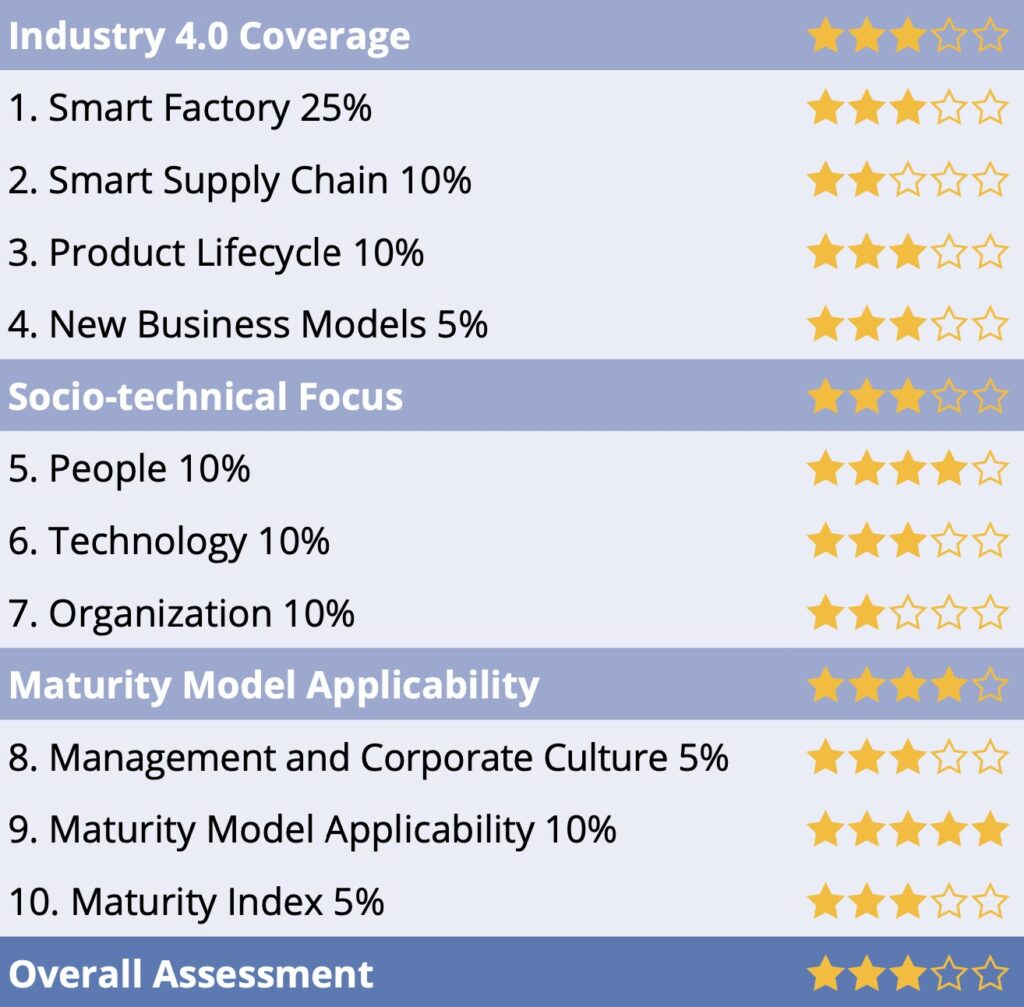
Conclusion: Recommended without restriction/for any use case.
In addition to topics of qualifications and further training, the role of people in general is also addressed. The area of technology is also described in detail, while organizational topics – apart from knowledge and competence management – are only indirectly addressed. The communication criterion is not addressed. The area of Management and Corporate Culture is very well depicted, in which the topics of transformation strategy, change management and corporate culture are addressed. The applicability of the maturity index meets all criteria. The maturity index is calculated for each observation area; an overall maturity index is not calculated.
Model 5
Industry 4.0 Quick Check (INLUMIA)
The Industry 4.0 Quick Check was created as part of the interdisciplinary research project INLUMIA (Pierenkemper, et al., 2019). The goal was to develop a “set of instruments for increasing performance through Industry 4.0” for SMEs (Heppner, et al., 2019). Maturity is determined by answering an (online) questionnaire with questions regarding the three dimensions of Technology, Business and People. Four areas of action are presented:
1. Technology
1.1 Technical organization
1.2 Engineering
1.3 Manufacturing
1.4 Product
2. Business
2.1 Strategy
2.2 Innovation culture
2.3 Business model
2.4 Data
3. Person
3.1 Work design
3.2 Qualification
3.3 Internal business communication
3.4 Interaction.
The answer options each correspond to one of four possible maturity levels.
Evaluation
The Quick Check Industry 4.0 only partially covers the areas where Industry 4.0 operates. The areas of Smart Products/Digital mapping of the product life cycle and New Business Models are only indirectly described, as the model addresses the development of new business models, but not the level of maturity of these various forms of new business models. In the Smart Factory area, the sub-areas of intralogistics, maintenance management, tool management and quality management are missing.
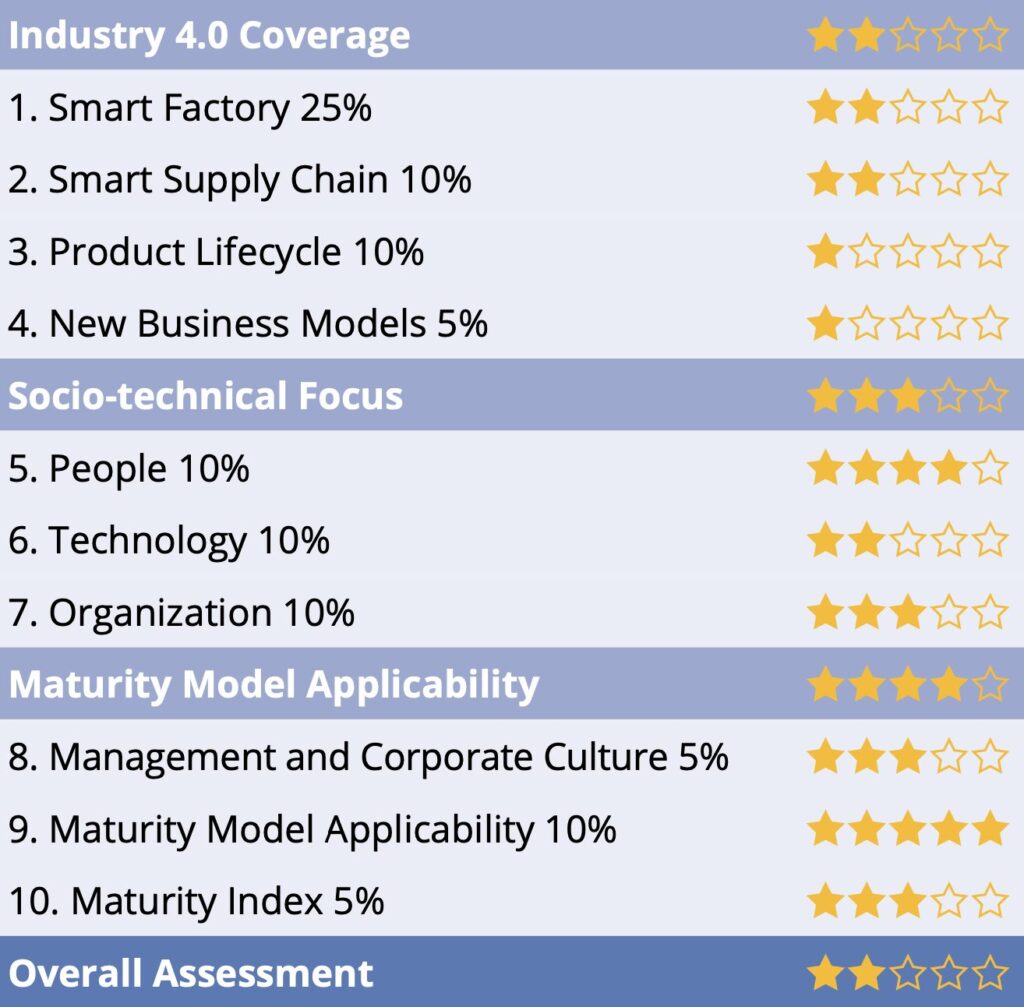
Conclusion: Recommended with some restrictions/ for some use cases.
Organizational issues in manufacturing and manufacturing planning and control were only addressed indirectly. The consideration of the People dimension is good; the role of people and qualifications were taken into account. The areas of technology and organizational aspects were only superficially taken into account. The topic of communication was not described by the model. The area of Management and Corporate Culture was well described; all three criteria were addressed directly or indirectly. The maturity model can be applied in all required areas. A maturity index is determined for each area under consideration.
Model 6
Industry 4.0 Maturity Model (WZL, RWTH Aachen)
The WZL’s Industry 4.0 Maturity Model (Schuh et al. 2018) is part of a guide for implementing Industry 4.0 solutions. In manufacturing companies, it is used to evaluate the status quo and to define concrete goals regarding the implementation of Industry 4.0. Maturity is determined by answering a questionnaire with questions spanning eight areas of consideration that are based on the corporate functions along the value chain of manufacturing companies:
- Marketing & Distribution
- Product Development
- Supply Chain Management & Purchasing
- Manufacturing Planning and Control
- Logistics
- Manufacturing
- Quality Assurance
- Supporting Features
The answer options are each assigned to one of six possible maturity levels (1 – Computerization, 2 – Networking, 3 – Visualization, 4 – Transparency, 5 – Forecasting and 6 – Adaptability).
Evaluation
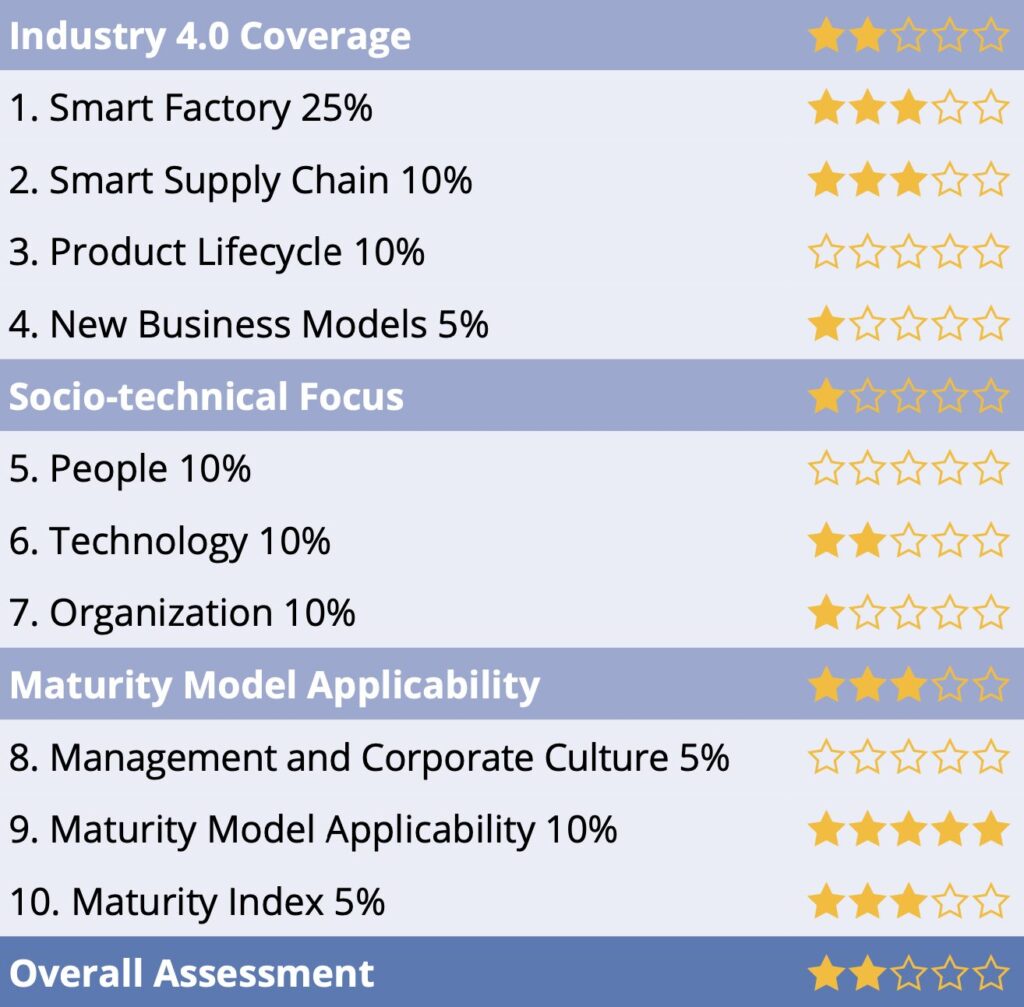
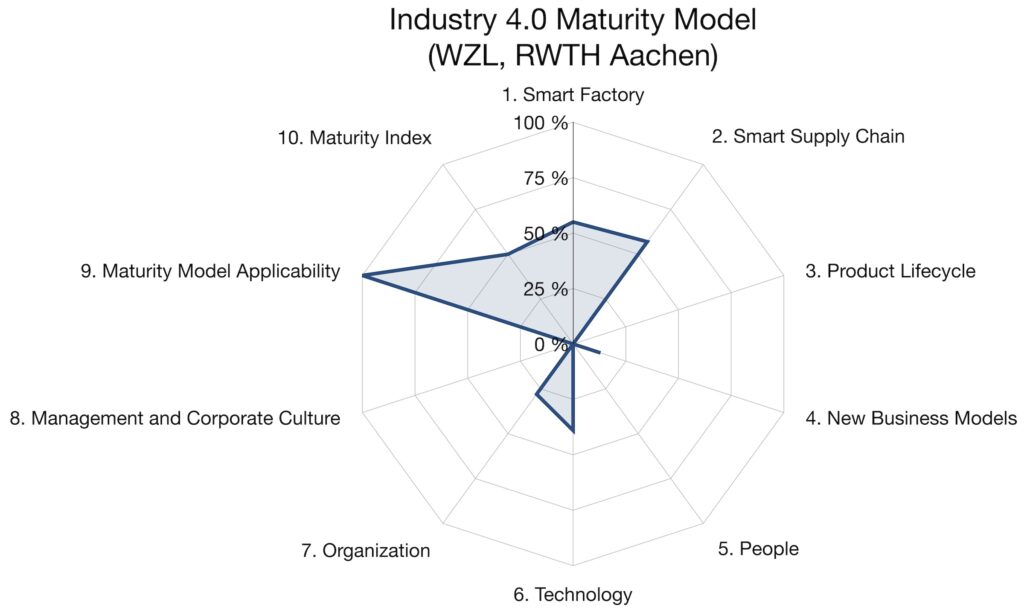
The Industry 4.0 maturity model focuses primarily on the internal processes of Smart Factory as well as on networking with partners throughout the supply chain to create value.
Conclusion: Not recommended.
New business models and the digital representation of the product life cycle are not discussed. The model does not have a socio-technical approach. The human dimension is not described, while technical and organizational aspects are only mentioned indirectly. Organizational issues in manufacturing as well as knowledge and competence management are not described. The area of management and corporate culture is not part of the maturity index, but is covered in detail in the guide mentioned above. The maturity model can be applied in all required areas. A maturity index is determined for each area of consideration.
Model 7
Maturity Model (Appelfeller & Feldmann)
The maturity model from Appelfeller & Feldmann is part of a comprehensive guide (Appelfeller & Feldmann, 2018) for structuring digital transformation and measuring the maturity of companies. It is based on a reference model of a digital company that was developed by the authors. Maturity is determined by answering a questionnaire with questions that span ten areas of consideration. The answer options each correspond toone of four maturity levels:
1. Processes
1.1 Level of digitalization
1.2 Level of digital automation
1.3 Level of digital integration
1.4 Level of digital self-control
2. Customer connection
2.1 Phase 1: Development of products and services
2.2 Phase 2: Presales
2.3 Phase 3: Sales
2.4 Phase 4: After Sales
2.5 Cross-phase criteria
3. Supplier connection
3.1 Initiation
3.2 Agreement
3.3 Fulfillment
3.4 Supplier management
4. Employees (mental/physical activity)
4.1 Paper use and IT support
4.2 Process characterization
4.3 Working hours
4.4 Hardware
4.5 Collaboration
4.6 Networking
4.7 Workplace
5. Data
5.1 Degree of integration of the systems
5.2 Scope of digital data
5.3 Share of digital data
5.4 Data quality
5.5 Data structure
5.6 Data management process (data governance)
5.7 Master data harmonization
5.8 Scope of data evaluations
5.9 Type of data evaluations
6. Products
6.1 Surveillance
6.2 Control
6.3 Optimization
6.4 Autonomy
6.5 Networking
7. Machine and robots
7.1 Data generation
7.2 Data processing and analysis
7.3 Integration capability: Networking and IT infrastructure
7.4 Integration capability: Horizontal and vertical networking
7.5 Integration capability: Machine-to-machine communication (M2M)
7.6 Support of self-controlling processes
7.7 Versatility
8. IT systems
8.1 Adaptability and ability for further development
8.2 Integration capability
8.3 Analytical and continuous learning abilities
9. Networking
9.1 Network density
9.2 Networking reach
9.3 Internet of Things: Networking machines and robots
9.4 Internet of Things: Connecting products
9.5 Internet of Things: Connecting employees
9.6 Cybersecurity
10. Business model
10.1 Importance of digitalization for the business idea
10.2 Importance of digitalization for service provision
10.3 Interaction with customers
10.4 Products and services
10.5 Digitalization goals
Evaluation
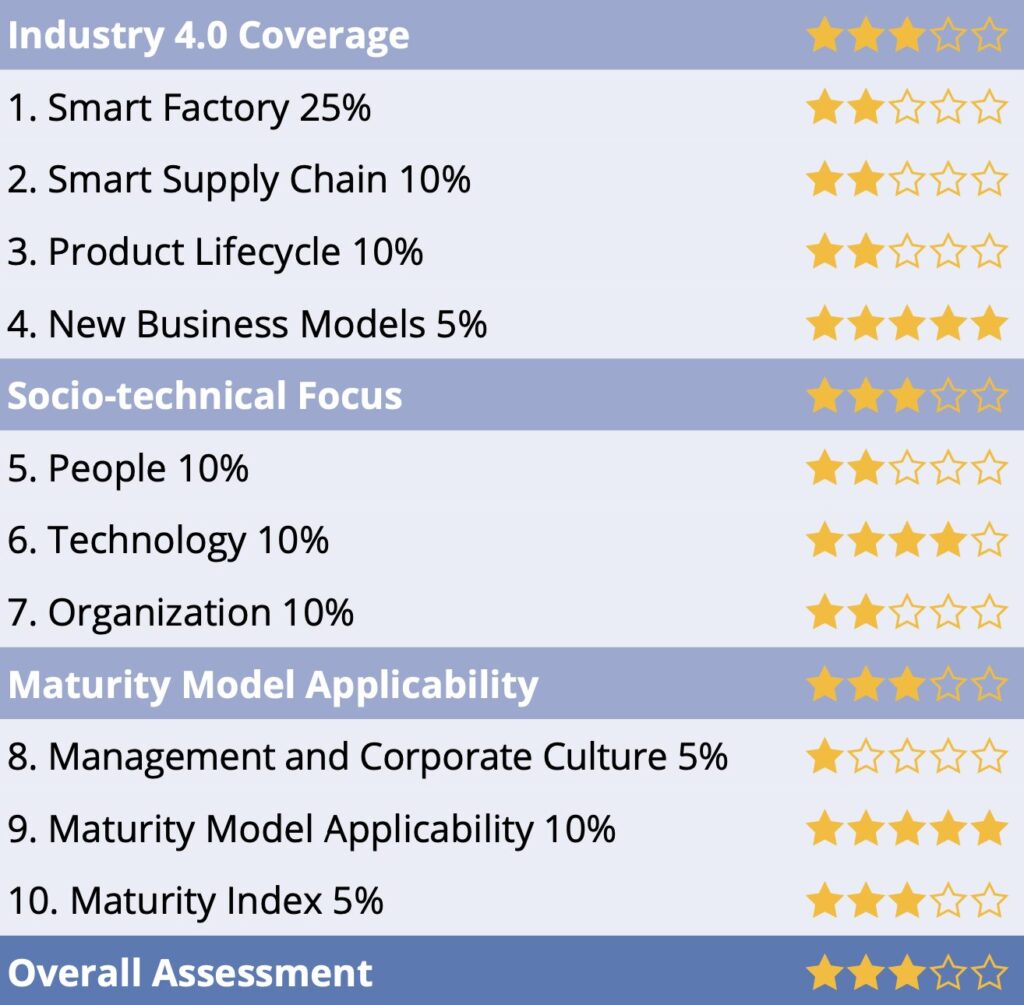
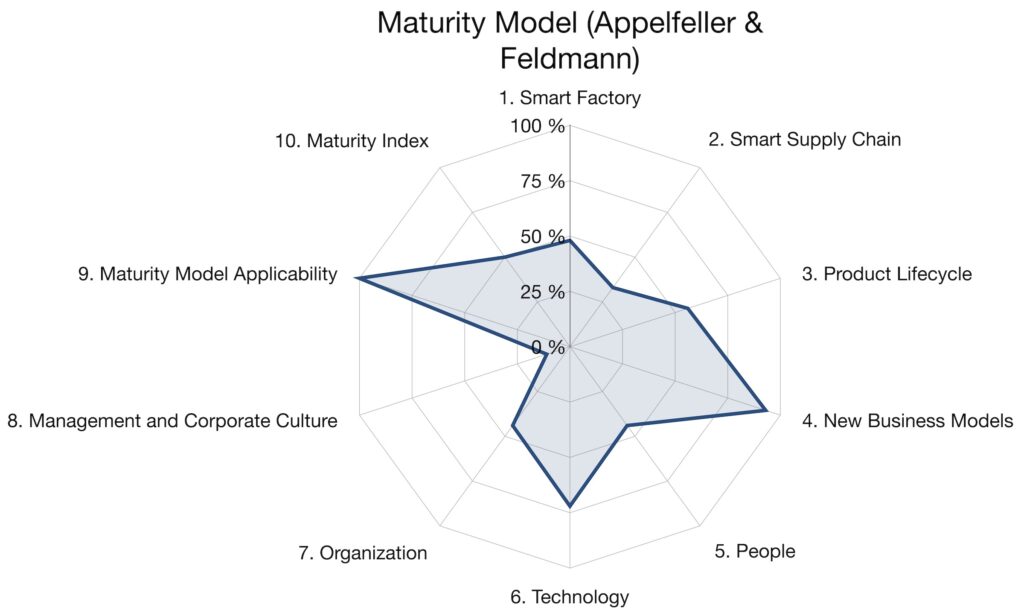
Of the Industry 4.0 areas of action, the area of New Business Models with data-based products and services, digital business models and digital platforms is best covered by the model. In the area of Smart Factory, the focus is on horizontal and vertical integration, data collection and analysis as well as assistance for people.
Conclusion: Recommended without restriction/for any use case!
Supporting processes such as maintenance management, tool management and quality management are not discussed. In the area Smart Supply Chain, the focus is on horizontal integration; other criteria are not addressed or only indirectly addressed. The model goes into the Technology dimension in great detail, but personell qualifications, knowledge, skills management and other organizational issues are not at all or only indirectly addressed. The area of management and corporate culture is also not anchored in the maturity model. The maturity model can be applied in all required areas. A maturity index is determined for each area of consideration.
Model 8
Industry 4.0 Maturity Model (INTRO 4.0)
The Industry 4.0 Maturity Model (Hübner, 2018) was created as part of the INTRO 4.0 research project. It is part of a four-stage process model for introducing Industry 4.0. Maturity is determined by answering an online questionnaire which poses questions about five fields of action, each with several design areas within them:
1. Organization and administration
1.1 IT infrastructure
1.2 General organization
1.3 Employees
1.4 Physical assistance systems
1.5 Data storage
1.6 Data analysis
2. Manufacturing planning and control
2.1 General manufacturing planning and control
2.2 Demand planning
2.3 In-house manufacturing planning and control
2.4 Inventory management
2.5 Manufacturing control
3. Quality and fault management
3.1 Quality management
3.2 Disturbance management
4. Stations
4.1 Interfaces
4.2 Feedback data
4.3 Condition monitoring technology
4.4 Inventory management
4.5 Station control
5. Product
5.1 Commication
5.2 Data collection
The answer options each correspond to one of four maturity levels.
Evaluation
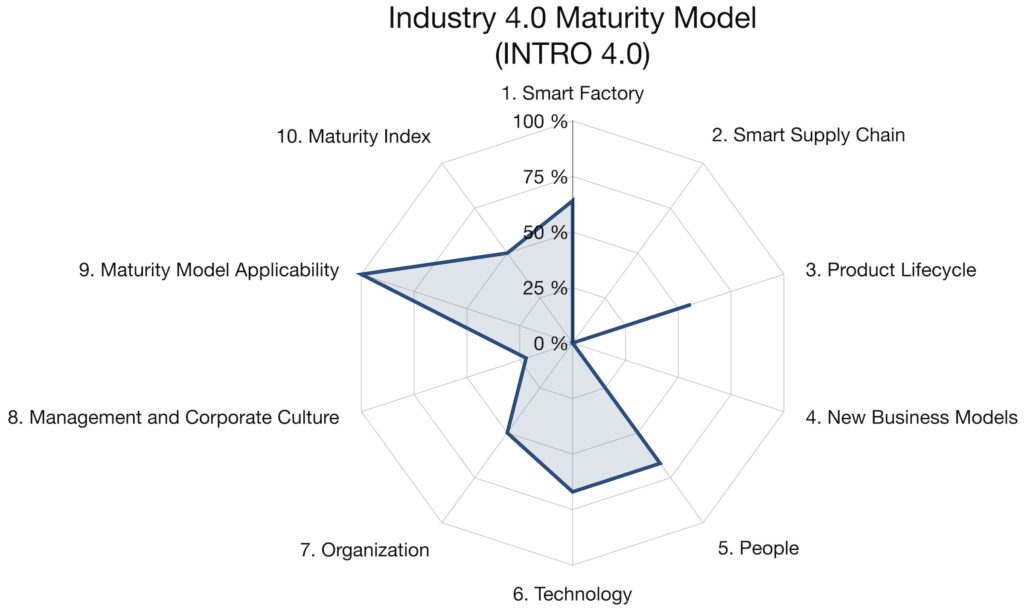
This Industry 4.0 Maturity Model focuses on the application of Industry 4.0 within the Smart Factory. The aspects of data collection, manufacturing planning and control, quality management, assistance systems and data analyses are for the most part examined in detail. Maintenance management and tool management are not considered; aspects of intralogistics are only indirectly discussed. The areas of Smart Supply Chain and New Business Models are not considered.
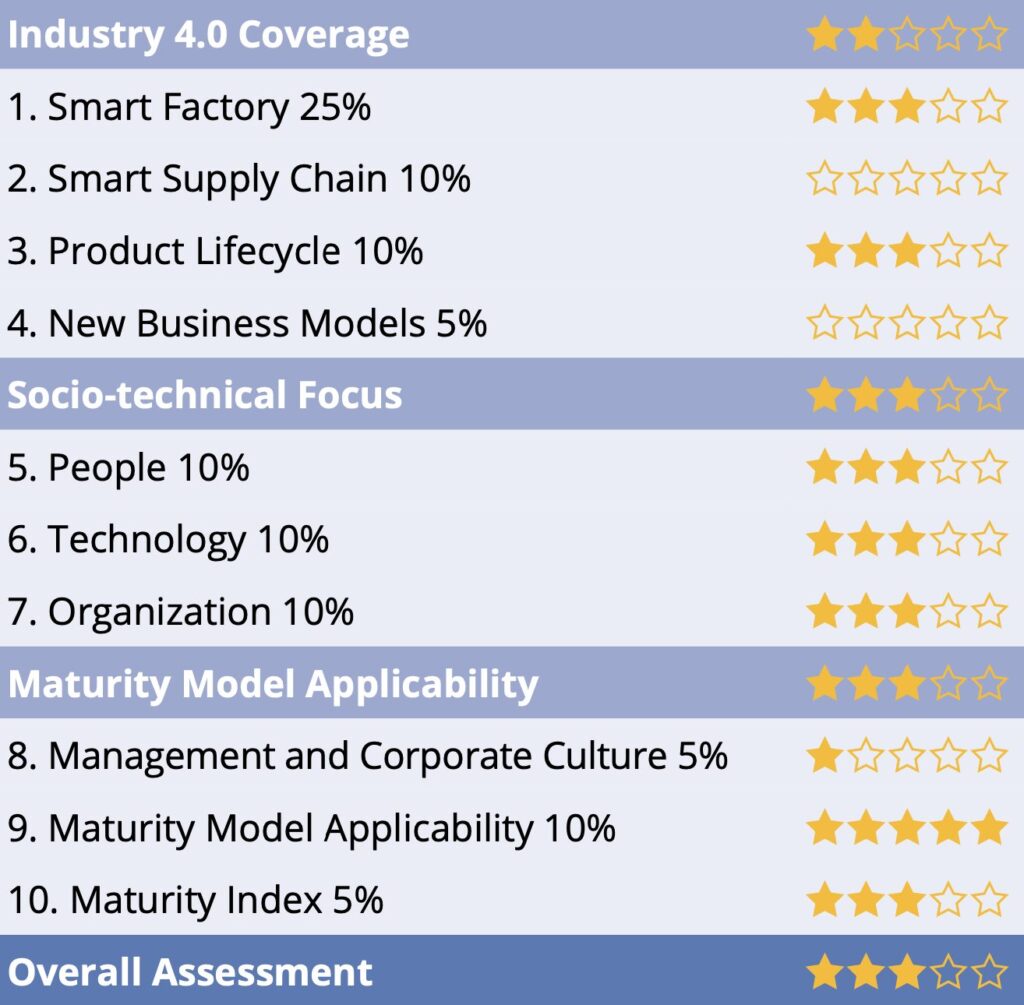
Conclusion: Recommended with some restrictions/ for some use cases
Smart Products and the digital representation of the product life cycle are included in the maturity model. The model offers a socio-technical focus. All dimensions of People, Technology and Organization are taken into account in the maturity model. Only the topics of communication and knowledge/competence management were not addressed or only indirectly addressed. Aspects of transformation strategy are partly included; the areas of change management and corporate culture are not discussed. The maturity model can be applied in all required areas. A maturity index is determined for each area of consideration.
Model 9
Industry 4.0 Maturity Model (Puchan & Zeifang)
The Industry 4.0 Maturity Model from the Munich University of Applied Sciences (Puchan & Zeifang, 2017) is based on a questionnaire with questions that span five overarching fields of action with a total of 29 action elements:
1. Key factors
1.1 Business model
1.2 IT security
1.3 Communication
1.4 Management
1.5 Legal framework
1.6 Industry norms/standards
1.7 Position of IT
1.8 IT networking
2. Employees
2.1 Work structures
2.2 Assistance systems
2.3 Engagement
2.4 Information systems
2.5 Industry 4.0 competence
3. Organization
3.1 Information exchange
3.2 Innovation and technology management
3.3 Key figure system
3.4 Process management
3.5 Industry 4.0 strategy
3.6 Knowledge management
4. Product
4.1 Data analytics
4.2 Product function
4.3 Product system
4.4 System integration
5. Manufacturing
5.1 Data collection
5.2 Use of data
5.3 Communication
5.4 Manufacturing logistics
5.5 Manufacturing resources
5.6 Manufacturing system
The answer options each correspond to one of five levels, ranging from Standard to Novice, Advanced, Expert and finally Pioneer.
Evaluation
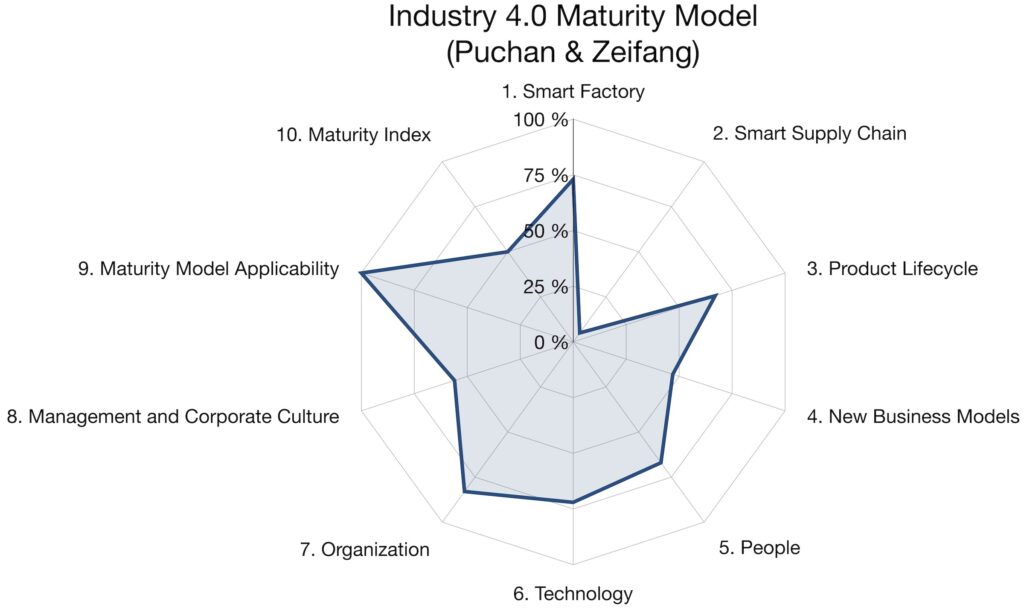
This Industry 4.0 maturity model does not address networking in the supply chain, but otherwise covers the Industry 4.0 areas of activity very well.
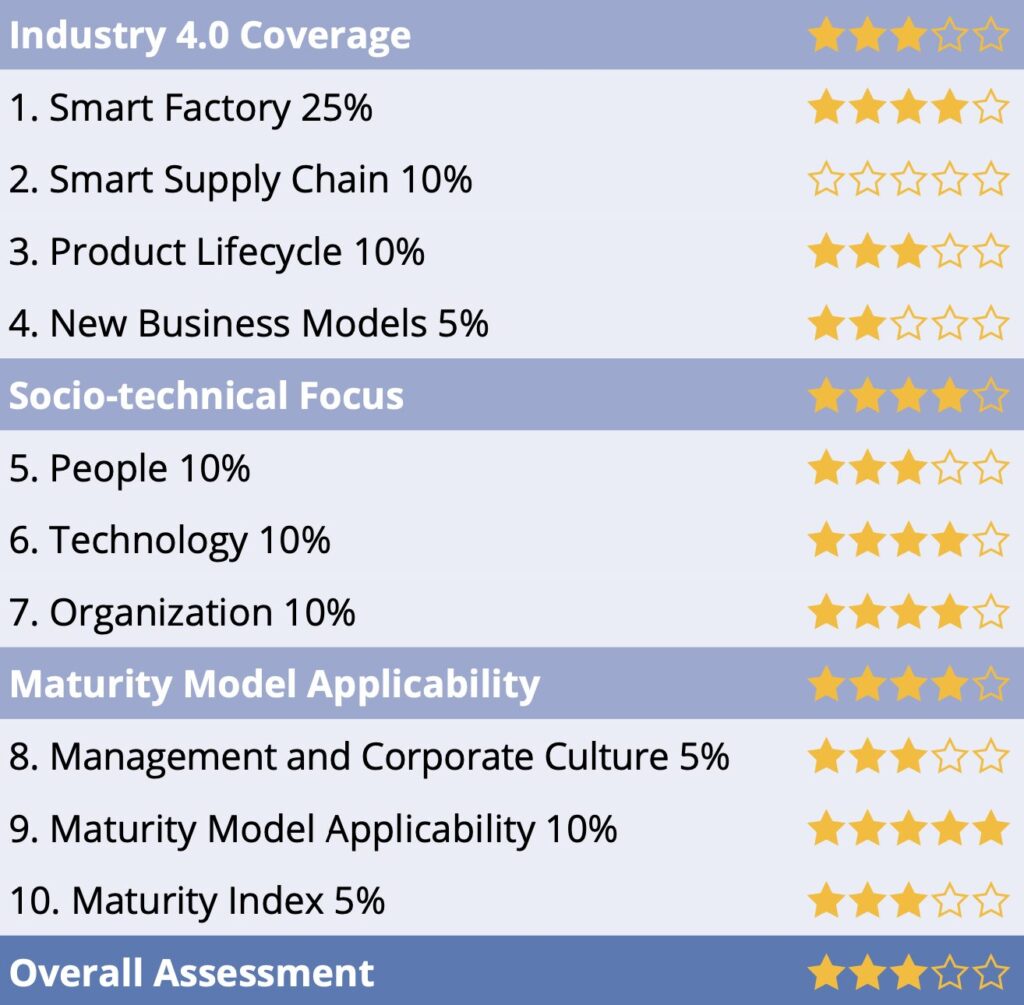
Conclusion: Recommended
In the area of Smart Factory, this applies to a limited extent; only the aspects of maintenance management, tool management and quality management are missing. The model also has a very high level of socio-technical focus. All three dimensions of People, Technology and Organization are discussed in great detail. In the area of Management and Corporate Culture, the transformation strategy criterion is well covered, though change management and corporate culture are indirectly mentioned. The maturity model can be applied in all required areas. A maturity index is determined for each area of consideration.
Model 10
Maturity Model (InAsPro)
This maturity model (Ehemann, et al., 2021) was created as part of the InAsPro research project. Maturity is determined by answering a questionnaire with questions which span five areas of consideration, each with several sub-areas that are focused on the socio-technicaldimensions of People, Technology and Organization:
1. Company
1.1 Technology
1.1.1 IT system design
1.1.2 IT security
1.2 Organization
1.2.1 Data management
1.2.2 Cooperation & Collaboration
1.3 People
1.3.1 Corporate culture
1.3.2 Guidance
1.3.3 Employee development
1.4 Strategy
1.4.1 Digitalization strategy
1.4.2 Business model
2. Development
2.1 Technology
2.1.1 Requirements definition
2.1.2 System design & architecture
2.1.3 Modeling and simulation
2.1.4 Validation
2.1.5 System integration & process planning / technical organization
2.1.6 Product and program planning
2.2 Organization
2.2.1 Data management
2.2.2 Process design
2.2.3 Cooperation & Collaboration
2.3 People
2.3.1 Corporate culture
2.3.2 Guidance
2.3.3 Employee development
3. Manufacturing
3.1 Technology
3.1.1 Manufacturing processes & machining
3.1.2 Storage
3.1.3 Transportation
3.1.4 Quality management
3.1.5 Manufacturing planning & control
3.1.6 IT system design
3.2 Organization
3.2.1 Data management
3.2.2 Process design
3.2.3 Cooperation & Collaboration
3.3 People
3.3.1 Corporate culture
3.3.2 Guidance
3.3.3 Employee development
4. Assembly
4.1 Technology
4.1.1 Assembly processes & machining
4.1.2 Storage
4.1.3 Transport
4.1.4 Quality management
4.1.5 Assembly planning & control
4.1.6 IT system design
4.2 Organization
4.2.1 Data management
4.2.2 Process design
4.2.3 Cooperation & Collaboration
4.3 People
4.3.1 Corporate culture
4.3.2 Guidance
4.3.3 Employee development
5. Aftersales
5.1 Technology
5.1.1 Customer service
5.1.2 Spare parts logistics & maintenance
5.1.3 IT system design
5.2 Organization
5.2.1 Data management
5.2.2 Process design
5.2.3 Cooperation & collaboration
5.3 People
5.3.1 Corporate culture
5.3.2 Guidance
5.3.3 Employee development
The answer options each correspond to one of four maturity levels.
Evaluation
This maturity model covers the area of New Business Models very well with the aspects of Smart Products, Smart Services and Digital Platforms. In the area of the Smart Factory, all criteria are described directly or indirectly, with the exception of tool management. The focus of the production criterion is on the digitalization and control of processes, rather than on organizational aspects such as modularization, for example.
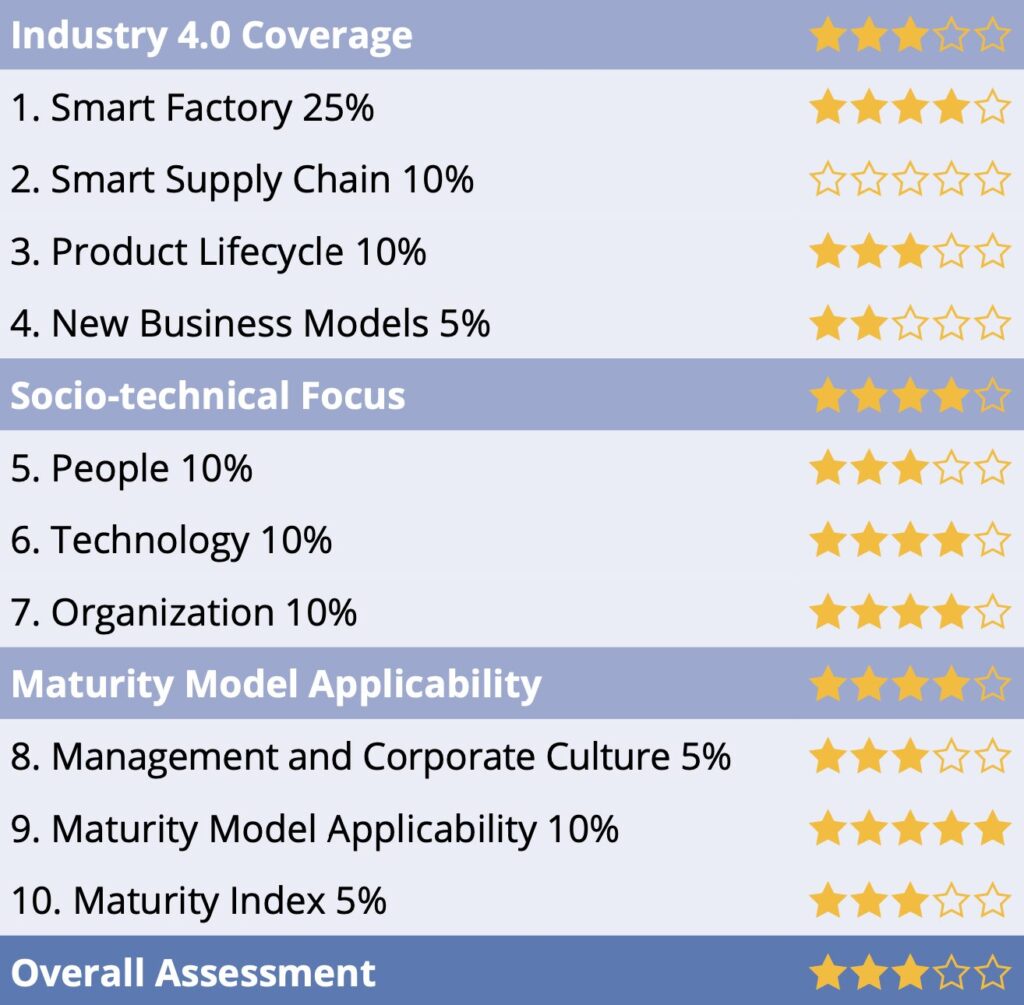
Conclusion: Best of the comparison.
Recommended without any restrictions and for any use cases.
In the area of assistance systems, only the human-machine interface aspect is evaluated. The topics of intralogistics are limited to the identification and traceability of products. In the area of smart supply chain, horizontal integration is discussed, but not the other criteria. The area of Smart Products/Digital Mapping of the Product Life Cycle is described directly or indirectly. New business models are very well covered. The model has a socio-technical focus, but does not go into great depth in all of the three dimensions of People, Technology and Organization. The areas of Management and Corporate Culture and Maturity Model Applicability are very well covered. The maturity index is calculated for each observation area and also as an overall index.
Bibliography
Angreani, L. S.; Vijaya, A.; Wicaksono, H.: 2020. Systematic Literature Review of Industry 4.0 Maturity Model for Manufacturing and Logistics Sectors. Procedia Manufacturing, Band 52, pp. 337-343.Appelfeller, W.; Feldmann, C.: 2018. Die digitale Transformation des Unternehmens. Systematischer Leitfaden mit zehn Elementen zur Strukturierung und Reifegradmessung. Berlin: Springer Gabler.
Dommermuth, M.: 2021. Entwicklung und Anwendung eines konse- kutiven integralen Transformationskonzeptes für Werke von Industrieunternehmen mit variantenreicher Fertigung zur Analyse, Planung, Umsetzung und Kontrolle von Industrie 4.0. Berlin: Springer.
Ehemann, T. et al.: 2021. Mit dem InAsPro- Transformationskonzept die Digitalisierung planen. In: W. Bauer, et al. Hrsg. Arbeit in der digitalisierten Welt. Berlin Heidelberg: Springer Vieweg, pp. 205-222.
Heppner, H.; Schlicher, K.; Hobscheidt, D.: 2019. INLUMIA – Instru- mentarium zur Steigerung der Leistungsfähigkeit durch Industrie 4.0. In: GfA, Hrsg. Frühjahrskongress 2019. Arbeit interdisziplinär analysieren – bewerten – gestalten C.3.7. Dort- mund: GfA.
Hübner, M.: 2018. Das Industrie 4.0-Reifegradmo- dell. In: G. Lanza & P. Nyhuis, Hrsg. Industrie 4.0 für die Praxis. Befähigungs- und Einführungsstrate- gien. Garbsen: TEWISS, pp. 184-196.
Kese, D.; Terstegen, S.: 2017. Benchmark Reife- gradmodelle. IEE Industrie Engineering Effizienz, 10, pp. 30-34.
Knackstedt, R.; Pöppelbuß, J. & Becker, J.: 2009. Vorgehensmodell zur Entwicklung von Reife- gradmodellen. Wien, Österreichische Computer Gesellschaft, pp. 535-544.
Lichtblau, K. et al.: 2015. Industrie 4.0-Readiness (gefördert von der IMPULS-Stiftung des VDMA), Aachen, Köln: Institut der deutschen Wirtschaft Köln Consult GmbH.
Matt, D. T. et al.: 2018. Industrie 4.0 Assessment – Bewertungsmodell zur Identifikation und Priori- sierung von Industrie 4.0 Umsetzungs- maßnahmen in KMUs. In: D. T. Matt, Hrsg. KMU 4.0 – Digitale Transformation in kleinen und mittelständischen Unternehmen. Schriftenreihe der WGAB. Berlin: GITO, pp. 93-112.
Müller, E.; Tawalbeh, M.; Hopf, H.: 2018. Reifegradbestimmung als Vorstufe der Industrie 4.0-Strategieentwicklung. In: D. T. Matt, Hrsg. KMU 4.0 – Digitale Transformation in kleinen und mittel- ständischen Unternehmen. Schriftenreihe der WGAB. Berlin: GITO, pp. 71-91.
Pierenkemper, C.; Reinhold, J.; Dumitrescu, R.; Gausemeier, J.: 2019. Erfolg versprechende Industrie 4.0-Zielposition. Ermittlung unter Berücksichtigung zukünftiger Umfeldentwicklungen. Industrie 4.0 Management, 5, Issue 35, pp. 30-34.
Puchan, J.; Zeifang, A.: 2017. Industrie-4.0-Reifegradmodell. In: T. Barton, et al. Hrsg. Angewandte Forschung in der Wirtschaftsinfor- matik. Prozesse, Technologie, Anwendungen, Systeme und Management. Tagungsband zur 30. AKWI-Jahrestagung. Heide: mana-Buch, pp. 257-265.
Schuh, G. et al.: 2017. Industrie 4.0 Maturity Index. Die digitale Transformation von Unternehmen steuern (acatech STUDIE). Mün- chen: Herbert Utz. Schuh, G. et al., 2018. Industrie 4.0: Implement it! – Ein Leitfaden zur erfolgreichen Implementierung von Industrie 4.0-Lösungen. Aachen: s.n.
Schumacher, A.; Erol, S.; Sihn, W.: 2016. A maturity model for asses- sing Industry 4.0 readiness and maturity of manufacturing enterprises. Procedia CIRP, Band 52, pp. 161-166.
VDMA, F. I. 4. (ed): 2017. Leitfaden Industrie 4.0 Orientierungshilfe zur Einführung in den Mittelstand. Frankfurt: VDMA Verlag GmbH.
Your downloads
You might also be interested in